Capture two important emission lines with one filter
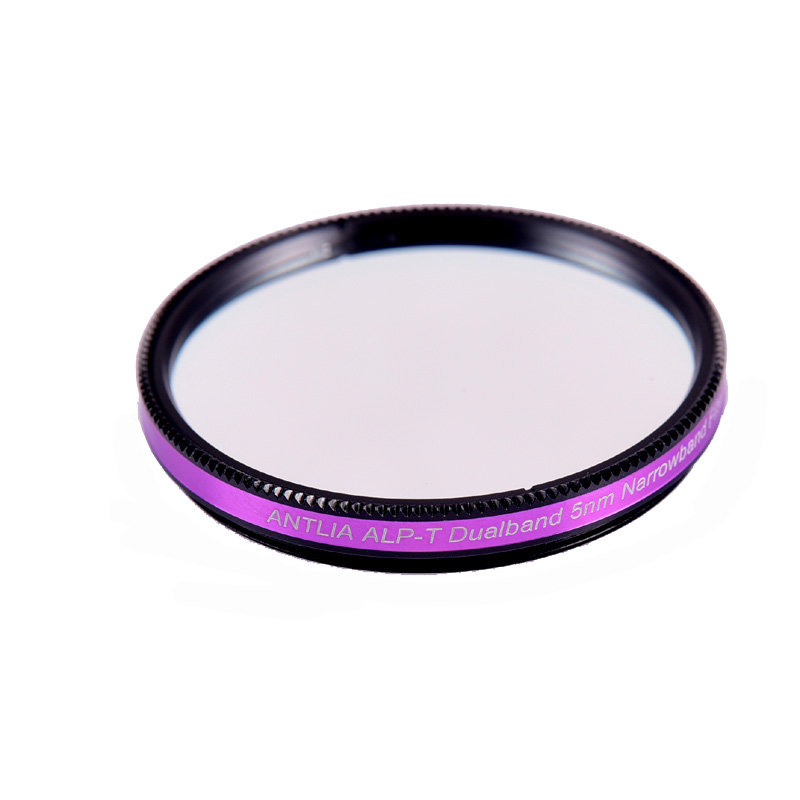
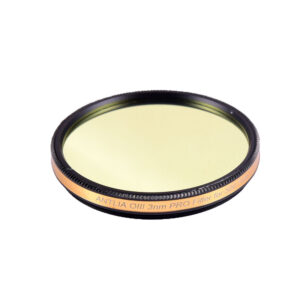
The Antlia ALP-T Dualband 5 nm Ha & O-III filter is designed to isolate two important emission lines commonly used in deep-sky astrophotography: H-alpha at 656.3 nm and O-III at 500.7 nm. Both have a narrow full width at half maximum (FWHM) of 5 nm, meaning that the filter transmits a narrow range of wavelengths around each target emission line.
This dual-band design allows both signals to be recorded in the same exposure. For astrophotographers using a one-shot colour camera, this is particularly useful when imaging emission nebulae, where hydrogen and oxygen emissions can reveal different structures within the same object.
Improve contrast under light-polluted skies
Light pollution, moonlight and natural airglow can introduce unwanted background signal into astronomical images, making faint nebular detail more difficult to distinguish. The ALP-T’s advanced multi-coatings are designed to transmit the targeted H-alpha and O-III wavelengths while strongly suppressing unwanted light. Antlia specifies optical density (OD) 4.5 or greater blocking over the 300–1100 nm range. This provides substantial suppression of wavelengths outside the intended passbands and can help produce a cleaner background, improved contrast and a better signal-to-noise ratio in emission nebula images. The filter is designed to suppress artificial lighting across Bortle scale 1 to Bortle scale 8. Actual results depend on the target, sky conditions, camera, telescope and exposure strategy; the filter reduces unwanted light but does not eliminate the effects of light pollution.
High transmission at the target wavelengths
Narrow passbands are useful only when the desired emission can still reach the camera efficiently. The standard ALP-T 5 nm version has a specified peak transmission of 90% at H-alpha and 82% at O-III. The coating design uses Ion Gun Assisted Deposition technology on a double-side-polished substrate. Antlia also specifies steep bandpass edges to minimise internal reflections. Together, these design features support selective wavelength transmission while suppressing unwanted light.
Designed for colour and monochrome cameras
The filter is primarily intended for one-shot colour cameras, including astronomical CMOS and CCD cameras and DSLR cameras. By recording H-alpha and O-III simultaneously, it can simplify the acquisition of narrowband data without requiring a separate filter for each emission line. It can also be used with monochrome cameras, where both emission lines can be recorded together. This may help reduce the imaging time required compared with collecting the two emission bands separately, depending on the imaging setup and acquisition strategy.
A practical choice for emission nebula imaging
The Antlia ALP-T Dualband 5 nm filter is intended for astrophotography rather than visual observation. Its two narrow passbands make it particularly suitable for emission nebulae that emit strongly in H-alpha and O-III, helping astrophotographers collect useful nebular signal while suppressing much of the surrounding unwanted light.
Important: This is an astronomical imaging filter, not a solar safety filter. Never look at the Sun through this filter, either directly or through optical equipment.

 Cookie policy
Reviews
There are no reviews yet.