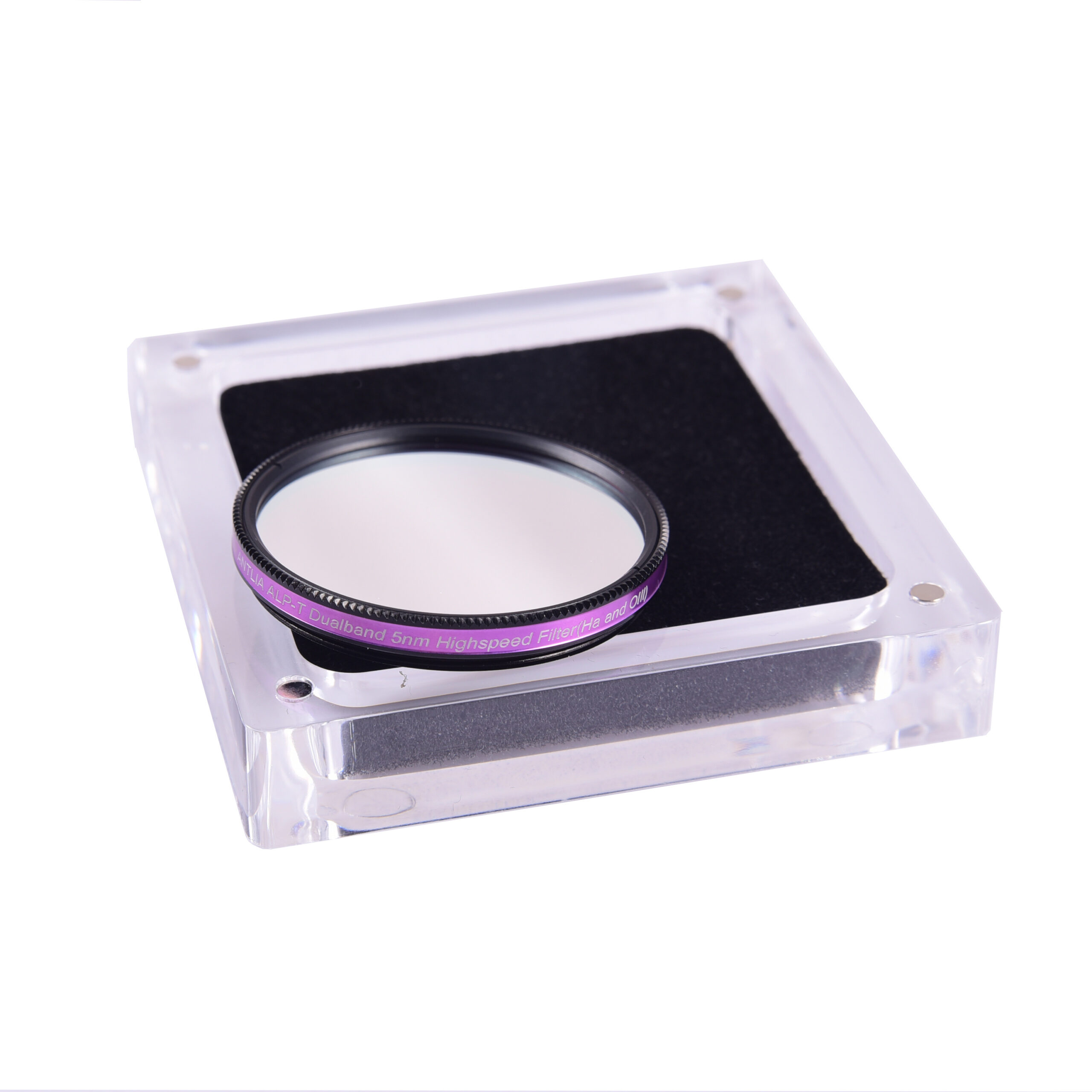
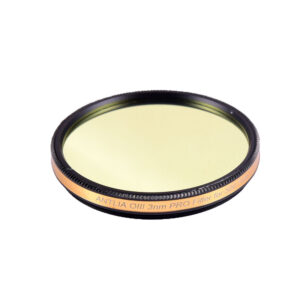
The Antlia ALP-T Dualband 5nm Highspeed 2″ Filter is designed for astrophotographers using fast optical systems who want to capture detailed images of emission nebulae. By transmitting two important wavelengths of nebula emission while suppressing much of the unwanted light, it helps improve image contrast, including when imaging under light-polluted skies.
Optimised for fast optical systems
Unlike the standard ALP-T Dualband 5nm filter, the Highspeed version uses specially shifted passbands to account for the wavelength shifts that occur when narrowband filters are used with fast optics. Antlia particularly recommends this version for optical systems between f/2.2 and f/3.6, with the Highspeed version also recommended for systems faster than f/2.2.
For systems slower than f/3.6, Antlia recommends the standard version instead. Choosing the appropriate version for your optical system helps maintain the filter’s intended performance.
Capture hydrogen-alpha and oxygen-III emission together
The filter transmits two narrow wavelength bands: hydrogen-alpha at a central wavelength of 657.8 nm and oxygen-III at 502.2 nm. Both have a full width at half maximum of 5 nm, meaning that each transmission band is narrowly restricted around its intended wavelength.
These emission lines are particularly useful for imaging emission nebulae. By capturing both through a single filter, you can record hydrogen-alpha and oxygen-III emission simultaneously, making this a practical choice for astrophotographers using one-shot colour cameras, including astronomical colour cameras and suitable digital single-lens reflex cameras.
The filter can also be used with monochrome cameras for narrowband imaging.
Reduce unwanted light and improve contrast
Advanced multi-layer coatings suppress unwanted wavelengths with an optical density of at least 4.5 across the specified blocking range of 300–1050 nm. This helps reduce the contribution of artificial light, moonlight and atmospheric airglow to your images.
The result is improved contrast between nebula emission and the surrounding background, helping you capture cleaner image data and making faint structures easier to distinguish during image processing.
Designed for astrophotography
The filter features steep transmission-band edges intended to minimise internal reflections, alongside a carefully designed passband profile to help reduce the effects of wavelength shifts. Antlia uses Ion Gun Assisted Deposition coating technology on a polished substrate.
The 2″ mounted filter has an M48 × 0.75 thread and a slim filter cell designed to maximise the available clear aperture and help minimise vignetting.
Important: This is an astrophotography filter and is not recommended for visual observing or solar imaging. Never look at the Sun through this filter.

 Cookie policy
Reviews
There are no reviews yet.