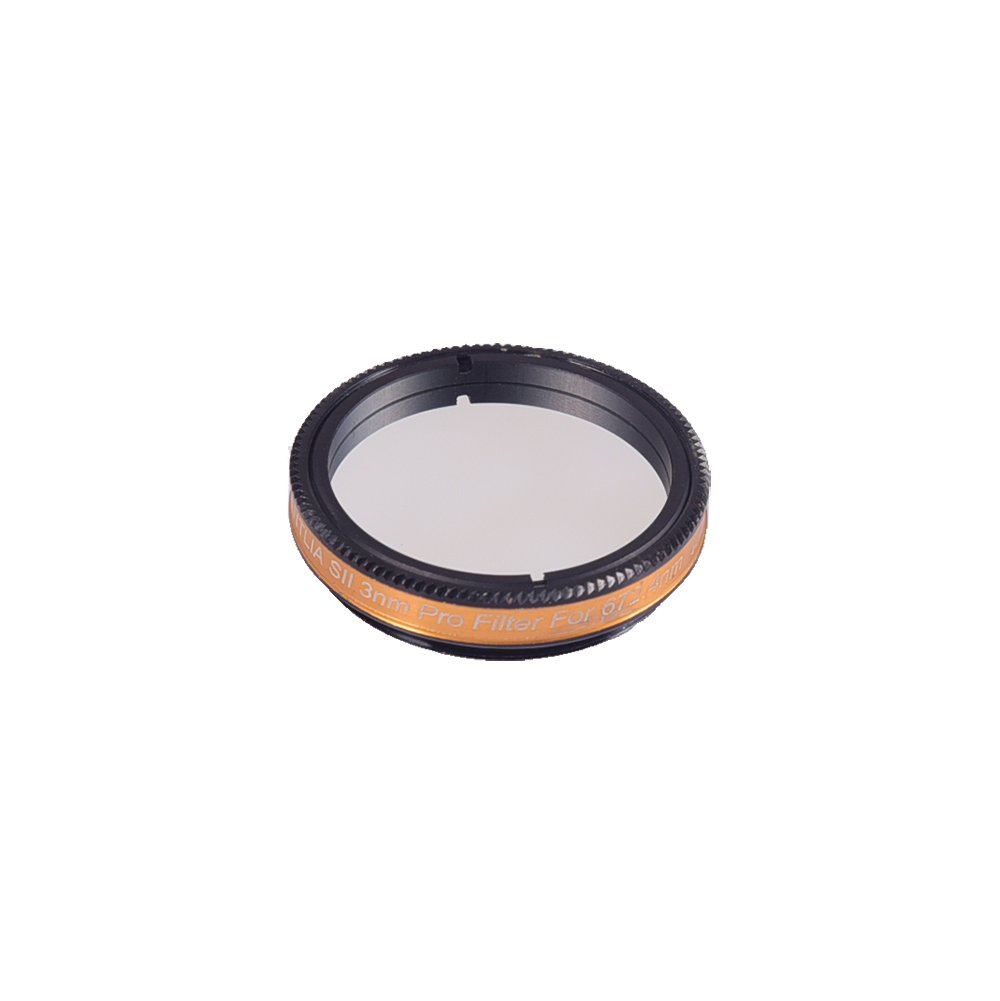
The Antlia S-II 3nm Pro 1.25″ Filter is designed for astrophotographers who want to capture fine detail in emission nebulae and other deep-sky objects that emit sulphur-II light. By transmitting a very narrow band of the desired emission while strongly suppressing unwanted wavelengths, it helps improve image contrast and reveal subtle structures that might otherwise be lost against the background.
Isolate sulphur-II emission
Sulphur-II, commonly abbreviated to S-II or SII, is an emission line produced by singly ionised sulphur. Its prominent emission wavelength is 672.4 nm, in the deep red part of the visible spectrum. With a full width at half maximum of just 3 nm, the filter transmits a narrow range of wavelengths around this emission line. This reduces the amount of unwanted background light reaching the camera, helping reveal faint structures within suitable nebulae. The filter is particularly useful for imaging emission nebulae, planetary nebulae, Wolf-Rayet nebulae and supernova remnants that contain S-II emission. It is less suitable for targets that do not emit strongly at this wavelength.
High transmission and strong light suppression
A narrow bandwidth is most useful when the desired signal can still pass through the filter efficiently. Antlia specifies peak transmission above 88% at 672.4 nm, helping preserve the S-II signal collected by your camera. Outside its intended transmission band, the filter provides optical density greater than 5 across the specified 300–1000 nm range. This strongly attenuates unwanted wavelengths, helping reduce background light from artificial lighting, moonlight and other sources. The result is improved contrast between the target and its surrounding background. The filter can therefore be useful when imaging from light-polluted locations as well as under darker skies. It may also help extend imaging opportunities when the Moon is present, although results depend on the target, lunar conditions and imaging setup.
Compatible with fast optical systems
Interference filters can experience a shift in their transmission wavelength when used with fast optical systems. Antlia’s 3 nm Pro design is engineered to maintain high transmission across a range of optical configurations, including systems as fast as f/3, with minimal loss of the targeted emission signal. This makes the filter suitable for a range of astrophotography telescopes and fast optical systems, including compatible HyperStar and Rowe-Ackermann Schmidt Astrograph (RASA) configurations.
Designed to minimise halos and internal reflections
Bright stars can produce unwanted halos in astrophotography, potentially distracting from the surrounding nebular detail. Antlia’s steep transmission profile is designed to minimise these halos. The filter uses a single, non-glued Schott optical glass substrate, avoiding internal reflections between bonded substrates. The filter’s edge treatment is also designed to reduce stray-light reflections, helping produce cleaner image data and reducing the need for corrective processing.
A 1.25″ mounted filter for astrophotography
The filter is supplied mounted in a 1.25″ filter cell, with a specified thickness of 2 mm ± 0.05 mm. The filter cell uses an M28.5 × 0.6 thread. The filter is intended for astrophotography rather than visual observing. It can be combined with hydrogen-alpha and oxygen-III filters for multi-band narrowband imaging, including workflows that use separate emission channels to construct detailed colour images.
Important: This filter is not suitable for visual observing or solar imaging. Never look at the Sun through this filter, either directly or through optical equipment.

 Cookie policy
Reviews
There are no reviews yet.