A complete premium colour-filter collection for lunar and planetary astronomy
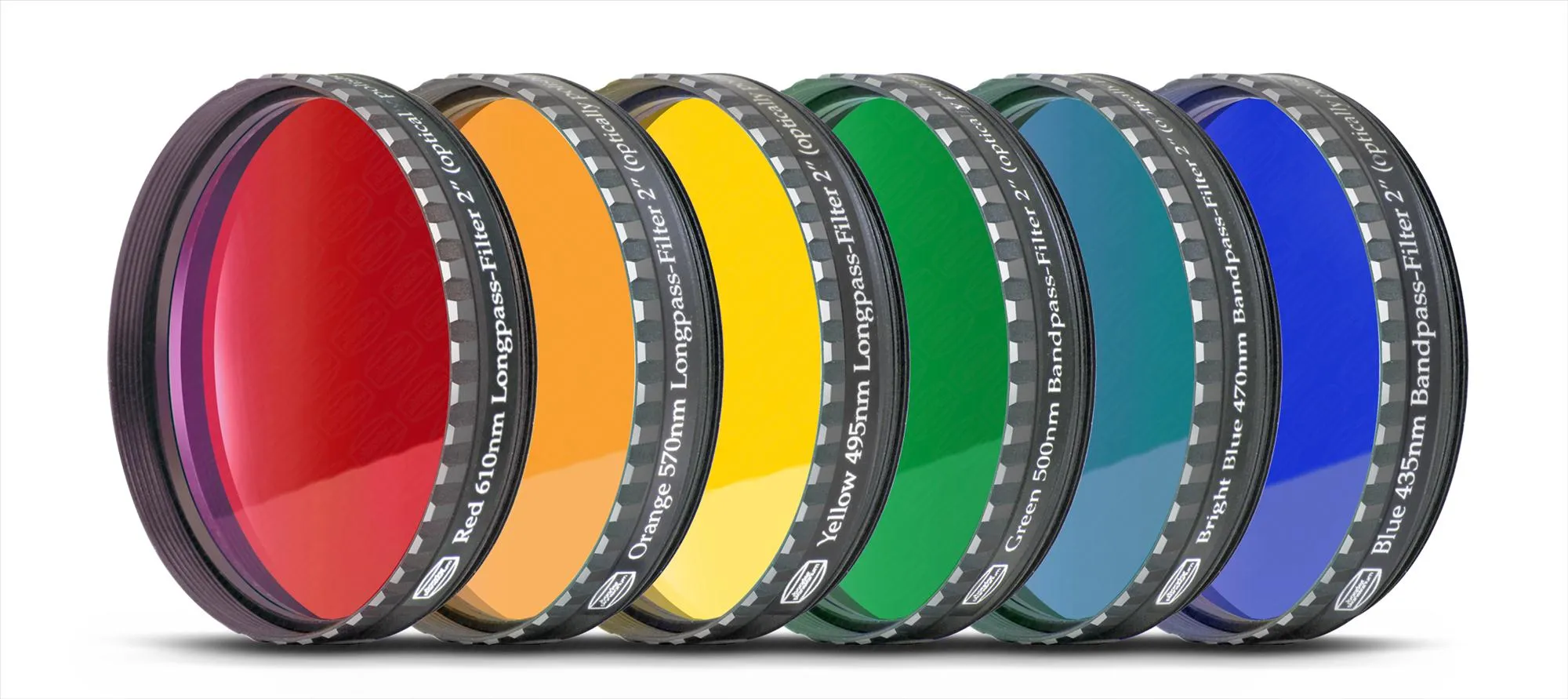
The Baader Planetarium 6-Colour Planetary 2″ Filter Set brings together six precision optical filters designed to enhance contrast and reveal subtle details on the Moon and planets. By selecting different regions of the visible spectrum, each filter changes the relative brightness of atmospheric and surface features, helping observers examine details that may be less apparent in unfiltered white light. The collection includes three broadband bandpass filters and three longpass filters, offering a wide range of complementary spectral responses. All six filters feature precision-polished optical glass, Baader’s advanced Phantom Group Coating™ and durable, low-profile 2″ mounting cells.
Six carefully selected spectral filters
The set contains six individual 2″ filters:
- Dark Blue 435 nm – Broadband bandpass: Emphasises violet-blue and blue light, making it useful for studying Martian clouds and haze, Jupiter’s Great Red Spot and selected atmospheric features on Saturn.
- Light Blue 470 nm – Broadband bandpass: Provides a broader blue spectral view for observing Jupiter’s cloud belts, Martian atmospheric phenomena and selected details on Saturn and Venus.
- Green 500 nm – Broadband bandpass: Useful for lunar crater detail, Martian frost and haze, atmospheric contrast on Jupiter and Saturn, and reducing the visible effects of chromatic aberration in certain refractors.
- Yellow 495 nm – Longpass: Transmits wavelengths longer than approximately 495 nm, helping improve selected planetary contrasts while suppressing shorter blue wavelengths.
- Orange 570 nm – Longpass: Transmits wavelengths longer than approximately 570 nm, providing strong contrast for Martian surface markings and selected atmospheric features on Jupiter and Saturn.
- Red 610 nm – Longpass: Transmits wavelengths longer than approximately 610 nm, making it particularly useful for observing darker Martian surface features and reducing the influence of shorter-wavelength atmospheric scattering.
The six filters complement one another rather than performing identical functions, making this set particularly valuable for observers who enjoy comparing different spectral views of the same target.
Three broadband bandpass filters
The Dark Blue 435 nm, Light Blue 470 nm and Green 500 nm filters are broadband bandpass designs. Unlike longpass filters, they transmit a broad region around their nominal wavelengths while attenuating much of the light on either side of the principal transmission band.
Based on Baader’s published transmission graphs, the approximate main passing-wavelength regions are:
- Dark Blue 435 nm: 350–550 nm, approximately 110 nm FWHM, with around 70% peak transmission.
- Light Blue 470 nm: 350–620 nm, approximately 145 nm FWHM, with around 69% peak transmission.
- Green 500 nm: 420–650 nm, approximately 100 nm FWHM, with around 69% peak transmission.
These figures are estimates derived from Baader’s transmission curves, not separately certified numerical specifications. The quoted main passing-wavelength ranges describe the approximate low-transmission boundaries, while FWHM describes the width measured at half the peak transmission. The nominal filter wavelengths should not be confused with their bandwidths or assumed to be the exact measured peak positions.
Three high-transmission longpass filters
The Yellow 495 nm, Orange 570 nm and Red 610 nm filters use longpass transmission characteristics. Rather than transmitting a band centred on the named wavelength, each filter suppresses shorter wavelengths and transmits longer wavelengths above its approximate transition. The three filters offer complementary options for reducing blue light, improving selected planetary contrasts and examining surface features at progressively longer wavelengths. Baader’s longpass colour-filter family achieves peak transmission of approximately 98%, helping preserve image brightness within the transmitted spectral region. Unlike the bandpass models, these filters do not have a conventional, finite FWHM bandwidth.
Reveal Martian surface features, clouds and haze
Mars is one of the most rewarding targets for a complete planetary colour-filter collection. The Red 610 nm and Orange 570 nm longpass filters are particularly useful for emphasising darker surface markings and reducing the influence of shorter-wavelength scattered light. The Yellow 495 nm filter provides a less strongly coloured alternative for selected surface and atmospheric observations. Meanwhile, the Dark Blue 435 nm and Light Blue 470 nm bandpass filters help reveal bright atmospheric clouds and hazes, allowing observers to compare the planet’s atmosphere with its underlying surface. The Green 500 nm filter can be useful for observing frost-related features and certain atmospheric phenomena. Switching between these six filters gives a more comprehensive view of the planet than relying on a single colour.
Explore Jupiter and Saturn in greater detail
On Jupiter, different colour filters can emphasise different atmospheric structures. Blue filters can improve the apparent contrast of selected reddish features, including the Great Red Spot, while green and yellow filtering can help distinguish cloud belts, zones and atmospheric disturbances. Orange and red filters provide complementary views of selected atmospheric features and may reduce the distracting influence of shorter-wavelength scattered light. On Saturn, the set offers several ways to examine subtle differences in atmospheric brightness and contrast. The effectiveness of each filter depends on telescope aperture, magnification, atmospheric seeing and the features visible during the observing session.
Enhanced lunar observation and refractor performance
The Green 500 nm filter is especially useful for studying selected lunar crater details, bright ray systems and subtle brightness differences across the surface. Yellow and other colour filters can provide alternative contrast effects when observing the Moon at different phases. Green filtering can also improve perceived sharpness in some achromatic and semi-apochromatic refractors by reducing the contribution of out-of-focus wavelengths associated with chromatic aberration. This can be helpful when observing bright targets or resolving close double stars. The filters do not correct the telescope’s underlying optical design, but they provide additional control over the wavelengths reaching the eye.
Precision-polished, plane-parallel optical glass
Each filter uses fine-optically polished, plane-parallel optical glass with an approximately 2 mm substrate thickness. Baader’s precision manufacturing is designed to preserve image sharpness and minimise optical distortion, even during high-magnification planetary observation. The optical quality also allows the filters to be positioned farther ahead of the focal plane in compatible optical systems, including ahead of some diagonals and binoviewers. This makes the 2″ format particularly useful for observers who want to filter the light before it reaches downstream accessories.
Seven-layer Phantom Group Coating™
All six filters feature Baader’s seven-layer Phantom Group Coating™ anti-reflection treatment on both optical surfaces. The coating system is individually tailored to the optical properties of each coloured-glass substrate. Baader specifies approximately 0.25% residual reflection per surface, helping minimise ghost images, unwanted reflections and scattered light. These coatings are especially beneficial when observing bright planets, where internal reflections can interfere with the visibility of subtle atmospheric and surface details. The precision polish and advanced coatings also make the filters suitable for stacking in compatible configurations.
Low-profile 2″ aluminium filter cells
Each filter is housed in a blackened aluminium cell with an approximately 6 mm low-profile construction. Standard M48 × 0.75 mm filter threads provide compatibility with suitable 2″ eyepieces, diagonals, filter drawers and other astronomical accessories. Male and female threads allow compatible filters to be stacked to create more selective combined transmission characteristics. The 2″ format is particularly convenient for certain binoviewer arrangements, where a single filter can be positioned ahead of the light path shared by both eyepieces.
Important considerations for planetary imaging
The three broadband bandpass filters are designed primarily for colour contrast enhancement and should not be confused with narrowband imaging filters or dedicated ultraviolet or infrared blocking filters. Baader’s transmission graphs show that the blue and green filters can exhibit some additional transmission at near-infrared wavelengths. When using an infrared-sensitive planetary camera, an appropriate additional UV/IR-cut filter may be required to prevent unwanted out-of-band light from affecting the image. For visual observation, the most effective filter will vary with telescope aperture, target brightness, atmospheric conditions and the specific detail being studied.
A versatile set for serious planetary observers
The Baader Planetarium 6-Colour Planetary 2″ Filter Set provides a comprehensive selection of spectral tools for detailed lunar and planetary astronomy. From Martian surface markings and atmospheric clouds to Jupiter’s complex weather systems and the Moon’s intricate crater structures, the six filters allow observers to explore the Solar System through a variety of complementary wavelengths. With premium optical quality, advanced coatings and durable 2″ construction, this complete set is an excellent choice for astronomers who want the flexibility to select the most effective colour filter for each observing target.


 Cookie policy
Reviews
There are no reviews yet.