High-quality luminance imaging for deep-sky astrophotography
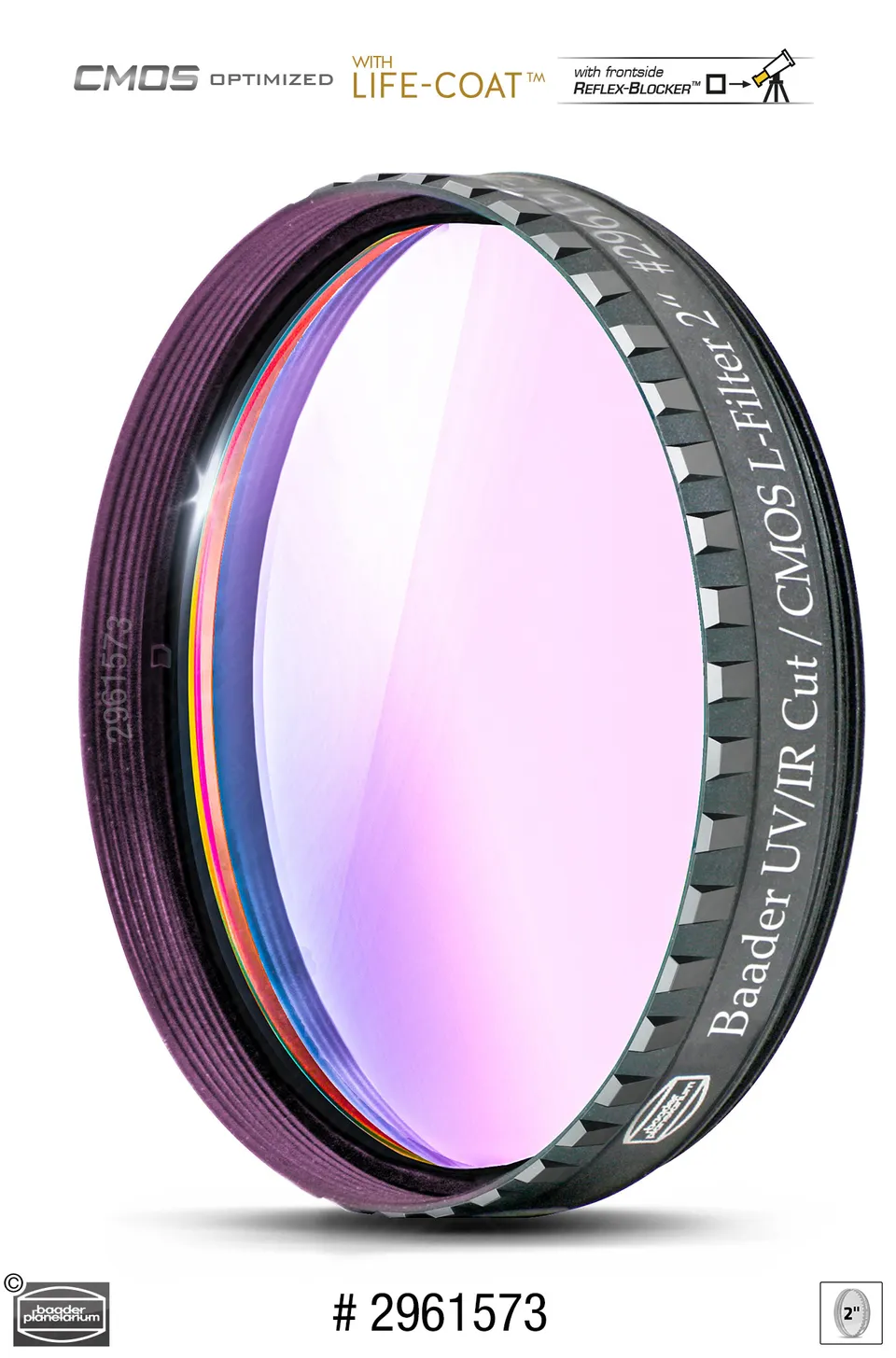
The Baader Planetarium CMOS-Optimized 2″ UV/IR-Cut / L-Filter is a precision optical filter designed to capture detailed broadband luminance images while blocking unwanted ultraviolet and infrared radiation. Optimised for modern monochrome CMOS sensors and equally suitable for CCD cameras, it helps produce sharper stars and cleaner images by limiting the incoming light to a carefully defined portion of the visible spectrum. As the luminance component of Baader’s CMOS-optimised LRGB filter series, it is an excellent choice for astrophotographers seeking detailed images of galaxies, nebulae, star clusters and other deep-sky objects.
Precisely defined visible-light transmission
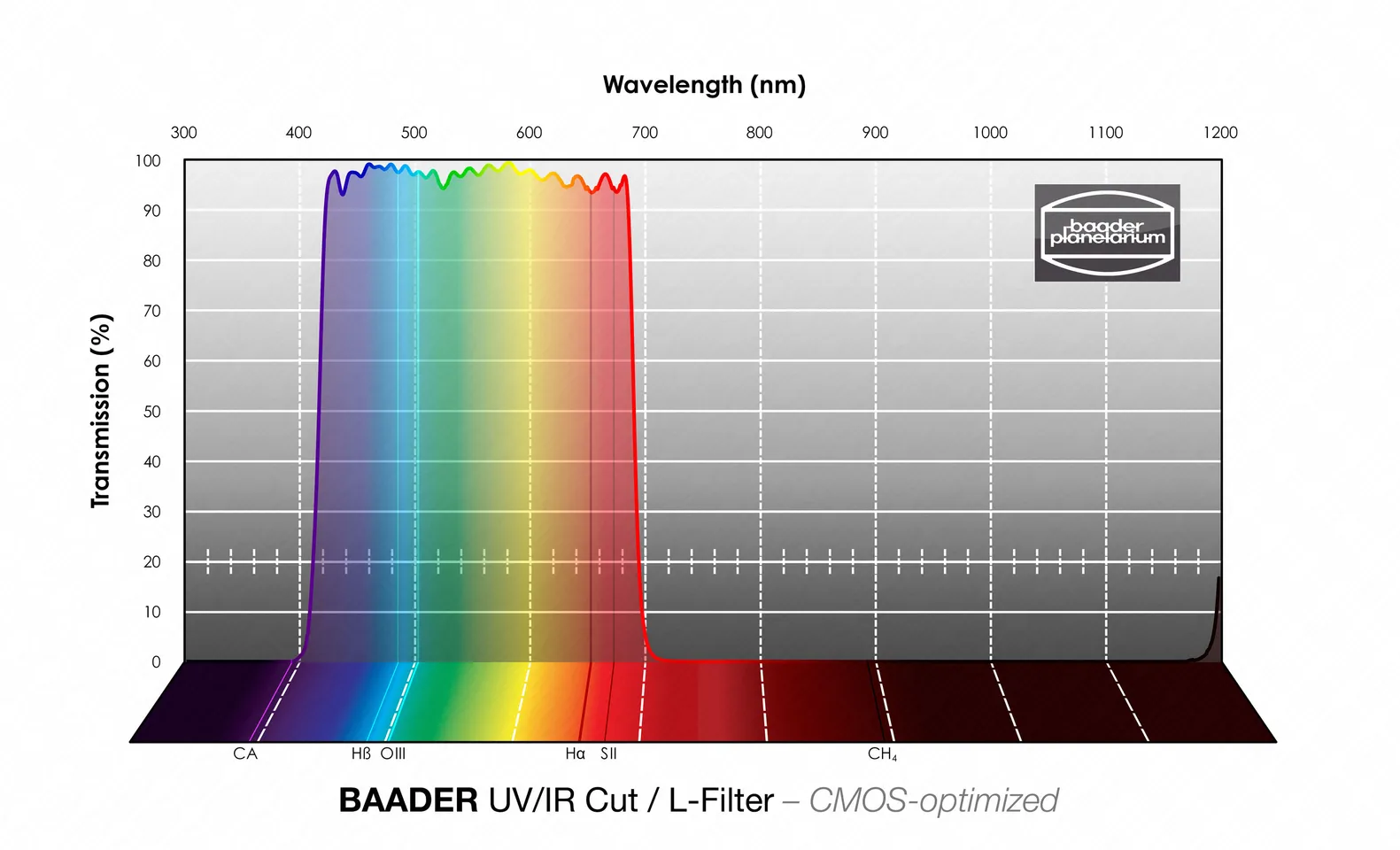
The filter transmits wavelengths between approximately 420 and 685 nm, covering most of the visible spectrum while rejecting ultraviolet and near-infrared light outside this range. Baader specifies approximately 98% transmission across the visible passband, allowing the camera to capture a high proportion of the available light. This broad transmission makes the filter particularly suitable for luminance imaging, where brightness and fine structural detail are recorded independently of the red, green and blue colour channels. The filter also transmits important nebular emission lines, including Hydrogen-beta (486.1 nm), Oxygen-III (495.9 and 500.7 nm) and Hydrogen-alpha (656.3 nm).
Sharper stars through effective UV/IR blocking
Many astronomical cameras are sensitive to wavelengths beyond the visible spectrum. If ultraviolet or infrared light reaches the sensor without being brought to the same focus as visible light, it can create bloated stars, reduced sharpness and unwanted colour artefacts. The Baader UV/IR-Cut / L-Filter suppresses these out-of-band wavelengths, helping maintain more precisely defined star profiles. This is especially valuable when using refractors, camera lenses, focal reducers and other optical systems that may not focus ultraviolet, visible and infrared light at exactly the same position. For cameras without a built-in UV/IR-cut window, the filter can also provide useful visible-light filtering during broadband imaging.
Advanced Reflex-Blocker™ coatings
Bright stars and reflective optical surfaces can create unwanted halos and internal reflections in astrophotography. Baader addresses these challenges through its proprietary Reflex-Blocker™ anti-reflection coatings, developed to reduce reflections between the filter and nearby optical components. The filter features planeoptically polished surfaces, individually applied coatings with sealed edges, and blackened outer edges to minimise scattered light. These design features help preserve image contrast and reduce optical artefacts, particularly in modern imaging systems with multiple optical elements.
Durable Life-Coat™ technology
The filter incorporates Baader’s Life-Coat™ technology, using hardened optical coatings designed for long-term durability. These coatings are developed to resist moisture, environmental exposure and repeated cleaning when handled according to the manufacturer’s instructions. Baader provides a limited lifetime warranty on qualifying Life-Coat™ coatings for the original purchaser, subject to the manufacturer’s warranty conditions.
2″ low-profile design for flexible imaging setups
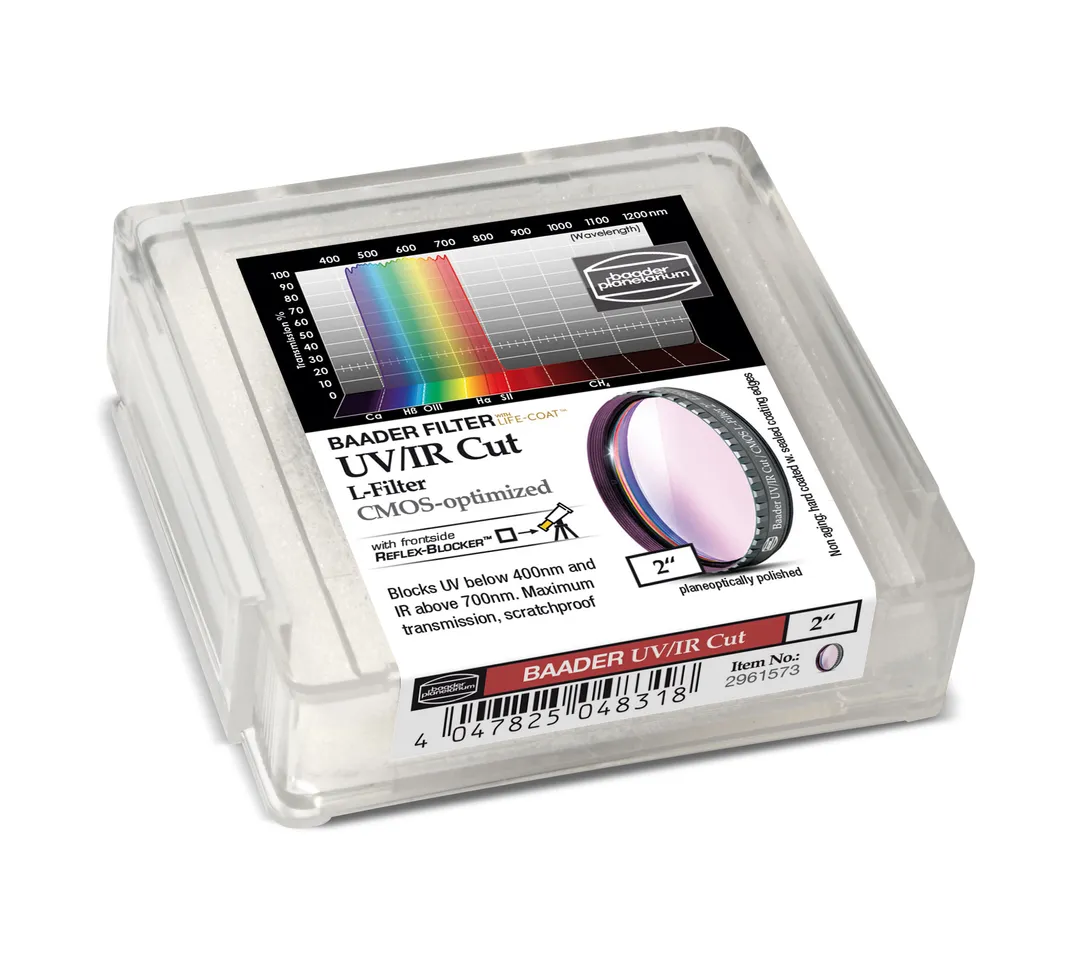
The filter is supplied in Baader’s Low Profile Filter Cell (LPFC), with an approximately 6 mm cell height and a 2 mm optical substrate. Its standard 2″ mounted format uses M48 × 0.75 threads, making it suitable for compatible filter wheels, filter drawers and threaded imaging accessories. The filter is designed for use with optical systems ranging from approximately f/15 to f/1.8, offering flexibility across conventional and fast astrophotography configurations. The larger 2″ format is particularly useful for imaging systems with larger camera sensors or optical arrangements where a smaller filter could introduce vignetting.
Complete your CMOS-optimised LRGB imaging system
The Baader CMOS-Optimized 2″ UV/IR-Cut / L-Filter is designed to complement the matching Baader RGB-Red, RGB-Green and RGB-Blue filters. In a typical LRGB workflow, the luminance filter captures fine detail and brightness information, while the RGB filters record the colour channels used to create a complete colour image. Its high transmission, controlled spectral response and durable coating technology make it a reliable foundation for detailed broadband deep-sky astrophotography.


 Cookie policy
Reviews
There are no reviews yet.