Premium green bandpass filter for lunar and planetary observation
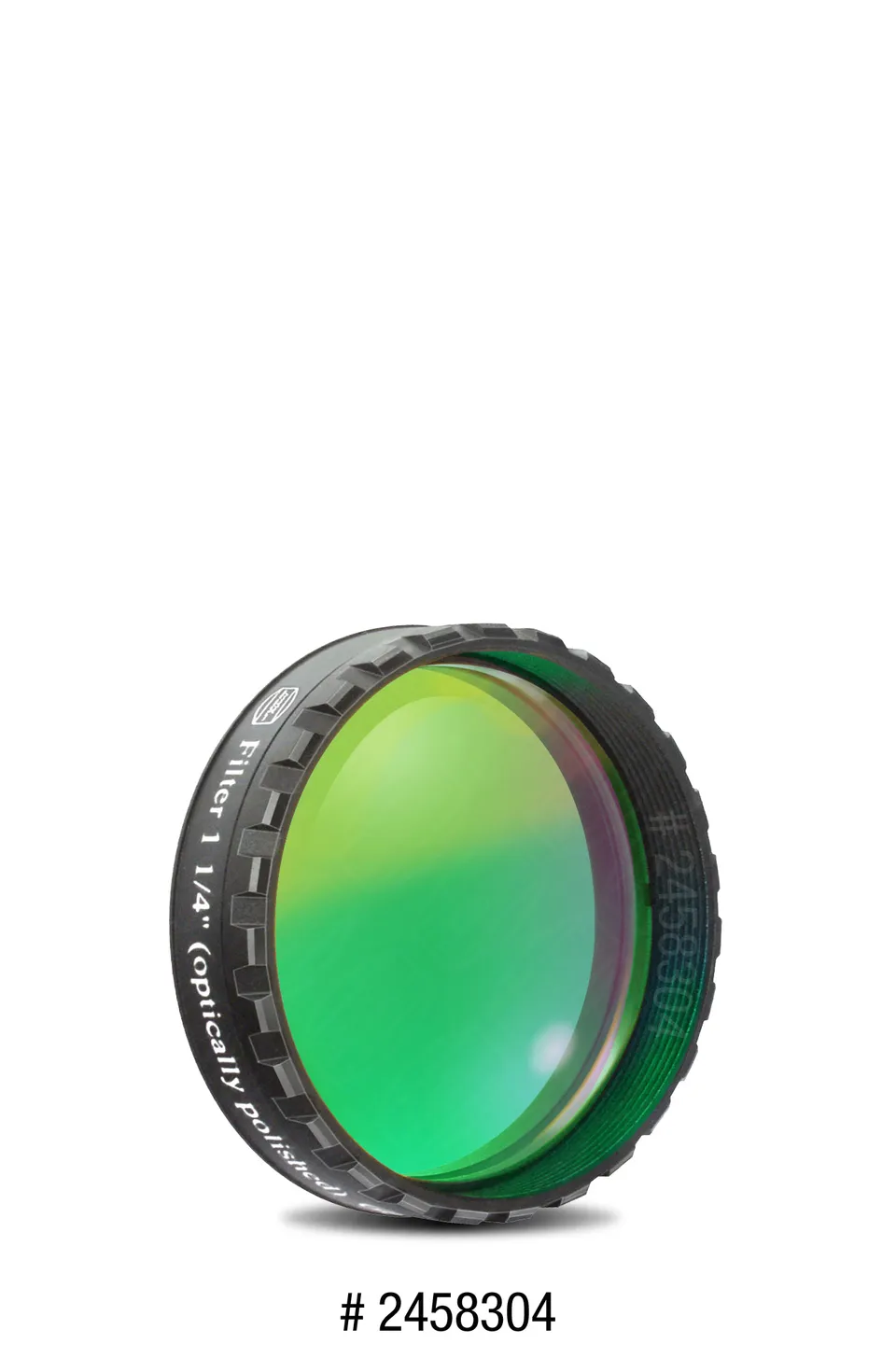
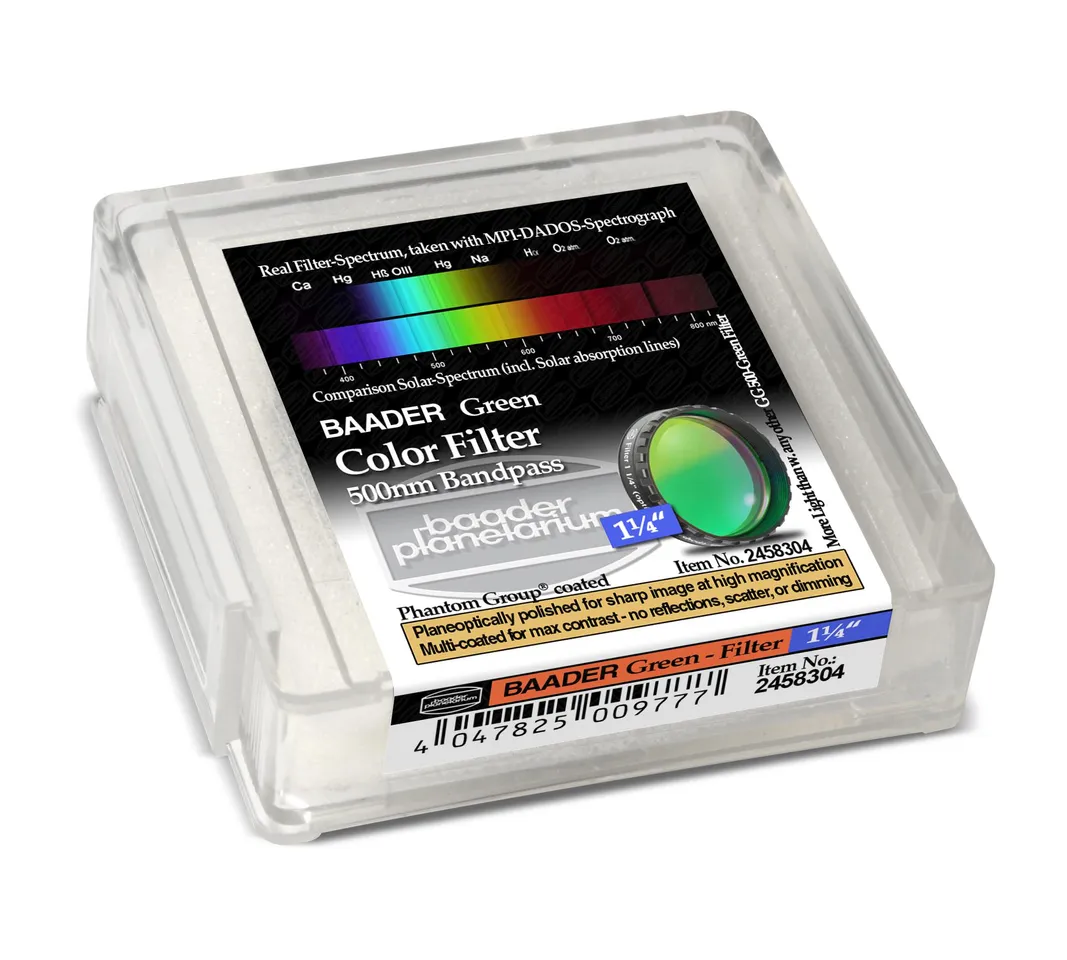
The Baader Planetarium Green (500 nm) Colour 1.25″ Filter is a precision optical accessory developed to enhance contrast and reveal fine details when observing the Moon and planets. By selectively transmitting a broad region of green light, it changes the relative brightness of different surface and atmospheric features, helping observers distinguish subtle structures that may otherwise be less apparent in unfiltered white light. Its precision-polished optical glass, advanced anti-reflection coatings and compact 1.25″ mounting make it an excellent addition to a dedicated lunar and planetary observing kit.
500 nm broadband green bandpass transmission
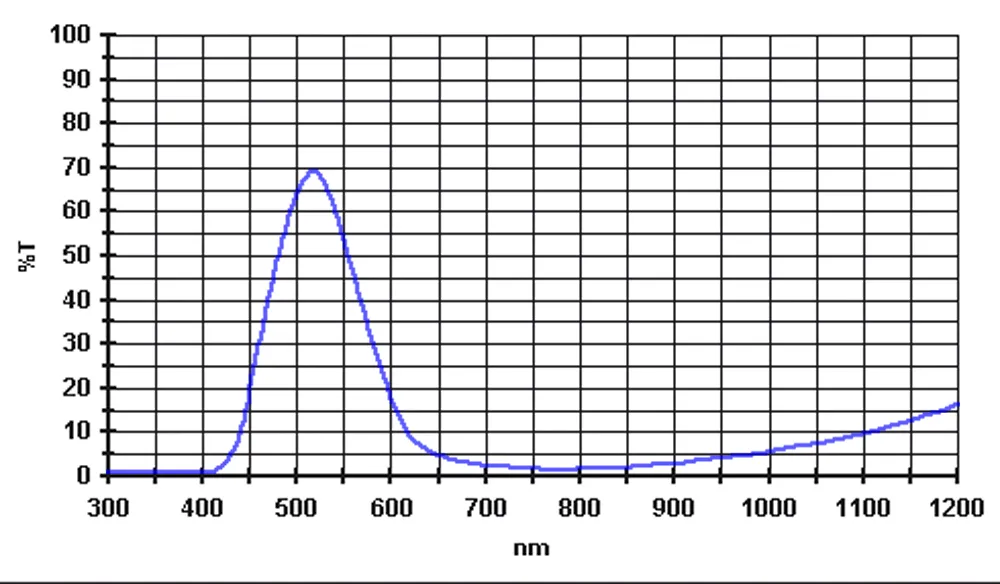
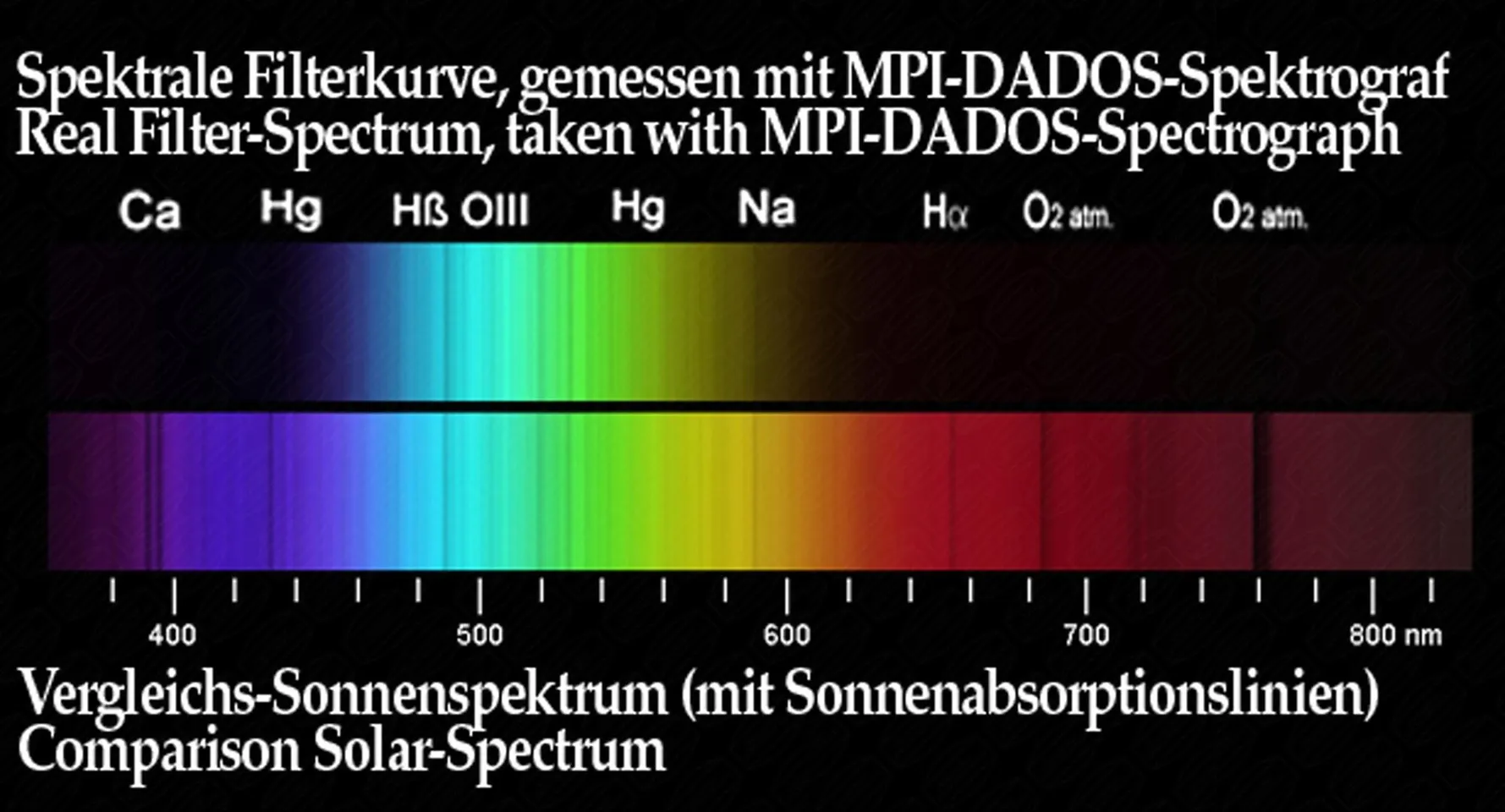
The Green 500 nm filter is a broadband bandpass colour filter, not a longpass or narrowband filter. Its nominal wavelength is approximately 500 nm, while Baader’s published transmission graph shows maximum transmission near 515–520 nm. Based on the graph, the main passing-wavelength region extends approximately from 420 to 650 nm, with peak transmission around 69%. The full width at half maximum (FWHM) is estimated at approximately 100 nm, measured at half the peak transmission level. These values are estimates from Baader’s transmission graph rather than separately certified numerical passband specifications. The filter’s transmission rises and falls gradually rather than switching abruptly at the stated wavelength limits.
Enhance fine detail on the lunar surface
The Green 500 nm filter is particularly useful for detailed lunar observation. It can improve the apparent contrast of selected surface structures, including crater walls, bright ray systems and regions of differing reflectivity. Prominent craters such as Tycho, Copernicus and Kepler are rewarding targets, with their surrounding terrain and extensive ray structures offering numerous opportunities for high-magnification study. The filter may also help distinguish subtle brightness differences when observing lunar features near the terminator.
Observe Martian frost, clouds and atmospheric haze
On Mars, green filtering can enhance the visibility of selected bright atmospheric and surface features. It is particularly useful for examining clouds, ground fog and frost-related phenomena, including seasonal frost under suitable conditions. By altering the relative brightness of different spectral components, the filter can help separate bright clouds and frost deposits from surrounding terrain. It complements red and orange planetary filters, which are generally more effective for emphasising darker Martian surface markings.
Improve atmospheric contrast on Jupiter and Saturn
The Green 500 nm filter is useful for studying selected atmospheric features on Jupiter and Saturn. On Jupiter, it can increase the apparent contrast between certain cloud belts, zones and atmospheric disturbances. On Saturn, the filter may help reveal subtle brightness differences across the planet’s atmospheric bands. The effectiveness of colour filtering depends on telescope aperture, magnification, atmospheric seeing and the particular planetary features visible at the time.
Reduce the visible effects of chromatic aberration
Green bandpass filtering can be especially useful with achromatic and semi-apochromatic refracting telescopes. By restricting the observed light to a narrower spectral region than unfiltered white light, it reduces the contribution of out-of-focus wavelengths associated with chromatic aberration. This can improve perceived sharpness when observing bright objects or attempting to resolve close double stars. The filter does not correct the telescope’s underlying optical design, but it can reduce the visible effects of secondary colour under suitable conditions.
Precision-polished optical glass
Baader manufactures its colour filters using fine-optically polished, plane-parallel optical glass. The approximately 2 mm optical substrate is designed to preserve image sharpness and minimise unwanted optical distortion. This is particularly important for high-magnification lunar and planetary observation, where even small imperfections in the optical path can become noticeable. The precision construction helps maintain the performance of high-quality telescope optics, eyepieces and diagonals.
Seven-layer Phantom Group Coating™
Both optical surfaces feature Baader’s seven-layer Phantom Group Coating™ anti-reflection treatment. The coating system is tailored to the characteristics of the coloured-glass substrate and is designed to minimise unwanted reflections, ghost images and scattered light. Baader specifies approximately 0.25% residual reflection per surface for the coating treatment. Reducing internal reflections helps preserve contrast when observing bright planets and the Moon.
Low-profile 1.25″ aluminium mounting
The filter is housed in a blackened aluminium cell with an approximately 6 mm low-profile design. Its standard M28.5 × 0.6 mm filter threads allow installation in compatible 1.25″ eyepieces, telescope diagonals, filter wheels and other astronomical accessories. The cell features male and female threads, allowing compatible filters to be stacked for specialised observing applications. A protective storage case is supplied to help safeguard the optical surfaces between observing sessions.
Important considerations for planetary imaging
Baader’s transmission graph shows that the principal visible-light passband is accompanied by some transmission at longer wavelengths. Beyond approximately 900 nm, near-infrared transmission gradually increases, reaching around 17% near 1,200 nm. The Green 500 nm filter should therefore not be treated as a complete infrared-blocking filter. When used with an infrared-sensitive planetary camera, an additional suitable UV/IR-cut filter may be required to prevent unwanted near-infrared light from affecting the recorded image.
A versatile addition to your observing equipment
The Baader Green (500 nm) Colour 1.25″ Filter is an excellent accessory for observers interested in lunar detail, Martian atmospheric phenomena and the cloud structures of Jupiter and Saturn. Its ability to improve perceived sharpness in certain refractors also makes it useful for selected double-star observations. Combining broad green bandpass transmission, premium optical coatings and durable 1.25″ construction, it offers dependable performance and versatility for serious visual astronomy.


 Cookie policy
Reviews
There are no reviews yet.