Premium blue bandpass filter for detailed planetary observation
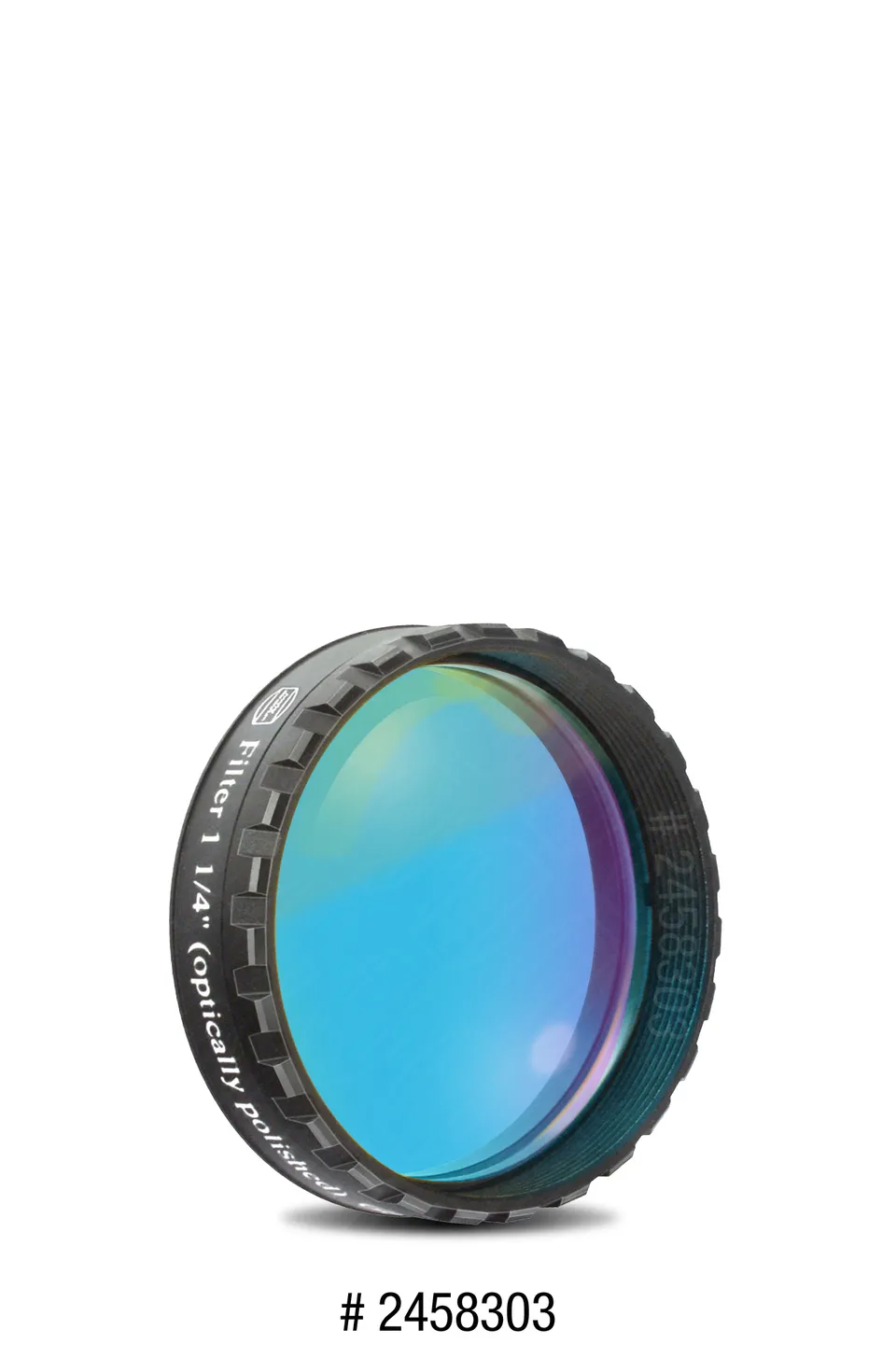
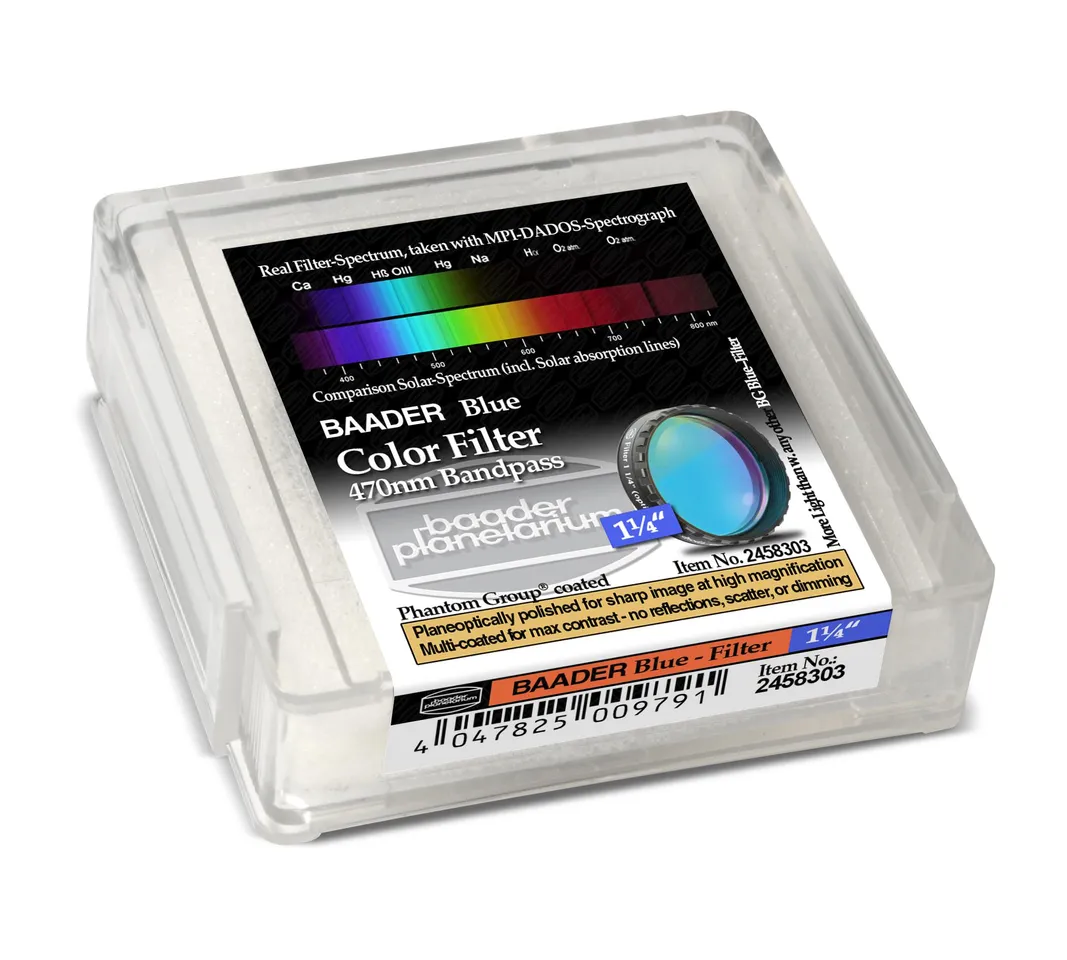
The Baader Planetarium Light Blue (470 nm) Colour 1.25″ Filter is a high-quality optical accessory developed to improve contrast and reveal subtle details when observing the Moon and planets. By selectively transmitting a broad region of blue light, it can make certain atmospheric structures easier to distinguish than in an unfiltered view. Its precision optical construction and advanced anti-reflection coatings are designed to preserve the image quality needed for high-magnification astronomy. The convenient 1.25″ format makes it especially suitable for observers using standard astronomical eyepieces, compatible diagonals and other threaded telescope accessories.
Broadband blue transmission centred around 470 nm
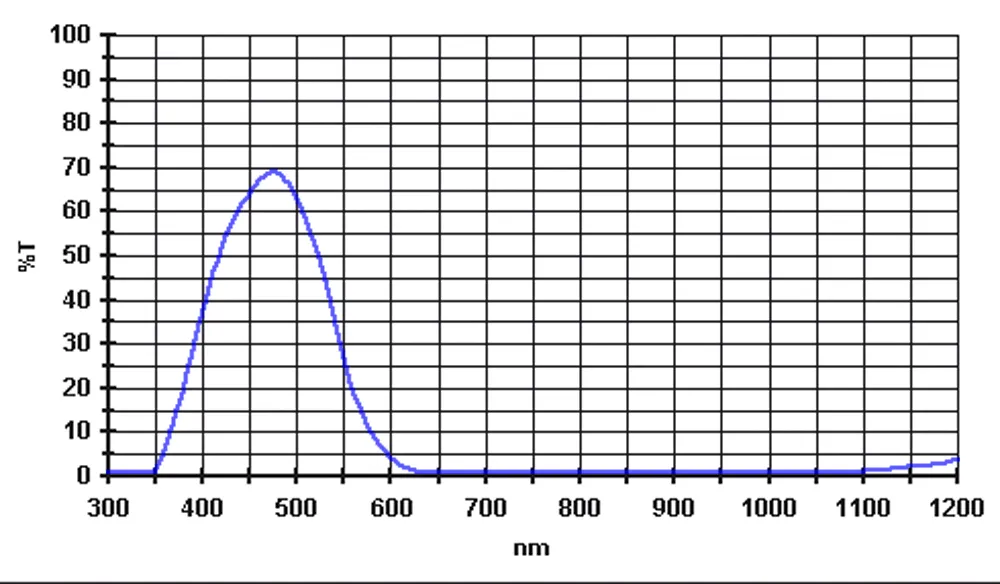
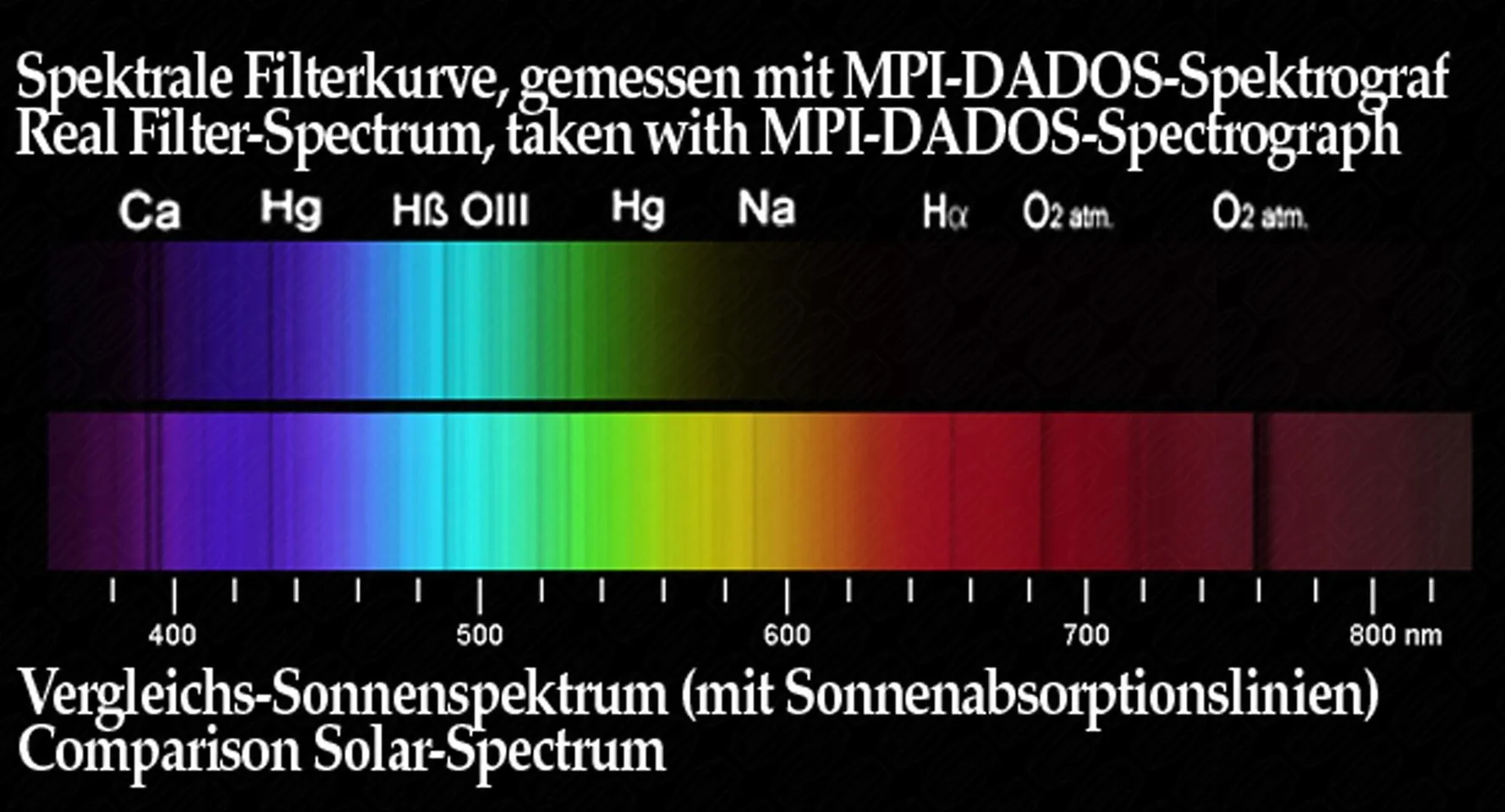
This filter is a broadband blue bandpass filter, not a longpass or narrowband filter. Its nominal wavelength is approximately 470 nm, close to the strongest part of its blue transmission band. According to Baader’s published transmission graph, the main passing-wavelength region extends approximately from 350 to 620 nm, with a peak transmission of around 69% near 470–475 nm. The full width at half maximum (FWHM) is approximately 145 nm, estimated from the graph at half the peak transmission level. These wavelength limits and bandwidth figures are approximate graphical measurements rather than separately certified numerical specifications. The filter’s transmission gradually rises and falls across the passband, rather than switching abruptly at its boundaries.
Enhance Jupiter’s cloud belts and atmospheric features
Jupiter is an excellent target for the Light Blue 470 nm filter. By changing the relative brightness of atmospheric features, the filter can improve the visibility of selected cloud belts, zones and atmospheric disturbances. It may also help distinguish details around the Great Red Spot and other cloud formations under suitable observing conditions. The improvement will vary with the planet’s position, atmospheric seeing, telescope aperture and the particular features visible at the time.
Study atmospheric clouds on Mars, Saturn and Venus
On Mars, blue filtering can help observers identify atmospheric clouds and hazes, providing a useful complement to red and orange filters that emphasise surface markings. On Saturn, the filter can increase the apparent contrast between selected atmospheric belts and cloud regions. For Venus, the filter can be used for general blue-light observation, although specialised ultraviolet filters are more effective for imaging the planet’s subtle upper-atmosphere cloud patterns. The filter may also be used for selected lunar observations, where altering the spectral balance can make certain brightness differences more noticeable.
Precision-polished optical glass
Baader uses precision-polished, plane-parallel optical glass to minimise image degradation and maintain sharpness. The approximately 2 mm optical substrate is designed to preserve optical performance, even when the filter is used at the high magnifications commonly required for planetary observation. Its carefully manufactured surfaces help minimise unwanted aberrations and distortion compared with basic, lower-quality coloured-glass filters. This makes it a practical choice for observers who want the benefits of colour filtering without compromising the performance of their telescope and eyepieces.
Seven-layer Phantom Group Coating™
The filter features Baader’s seven-layer Phantom Group Coating™ anti-reflection treatment on both optical surfaces. This coating system is designed to minimise unwanted reflections, ghost images and scattered light while maintaining high contrast on bright astronomical targets. Baader specifies approximately 0.25% residual reflection per surface for the coating system. The coatings are particularly valuable when observing bright planets, where internal reflections can otherwise reduce the visibility of fine details.
Low-profile 1.25″ aluminium filter cell
The filter is mounted in a blackened aluminium cell with an approximately 6 mm low-profile design. Its standard M28.5 × 0.6 mm filter threads allow it to be fitted to compatible 1.25″ eyepieces, diagonals, filter wheels and other accessories. The cell features male and female threads, enabling compatible filters to be stacked for more specialised transmission characteristics. A protective storage case is supplied to keep the filter safe when not in use.
A versatile addition to your planetary filter collection
The Baader Light Blue (470 nm) Colour 1.25″ Filter is a useful tool for observers seeking additional contrast when studying the atmospheres of Jupiter, Saturn and Mars. It also complements other planetary colour filters, allowing observers to compare different spectral views and identify details that respond best to particular wavelengths. Combining broad blue bandpass transmission, precision-polished optics and durable German-engineered construction, it offers dependable performance for both experienced planetary observers and enthusiasts building their first serious filter collection.


 Cookie policy
Reviews
There are no reviews yet.