High-contrast Hydrogen-alpha imaging for deep-sky astrophotography
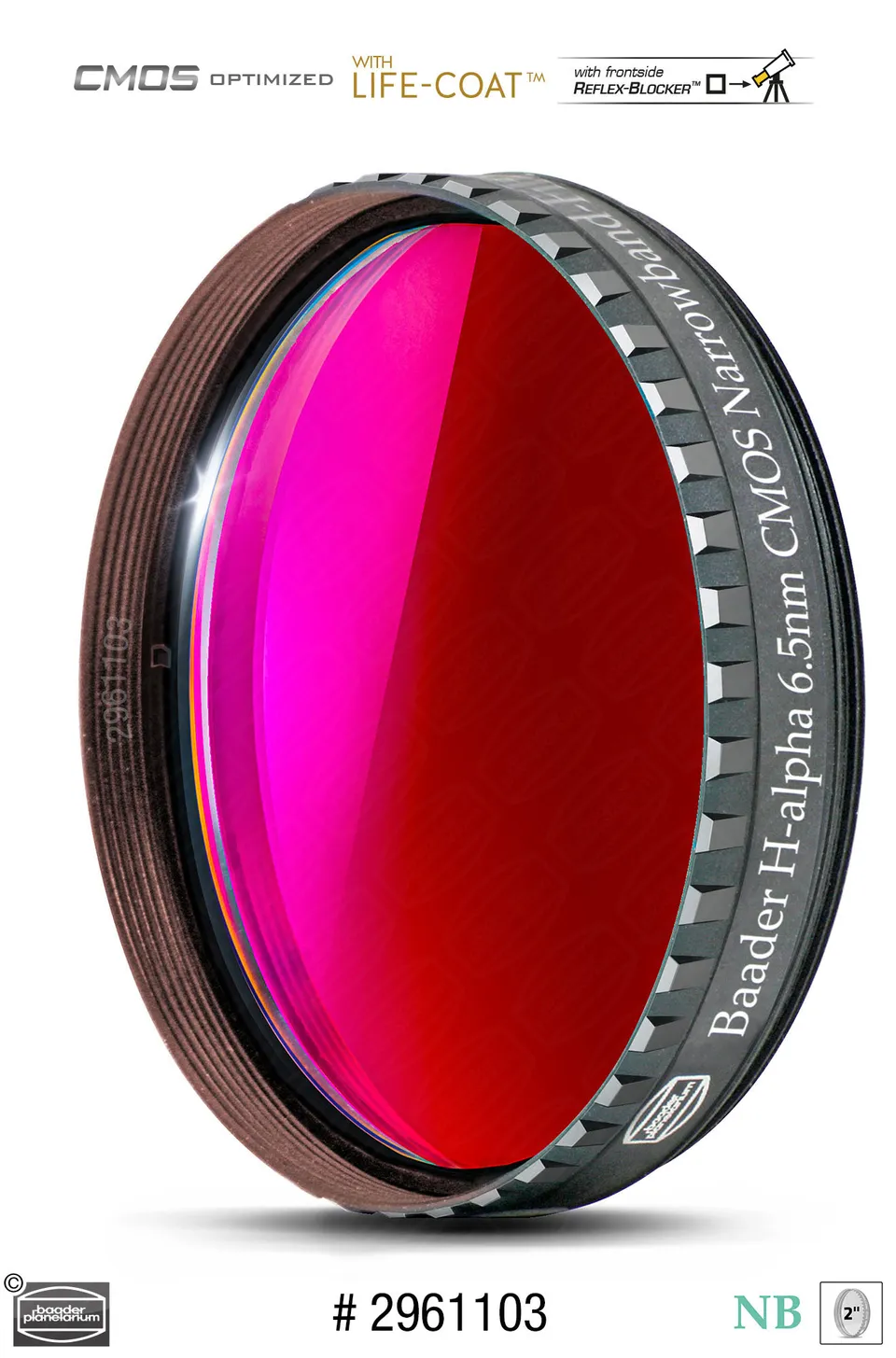
The Baader Planetarium Narrowband (6.5 nm) CMOS-Optimized H-alpha 2″ Filter is a precision optical filter designed to capture the distinctive red emission of ionised hydrogen in deep-sky objects. Optimised for modern monochrome CMOS cameras and equally suitable for CCD sensors, it isolates the Hydrogen-alpha wavelength while suppressing much of the unwanted light from artificial illumination, natural skyglow and other parts of the spectrum. This makes it an excellent choice for imaging emission nebulae, supernova remnants and star-forming regions, especially from locations where broadband imaging is affected by light pollution.
Precisely defined 6.5 nm H-alpha transmission
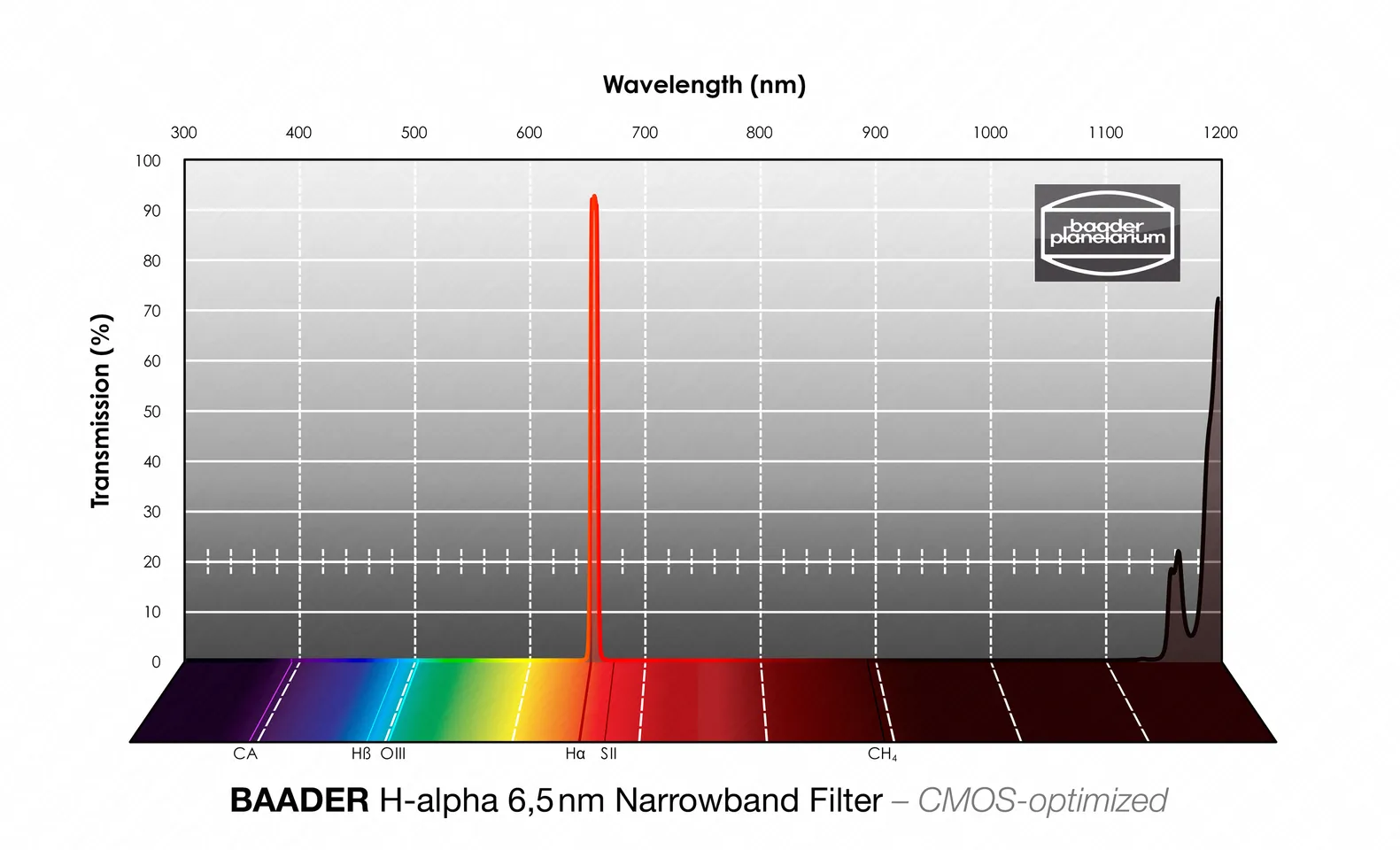
The filter is centred on the Hydrogen-alpha emission line at 656.3 nm and has a full width at half maximum (FWHM) bandwidth of 6.5 nm. This carefully controlled passband allows the camera to record light emitted by ionised hydrogen while strongly reducing wavelengths outside the desired spectral region. The narrow transmission profile improves the contrast between emission nebulae and the surrounding sky, helping reveal delicate filaments, faint outer structures and subtle variations in hydrogen emission. Unlike a broadband red filter, the H-alpha filter is dedicated to recording a specific astronomical emission line rather than a wide range of visible wavelengths.
Improved contrast under light-polluted skies
Narrowband imaging is particularly effective when artificial lighting or natural skyglow makes faint nebular detail difficult to capture. By restricting transmission to a narrow region around 656.3 nm, the Baader H-alpha filter reduces much of the unwanted background signal while retaining the target’s hydrogen emission. This allows astrophotographers to capture detailed emission nebulae from suburban observing sites and during some moonlit conditions, although strong moonlight and poor atmospheric conditions can still affect image quality. The filter is especially valuable for targets such as the North America Nebula, Rosette Nebula, Heart Nebula and California Nebula.
Advanced Reflex-Blocker™ coatings
Bright stars and reflective optical components can create unwanted halos and internal reflections in astrophotography. Baader addresses these effects through its Reflex-Blocker™ hard-coating technology, developed to minimise reflections between the filter and surrounding optical surfaces. The filter features planeoptically polished surfaces, sealed coating edges and blackened outer edges to reduce scattered light. A telescope-facing orientation indicator on the filter rim helps ensure correct installation within the imaging system. Together, these features support cleaner star profiles and improved contrast in demanding narrowband imaging applications.
Durable Life-Coat™ technology
The filter incorporates Baader’s Life-Coat™ technology, featuring hardened optical coatings designed for long-term durability. These coatings are developed to resist moisture, environmental exposure and repeated cleaning when handled according to the manufacturer’s instructions. Baader provides a limited lifetime warranty on qualifying Life-Coat™ coatings for the original purchaser, subject to the manufacturer’s warranty conditions.
Designed for conventional astrophotography systems
This standard 6.5 nm Narrowband filter is recommended for optical systems with focal ratios slower than approximately f/3.4. At very fast focal ratios, the converging light cone can shift the effective transmission band of an interference filter, potentially reducing transmission at the desired H-alpha wavelength. For systems operating around f/2, such as certain fast astrographs, Baader offers a separate f/2 Highspeed H-alpha filter designed specifically for those optical configurations. The standard filter’s 2 mm optical substrate is mounted in Baader’s approximately 6 mm Low Profile Filter Cell (LPFC). Its 2″ format uses standard M48 × 0.75 filter threads for compatible filter wheels, drawers and imaging accessories.
Complete your narrowband imaging system
The Baader CMOS-Optimized H-alpha 6.5 nm Filter can be used on its own to create detailed monochrome images of hydrogen-rich nebulae or combined with matching Oxygen-III (O-III) and Sulphur-II (S-II) narrowband filters. Together, these filters allow the creation of multi-channel narrowband images, including popular Hubble Palette (SHO) and HOO colour combinations. With its precisely defined passband, advanced reflection control and durable construction, this filter is a reliable foundation for high-contrast deep-sky narrowband astrophotography.


 Cookie policy
Reviews
There are no reviews yet.