High-contrast Oxygen-III imaging for deep-sky astrophotography
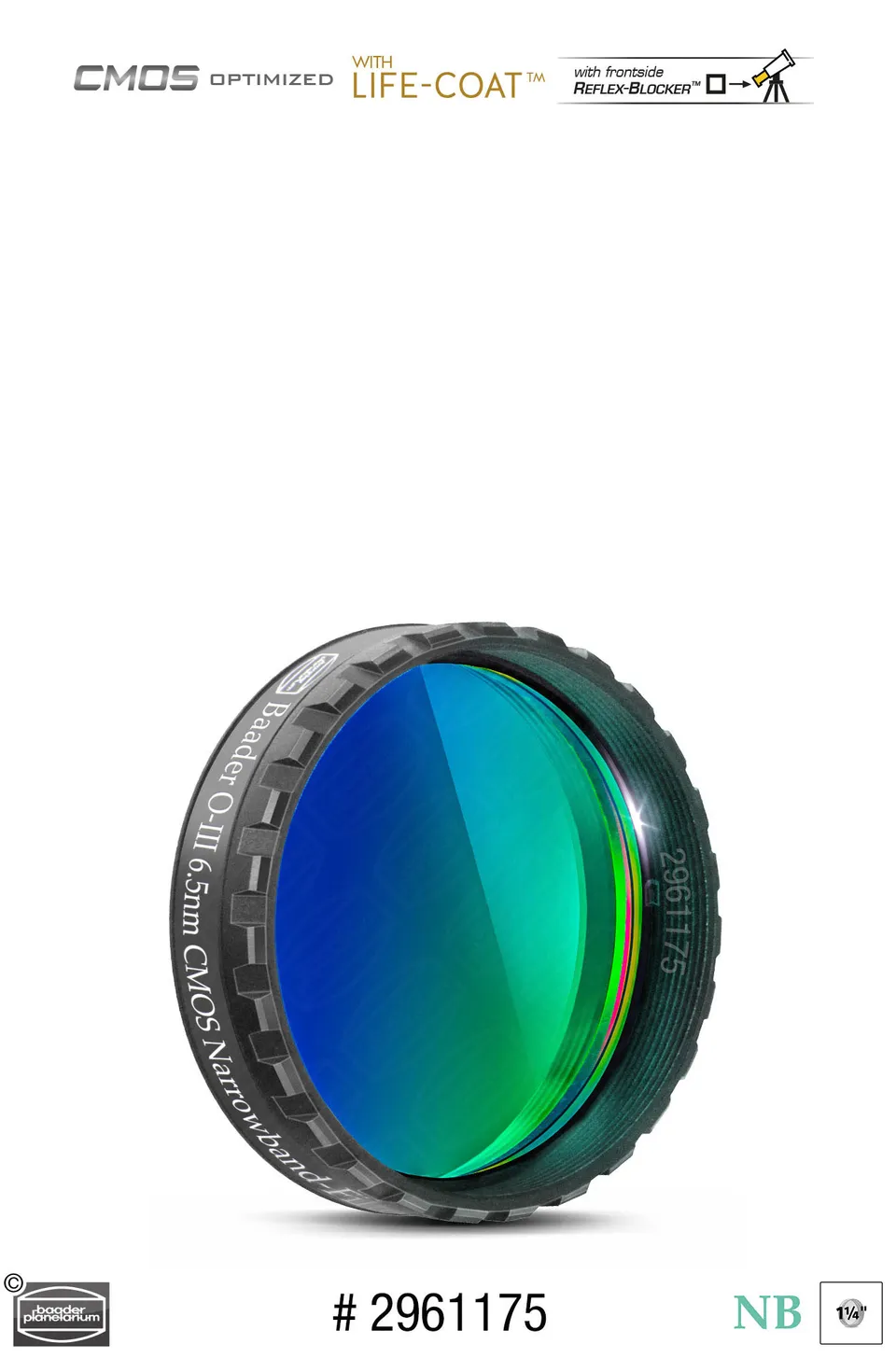
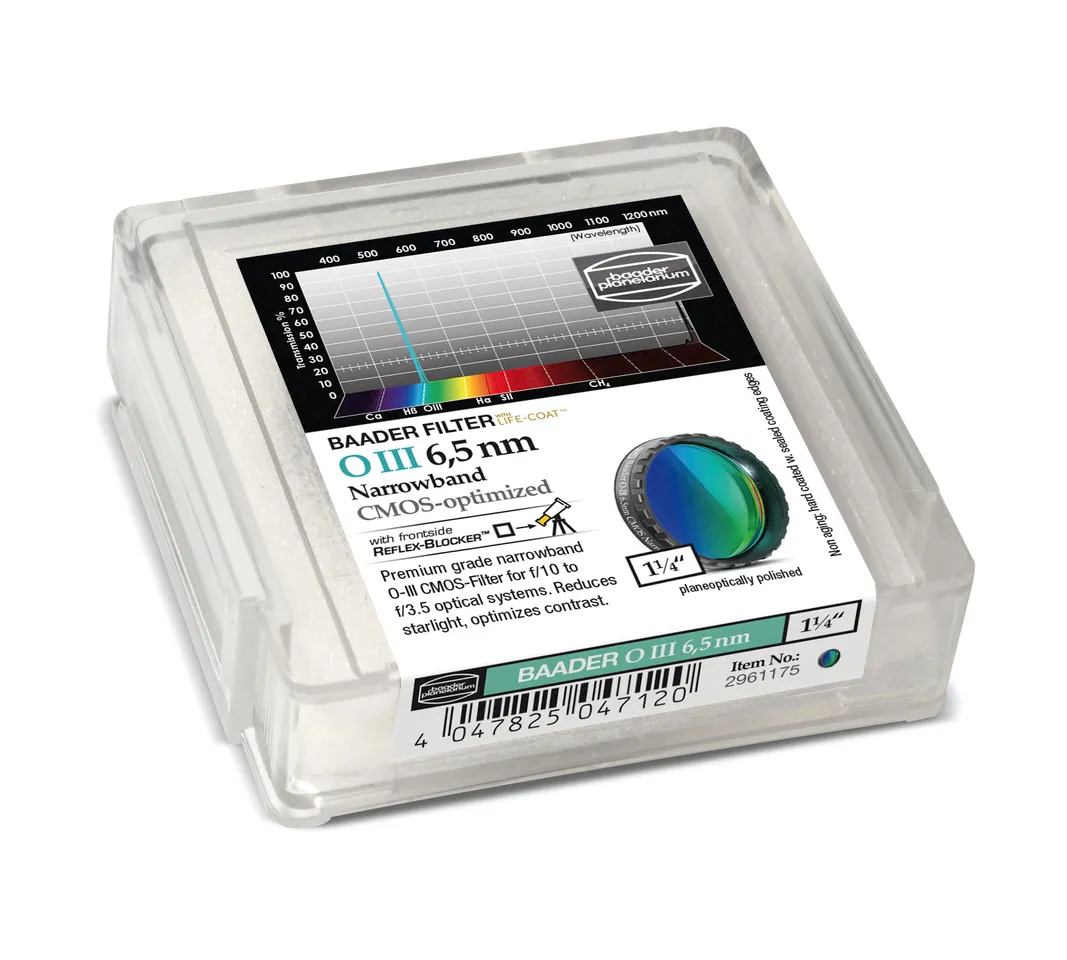
The Baader Planetarium Narrowband (6.5 nm) CMOS-Optimized O-III 1.25″ Filter is a precision optical filter designed to capture the distinctive blue-green emission of doubly ionised oxygen in astronomical nebulae. Optimised for modern monochrome CMOS cameras and equally suitable for CCD sensors, it selectively transmits the principal Oxygen-III emission line while suppressing much of the unwanted light from artificial illumination and natural skyglow. This makes it particularly effective for imaging planetary nebulae, supernova remnants and oxygen-rich emission regions, even when broadband astrophotography is limited by light pollution.
Precisely defined 6.5 nm O-III transmission
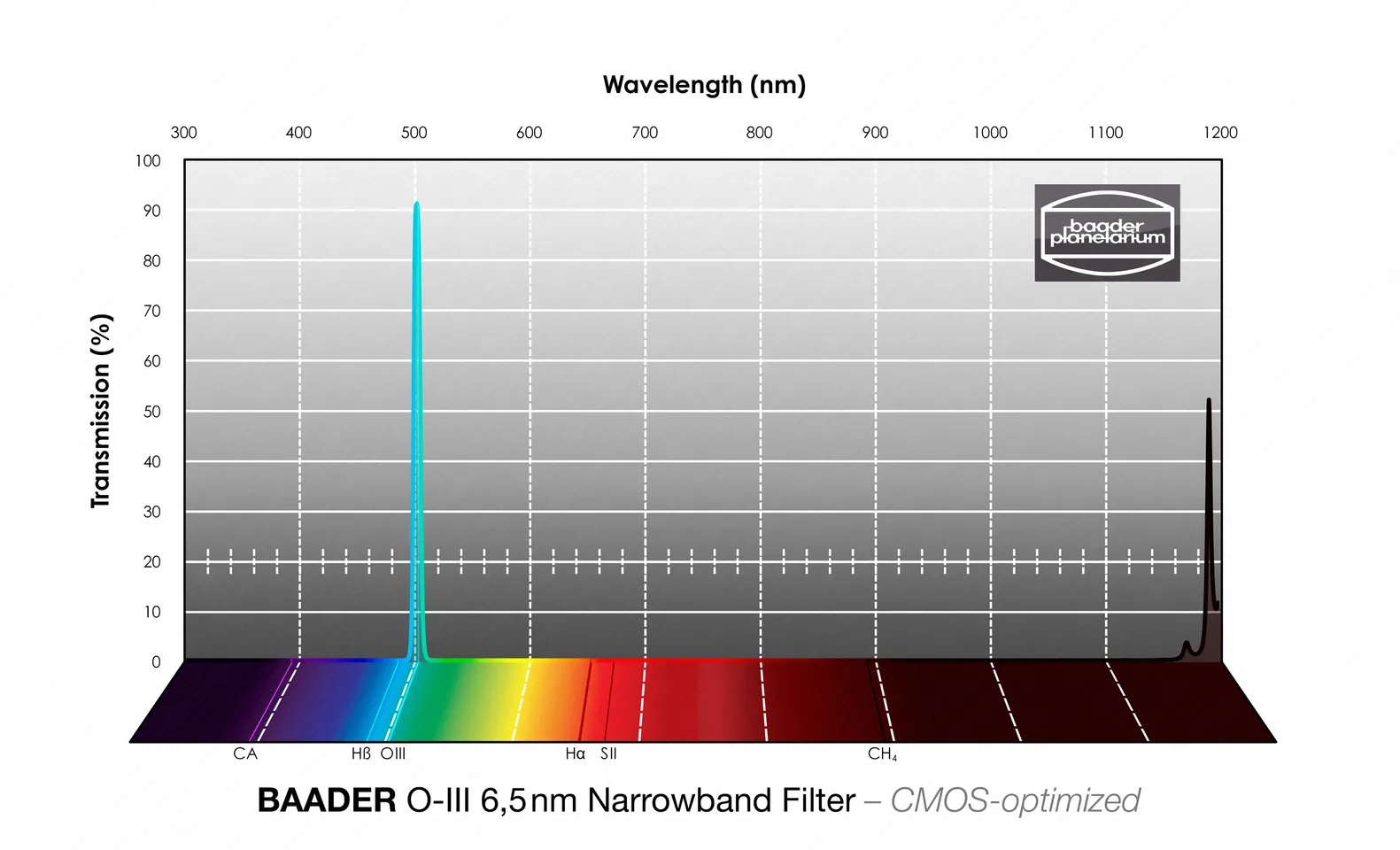
The filter is centred at 500.7 nm, the stronger of the two principal astronomical O-III emission lines, and has a full width at half maximum (FWHM) bandwidth of 6.5 nm. Assuming a symmetrical passband, the nominal half-maximum boundaries are approximately 497.45–503.95 nm. This narrow spectral window helps capture the desired oxygen emission while substantially reducing wavelengths outside the intended passband. The secondary O-III line at approximately 495.9 nm lies outside this nominal half-maximum interval, so its transmission may be significantly lower than that of the main 500.7 nm line. Specialist retailer specifications report peak transmission greater than 90%, allowing efficient capture of the targeted emission line.
Improved contrast under light-polluted skies
By restricting incoming light to a narrow spectral region, the Baader O-III filter helps separate faint oxygen emission from the surrounding sky background. It is especially useful for imaging objects such as the Veil Nebula, Dumbbell Nebula, Crescent Nebula and many planetary nebulae, where O-III emission contributes prominently to visible structure. The filter can also support narrowband imaging during some moonlit conditions, although strong moonlight, atmospheric transparency and local light pollution can still affect the final signal-to-noise ratio.
Advanced Reflex-Blocker™ coatings
Bright stars and reflective surfaces within an imaging train can generate unwanted halos and internal reflections. Baader’s Reflex-Blocker™ hard coatings are designed to reduce these effects, supporting cleaner star profiles and improved image contrast. The filter incorporates planeoptically polished surfaces, individually applied coatings with sealed edges, and blackened glass edges to help suppress scattered light. A contrasting rim identifies the intended telescope-facing side of the filter for correct installation.
Durable Life-Coat™ technology
Baader’s Life-Coat™ technology provides hardened optical coatings designed to withstand long-term use and appropriate optical cleaning. The individually coated glass substrate and sealed coating edges help protect the filter against environmental exposure. Baader offers a limited lifetime coating warranty for qualifying filters, subject to the manufacturer’s conditions.
Compact 1.25″ format for compatible imaging systems
The 2 mm optical substrate is mounted in Baader’s approximately 6 mm Low Profile Filter Cell (LPFC), making it suitable for compatible 1.25″ filter wheels, filter drawers and threaded imaging accessories. The 1.25″ format is particularly practical for cameras with smaller sensors. Users should check the clear aperture and filter-to-sensor distance to ensure the filter does not introduce unwanted vignetting. This standard 6.5 nm filter is recommended for optical systems slower than approximately f/3.4. At faster focal ratios, the effective passband of an interference filter can shift towards shorter wavelengths, reducing transmission at the target emission line. For very fast systems around f/2, Baader offers a dedicated f/2 Highspeed O-III filter instead.
Build a complete narrowband imaging system
The Baader CMOS-Optimized O-III 6.5 nm Filter can be used independently for detailed monochrome images or combined with matching Hydrogen-alpha (H-alpha) and Sulphur-II (S-II) filters. These combinations support popular narrowband colour-processing techniques, including HOO and the Hubble Palette (SHO). With its carefully controlled bandwidth, high transmission, advanced coatings and compact mechanical design, this filter provides a reliable foundation for detailed oxygen-emission astrophotography.


 Cookie policy
Reviews
There are no reviews yet.