Complete three-channel narrowband astrophotography
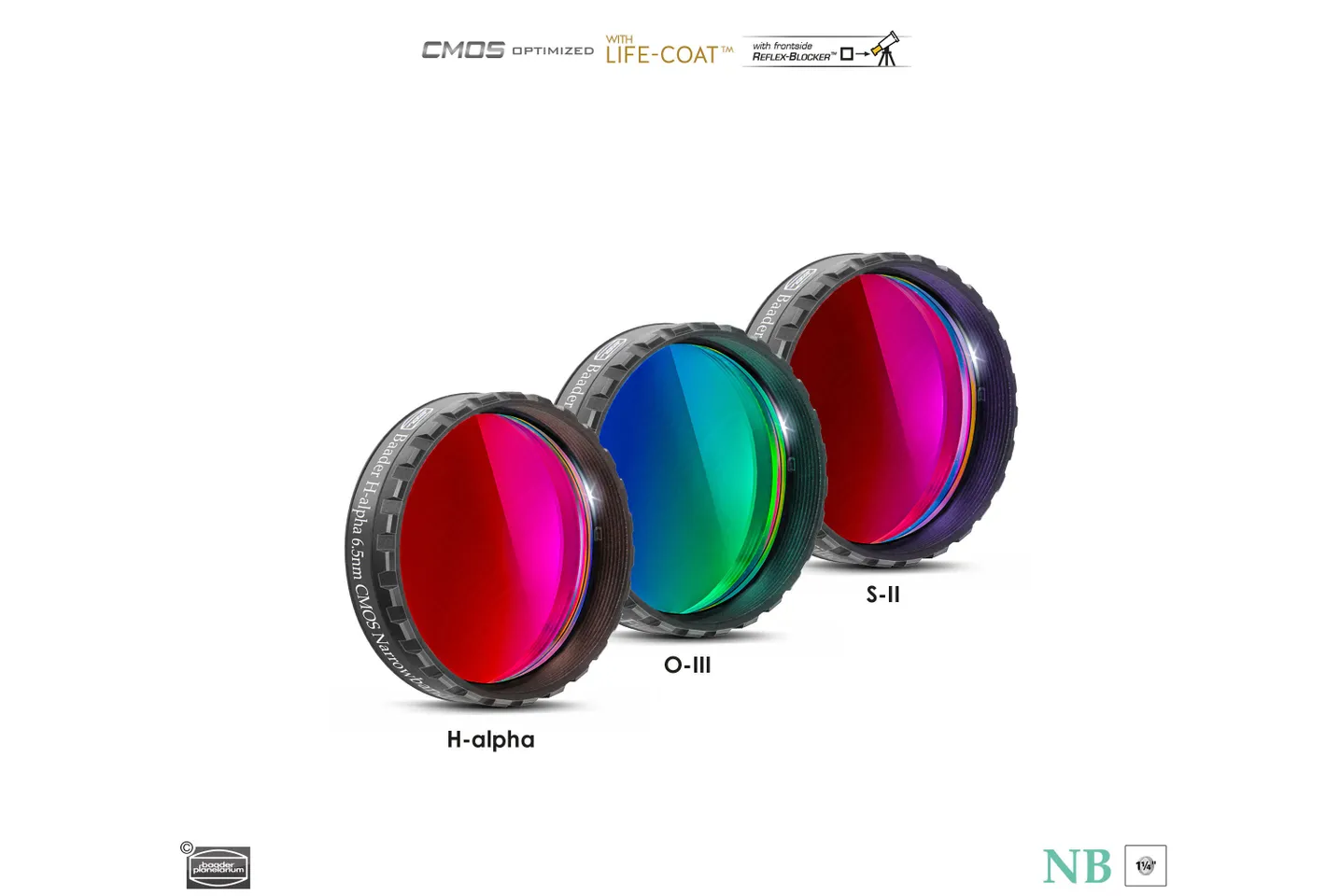
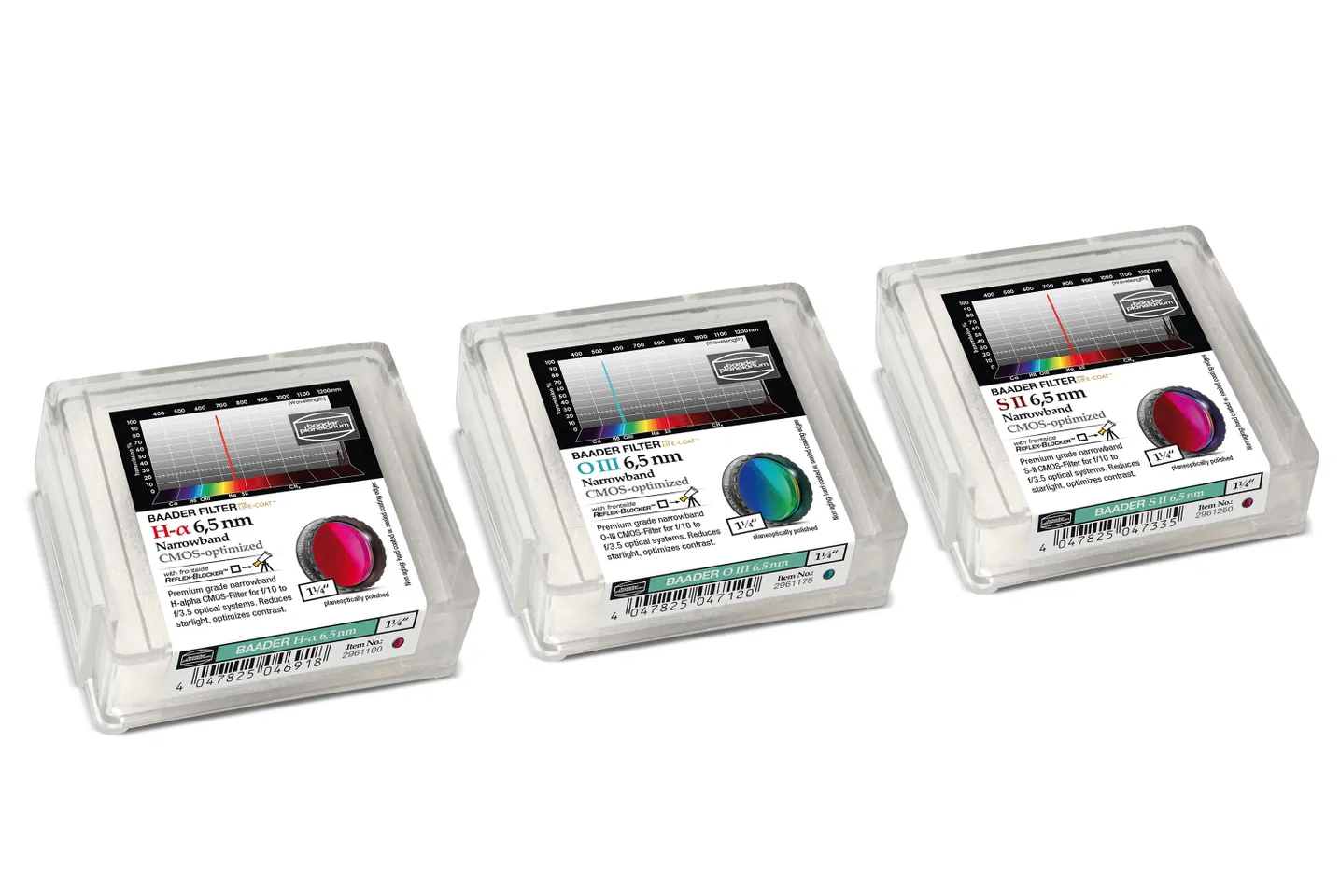
The Baader Planetarium Narrowband CMOS-Optimized (H-alpha, O-III, S-II) 1.25″ Filter Set provides three precision emission-line filters for capturing the distinctive light signatures of hydrogen, oxygen and sulphur in deep-sky objects. Developed for modern monochrome CMOS cameras and equally suitable for CCD sensors, this coordinated filter set allows astrophotographers to record detailed images of emission nebulae, planetary nebulae, supernova remnants and complex star-forming regions. Each filter selectively transmits its target emission wavelength while suppressing much of the unwanted artificial illumination, natural skyglow and continuum light that can reduce contrast in broadband imaging.
Three precisely controlled 6.5 nm passbands
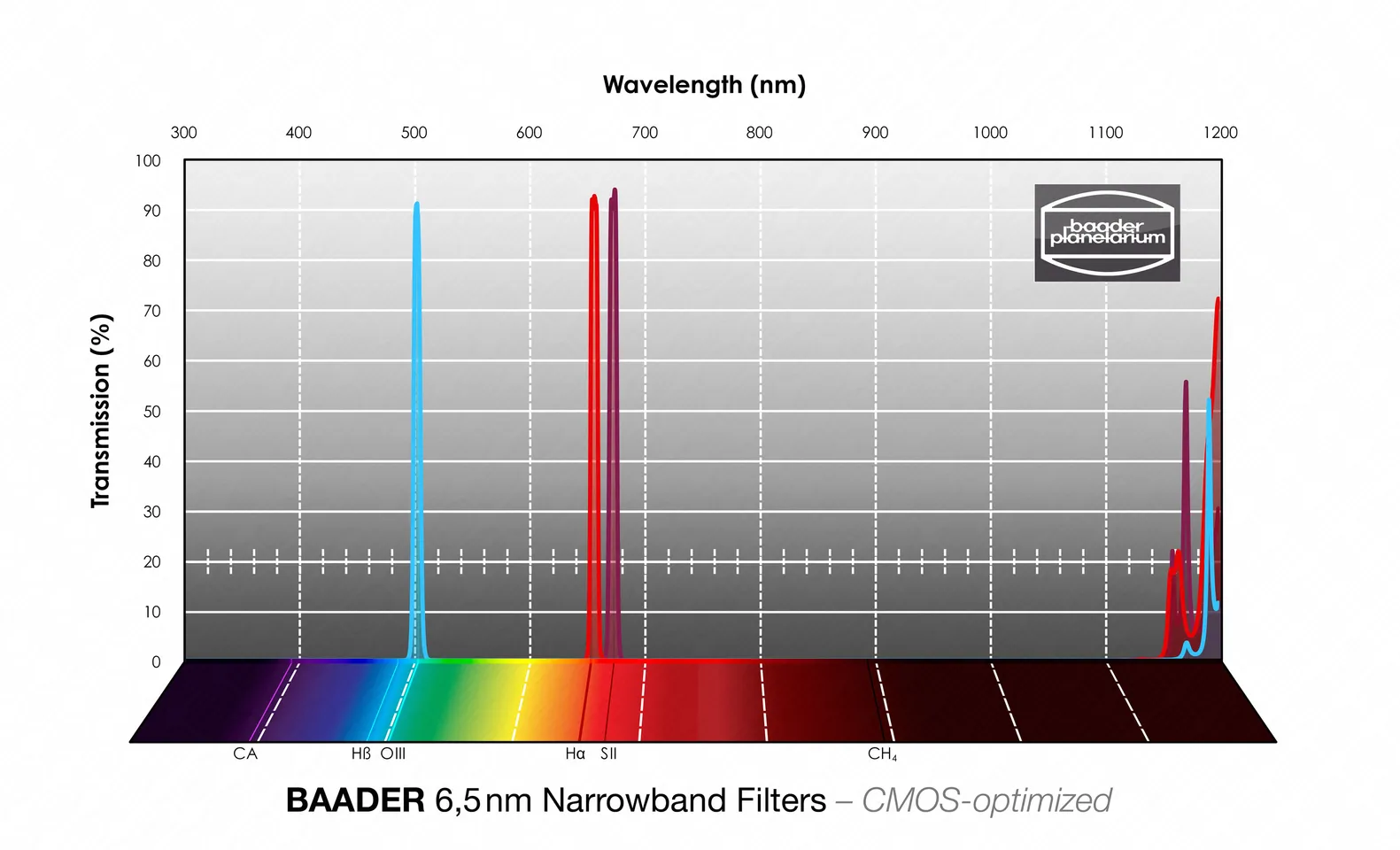
The set includes three individually mounted 1.25″ filters, each with a nominal full width at half maximum (FWHM) bandwidth of 6.5 nm. The H-alpha filter is centred at 656.3 nm, capturing the characteristic red emission of hydrogen that dominates many large emission nebulae. The O-III filter is centred at 500.7 nm, isolating the stronger blue-green emission line of doubly ionised oxygen. The secondary O-III line at approximately 495.9 nm lies outside the nominal half-maximum passband and may be significantly attenuated. The S-II filter is centred at 671.7 nm, targeting the deep-red emission of singly ionised sulphur. Its passband encompasses the principal S-II emission lines at approximately 671.6 nm and 673.1 nm. Together, these filters record complementary information about the structure and distribution of different emitting gases.
Create striking Hubble Palette and HOO images
The three-filter set is particularly well suited to SHO imaging, commonly known as the Hubble Palette. In a typical SHO composition, Sulphur-II is assigned to red, Hydrogen-alpha to green and Oxygen-III to blue. Combining these channels produces richly detailed false-colour images that highlight different emission structures within complex nebulae. The H-alpha and O-III filters can also be combined for HOO compositions, while each filter can be used independently for detailed monochrome imaging. This flexibility makes the set an excellent foundation for a complete narrowband imaging workflow.
Enhanced contrast under challenging skies
The 6.5 nm passbands reduce unwanted background illumination while transmitting the selected nebular emission lines. This makes the filters particularly useful for imaging from suburban locations affected by artificial lighting and natural skyglow. Suitable targets include the Rosette Nebula, North America Nebula, Veil Nebula, Heart Nebula and Eagle Nebula. Although narrowband imaging can improve target-to-background contrast, the final result still depends on atmospheric transparency, moonlight, optical configuration and total exposure time. Sulphur-II emission is often weaker than Hydrogen-alpha emission, so the S-II channel may require longer integration times to achieve a comparable signal-to-noise ratio.
Advanced Reflex-Blocker™ coatings
Baader’s Reflex-Blocker™ hard coatings are designed to minimise unwanted reflections and halos caused by bright stars and reflective components within an imaging system. Each filter features planeoptically polished optical surfaces, individually applied coatings with sealed edges and blackened glass edges to reduce scattered light. A black telescope-facing outer rim serves as an orientation indicator to assist with correct installation. These construction details help preserve image contrast and maintain cleaner star profiles during demanding long-exposure astrophotography.
Durable Life-Coat™ technology and consistent optical thickness
All three filters incorporate Baader’s Life-Coat™ technology, using hardened optical coatings developed for long-term durability. Each filter has a 2 mm optical substrate, providing consistent optical thickness across the set and helping minimise focus shifts when changing channels. The matched construction supports parfocal operation within the filter set, although final focus should still be checked during imaging, particularly when temperatures change. Baader provides a limited lifetime coating warranty for qualifying filters, subject to the manufacturer’s warranty conditions.
Compact 1.25″ mounting and optical compatibility
Each filter is mounted in Baader’s approximately 6 mm Low Profile Filter Cell (LPFC) and uses the standard M28.5 × 0.6 thread associated with 1.25″ astronomical filters. The compact format is particularly practical for smaller-sensor cameras, compatible filter wheels and filter drawers. Users should verify the clear aperture and filter-to-sensor distance to avoid unwanted vignetting. The standard 6.5 nm Narrowband filters are recommended for optical systems slower than f/3.4. In faster optical systems, increased light-incidence angles can shift the effective passband towards shorter wavelengths, reducing transmission at the desired emission line. For astrographs operating around f/2, Baader offers a separate f/2 Highspeed narrowband set specifically designed for those faster optical systems.
A versatile foundation for serious deep-sky imaging
The Baader 1.25″ Narrowband CMOS-Optimized Filter Set combines three essential emission channels, advanced reflection control and durable optical construction in one coordinated package. Whether creating monochrome emission-line images, natural-looking HOO compositions or richly coloured SHO/Hubble Palette images, this set provides the precision and versatility needed for detailed deep-sky astrophotography.


 Cookie policy
Reviews
There are no reviews yet.