Premium red longpass filter for high-contrast planetary observation
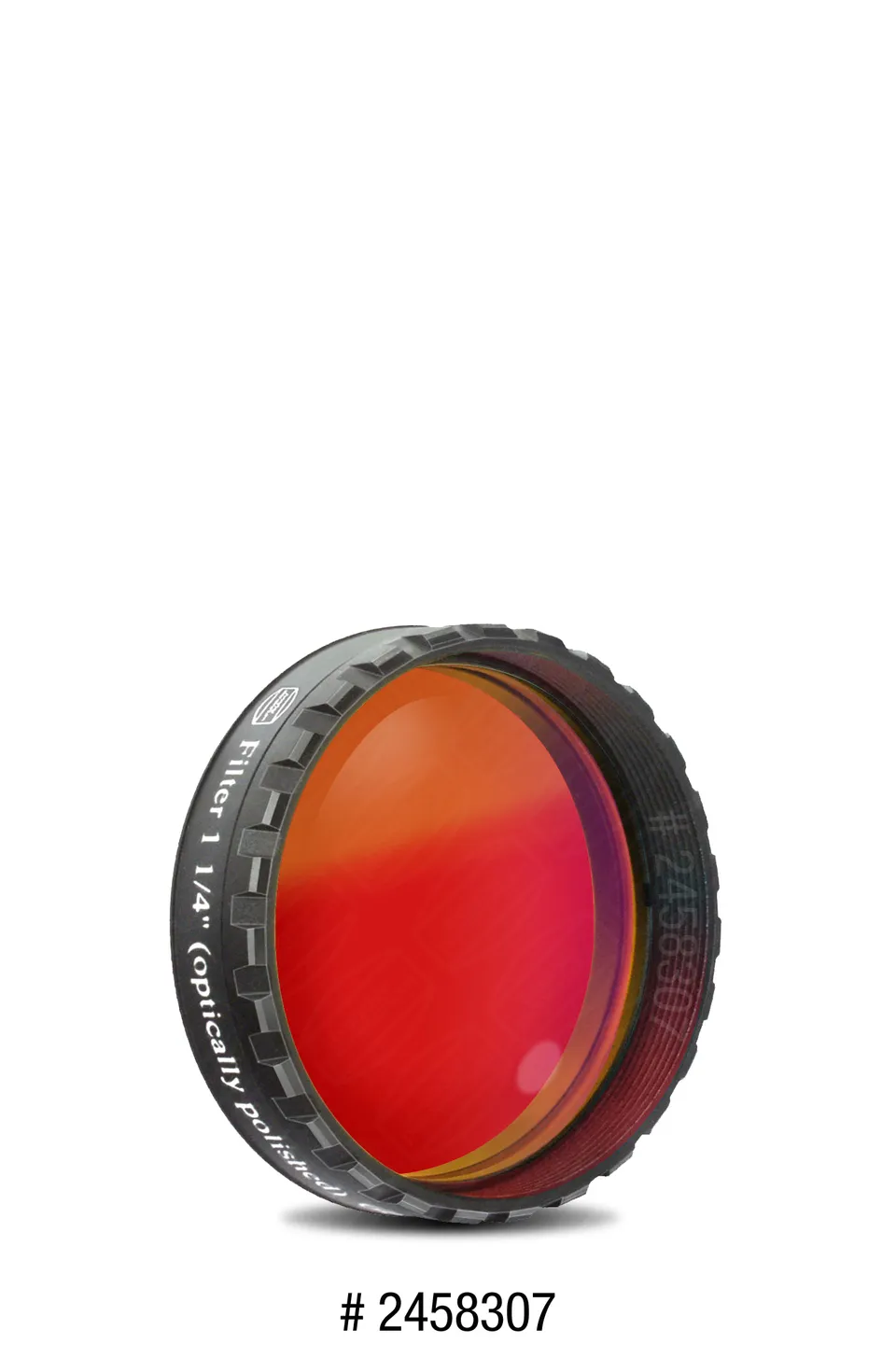
The Baader Planetarium Red (610 nm) Colour 1.25″ Filter is a precision optical accessory designed to improve contrast and reveal subtle features during lunar and planetary observation. Its red longpass transmission selectively suppresses shorter visible wavelengths while allowing red and longer-wavelength light to pass through the optical system. This spectral selectivity can make selected planetary surface markings, atmospheric structures and lunar features easier to distinguish, particularly when observing bright targets at high magnification. Designed for demanding visual observers, the filter is also suitable for compatible monochrome planetary imaging applications.
610 nm longpass transmission with exceptional efficiency
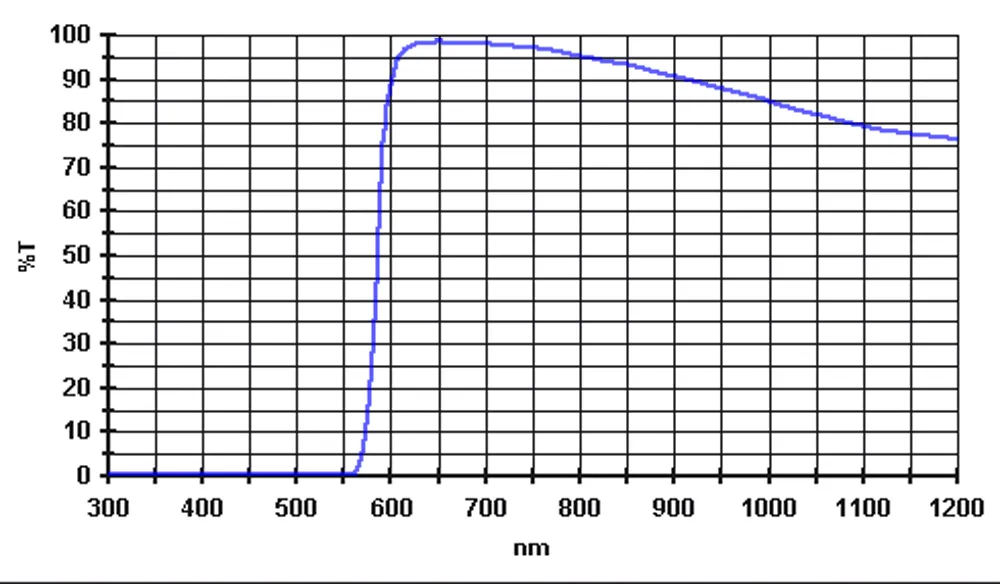
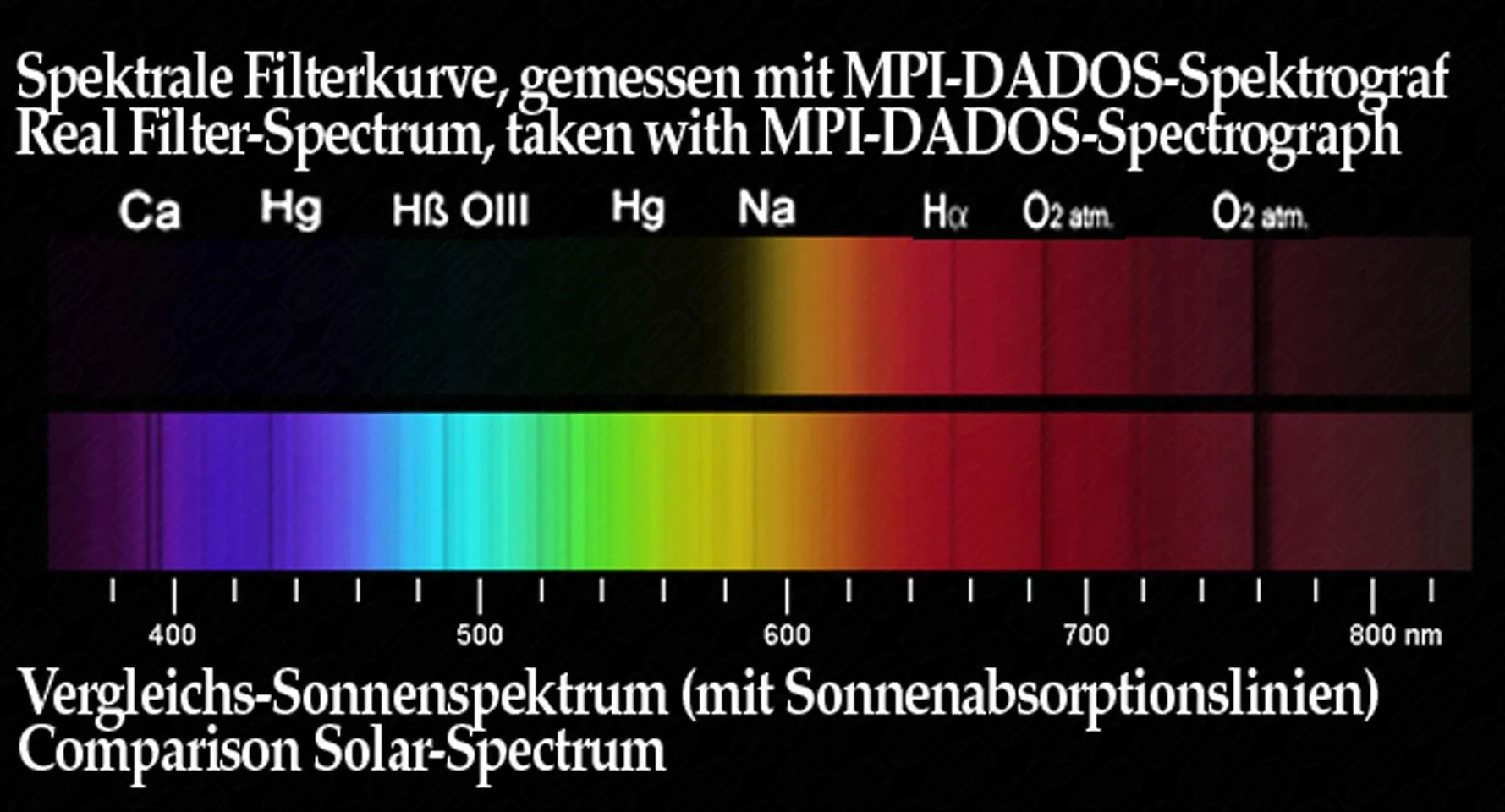
The filter features a nominal longpass transition at approximately 610 nm. Wavelengths shorter than this transition are increasingly attenuated, while longer wavelengths are transmitted with high efficiency. Baader’s red longpass colour filter achieves approximately 98% peak transmission within its passband, helping preserve image brightness despite its selective red transmission. Unlike a narrowband filter centred at 610 nm, this longpass design transmits a broad range of longer wavelengths. It should therefore be classified as a red longpass colour filter rather than a 610 nm narrowband filter.
Reveal distinctive detail on Mars
The Red 610 nm filter is particularly useful for observing Mars, where longer-wavelength contrast can help distinguish darker surface regions from brighter surrounding terrain. It can also enhance the visibility of certain atmospheric phenomena, including frost-related features and surface haze, depending on observing conditions. By suppressing shorter wavelengths, the filter reduces the influence of blue-rich scattered light and can improve the apparent definition of selected Martian features. This makes it a valuable accessory during favourable Mars apparitions, particularly with medium- and large-aperture telescopes.
Improved contrast on Jupiter, Saturn and the Moon
On Jupiter and Saturn, the red filter can enhance contrast between selected atmospheric regions, making certain belt and cloud structures easier to examine. It is also useful for studying the Moon, where the filter can emphasise subtle tonal differences around prominent crater formations such as Tycho, Copernicus and Kepler. The degree of improvement depends on telescope aperture, atmospheric seeing, magnification and the specific feature being observed. Because the filter removes a substantial portion of the visible spectrum, it is best suited to bright targets and telescopes with sufficient light-gathering capability.
Reduced atmospheric turbulence and refractor colour fringing
Shorter wavelengths are generally more strongly affected by atmospheric scattering and seeing-related image degradation. By favouring longer red wavelengths, the Baader Red 610 nm filter can produce steadier-looking planetary images under certain turbulent conditions. This can be particularly beneficial for high-resolution monochrome planetary imaging, where sharper individual frames improve the results of lucky-imaging and image-stacking techniques. The filter also helps suppress residual blue-violet chromatic aberration in achromatic refractors. Although it does not correct the telescope’s optical aberrations, it reduces the contribution of wavelengths that may be poorly focused.
Precision-polished glass for demanding optical systems
Baader uses fine-optically polished, plane-parallel glass to preserve image quality at high magnification. The 2 mm optical substrate helps minimise wavefront errors and avoids the image degradation that can occur with poorly finished coloured-glass filters. The filter is suitable for installation in compatible eyepieces and optical accessories, including configurations where the filter is positioned farther from the focal plane. Its precision construction makes it suitable for serious planetary observation and selected imaging applications.
Seven-layer Phantom Group Coating™
Both optical surfaces feature Baader’s seven-layer Phantom Group Coating™ anti-reflection treatment. These coatings are optimised for the optical characteristics of the coloured glass and are specified to provide approximately 0.25% residual reflection per surface. By minimising reflections, ghost images and scattered light, the coatings help maintain contrast around bright planetary targets. The precision-polished glass and advanced coating system distinguish this filter from basic coloured-glass accessories.
Robust, low-profile 1.25″ mounting
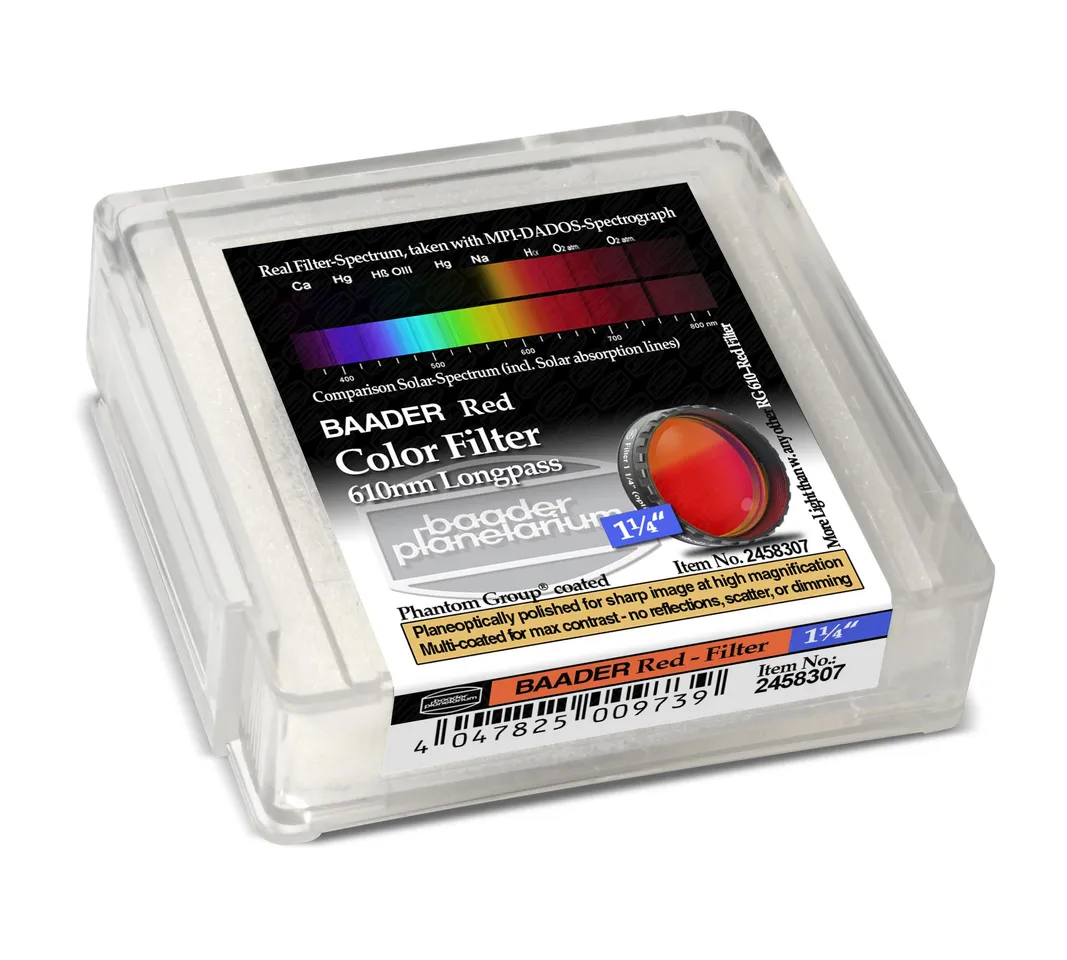
The filter is mounted in a blackened aluminium cell with a low-profile construction of approximately 6 mm. Standard M28.5 × 0.6 mm threads allow installation in compatible 1.25″ eyepieces, telescope diagonals, filter drawers and other astronomical accessories. Male and female threads allow compatible filters to be stacked for specialised observing or imaging applications. The filter is supplied with a protective storage case to help preserve the optical surfaces between observing sessions.
A precision upgrade for serious planetary observers
The Baader Red (610 nm) Colour 1.25″ Filter combines a carefully selected longpass response, excellent transmission and premium optical construction. It is particularly valuable for observers studying Mars, selected lunar features and atmospheric structures on Jupiter and Saturn, as well as imagers seeking a longer-wavelength channel under challenging seeing conditions. For astronomers who demand high-quality optics and reliable performance, it is a versatile addition to a lunar and planetary observing kit.


 Cookie policy
Reviews
There are no reviews yet.