Reveal the ultraviolet cloud patterns of Venus
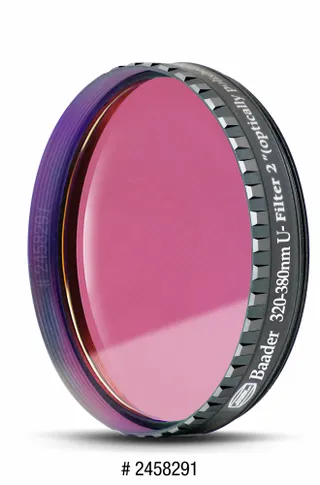
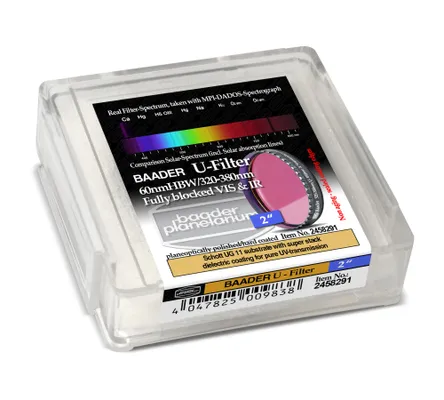
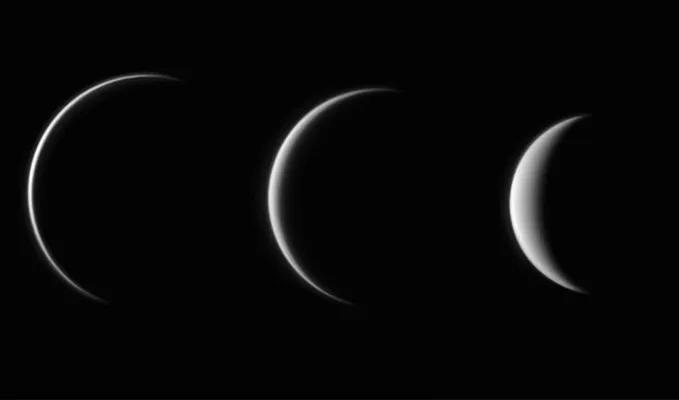
The Baader Planetarium U-Venus 2″ Filter is a specialised ultraviolet-pass filter designed for high-resolution planetary imaging of Venus. Although the planet often appears almost featureless in ordinary visible-light photographs, its upper atmosphere reveals complex cloud patterns when observed at suitable ultraviolet wavelengths. By isolating a carefully selected region of the ultraviolet spectrum, the U-Venus filter allows astrophotographers to record atmospheric structures and changing cloud formations that are otherwise difficult to capture. It is designed exclusively for photographic use with suitable UV-sensitive imaging equipment.
Precisely defined 350 nm ultraviolet transmission
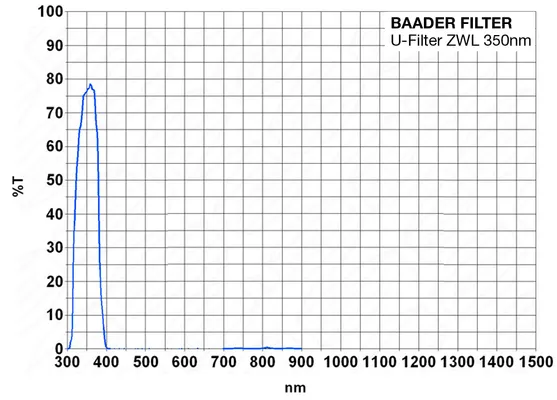
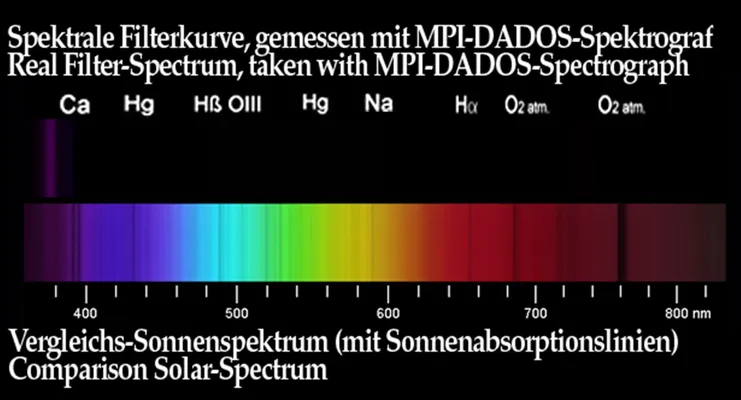
The filter has a central wavelength of 350 nm and a full width at half maximum (FWHM) bandwidth of approximately 60 nm, corresponding to a nominal transmission region of 320–380 nm. Its peak transmission reaches approximately 80% at 350 nm, allowing a useful proportion of the available ultraviolet light to reach the camera sensor. This spectral region is particularly valuable for recording contrasts in the upper cloud layers of Venus, where atmospheric absorption and scattering create patterns that are not readily visible in broadband light. Unlike general-purpose colour or luminance filters, the U-Venus is specifically optimised for ultraviolet imaging rather than conventional visible-light observation.
Strong visible-light and infrared suppression
Accurate ultraviolet imaging requires more than simply transmitting UV light. Visible and infrared wavelengths must also be strongly suppressed to prevent unwanted light from overwhelming the comparatively weak ultraviolet signal. The U-Venus filter uses a combination of ultraviolet-transmitting optical glass and specialised dielectric multilayer coatings to isolate the desired passband. Published specifications describe out-of-band blocking over the 200–1120 nm spectral region, apart from the intended ultraviolet transmission band. This helps ensure that recorded contrast comes predominantly from ultraviolet light rather than contamination from longer wavelengths.
Precision-polished Schott glass and dielectric coatings
The optical element is manufactured from Schott UG-11 ultraviolet-transmitting glass with finely polished optical surfaces. A specialised multilayer dielectric coating system provides the required spectral transmission and blocking characteristics while maintaining optical quality for high-resolution planetary imaging. The filter is designed to preserve sharpness even at high magnifications, making it suitable for capturing fine atmospheric structures during short-exposure planetary imaging sessions.
Equipment requirements for successful Venus imaging
Ultraviolet imaging is more demanding than conventional planetary photography. A camera with sufficient sensitivity around 350 nm is essential, and a monochrome planetary camera is generally preferable to a standard colour camera. The telescope and any additional optical components must also transmit ultraviolet light effectively. Many conventional lenses, correctors, protective windows and camera covers significantly reduce transmission at these wavelengths. A telescope aperture of at least approximately 5″ is recommended, with 8″ or larger generally preferable because of the limited ultraviolet signal. Atmospheric conditions, Venus’s altitude and the optical system’s UV transmission will strongly influence the achievable results.
Convenient 2″ low-profile mounting
The filter is supplied in Baader’s Low Profile Filter Cell (LPFC), with an approximately 6 mm cell height. Its 2 mm optical substrate is mounted in a standard 2″ threaded housing, compatible with suitable M48 × 0.75 filter holders, drawers and imaging accessories. The larger filter diameter offers additional flexibility when integrating the U-Venus into specialised camera systems or ultraviolet-sensitive imaging arrangements.
A dedicated tool for advanced planetary imaging
The Baader Planetarium U-Venus 2″ Filter is an excellent choice for experienced planetary astrophotographers who want to explore the atmospheric dynamics of Venus beyond the visible spectrum. Its carefully controlled ultraviolet passband, strong out-of-band rejection and precision optical construction make it a specialised instrument for recording cloud formations and monitoring changes in the Venusian atmosphere.
Important: This filter is not suitable for visual observation or direct solar viewing. It is intended for use with compatible ultraviolet-sensitive cameras and appropriately configured optical equipment.


 Cookie policy
Reviews
There are no reviews yet.