Improved contrast for deep-sky observation and astrophotography
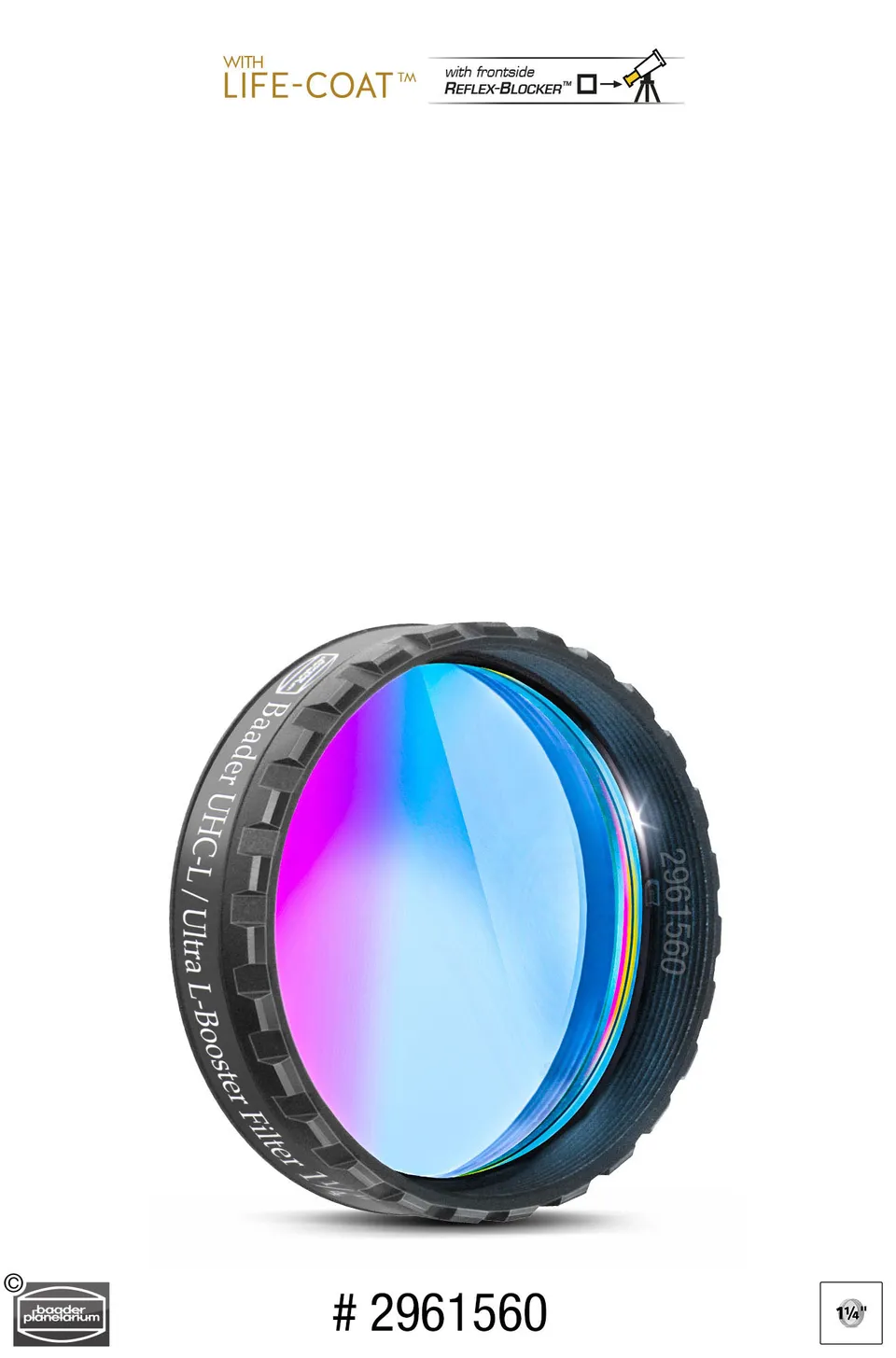
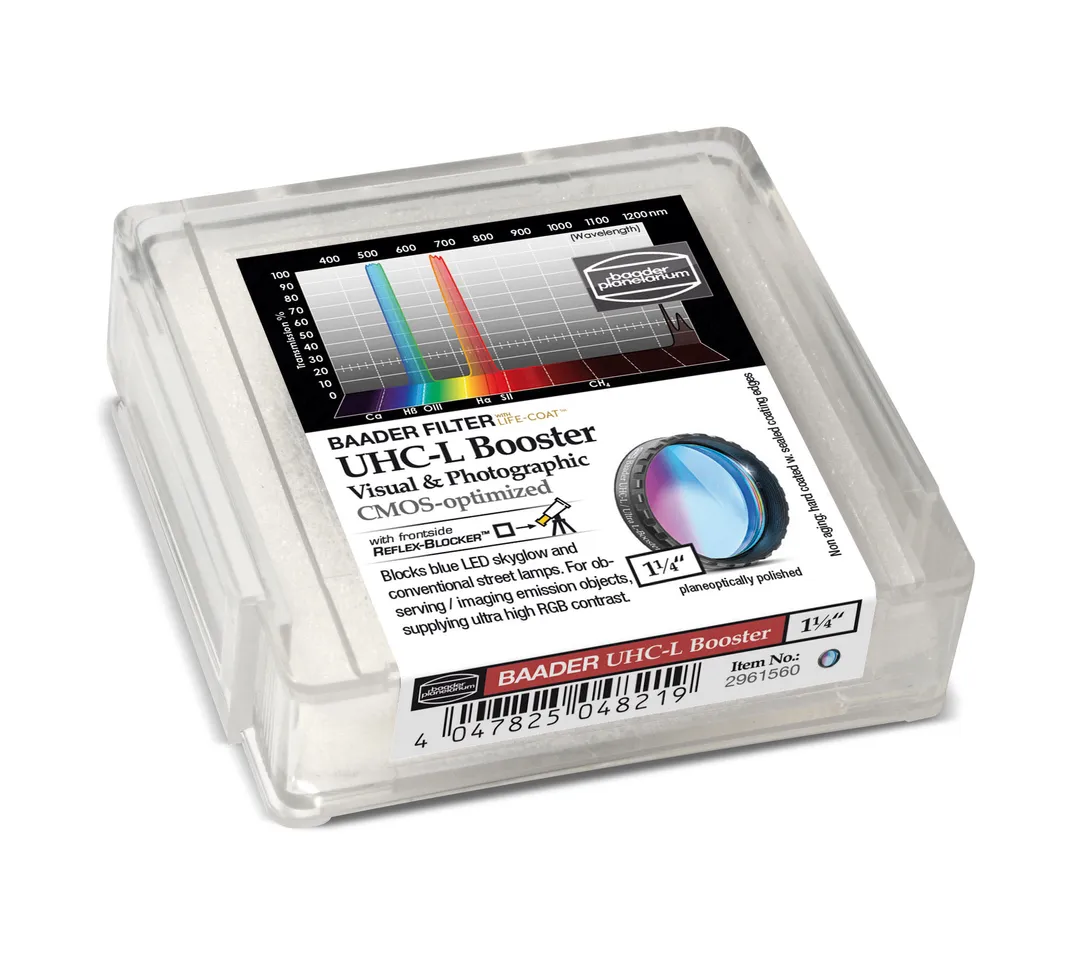
The Baader Planetarium UHC-L / Ultra L-Booster 1.25″ Filter is a high-performance multi-band contrast-enhancement filter designed for visual astronomy and deep-sky imaging. It selectively suppresses unwanted wavelengths associated with light pollution and skyglow while allowing important astronomical emission lines to pass through. The filter is particularly useful for observing and photographing emission nebulae and planetary nebulae, where improved separation between the object and background sky can reveal otherwise subtle structures.
Selective multi-band transmission
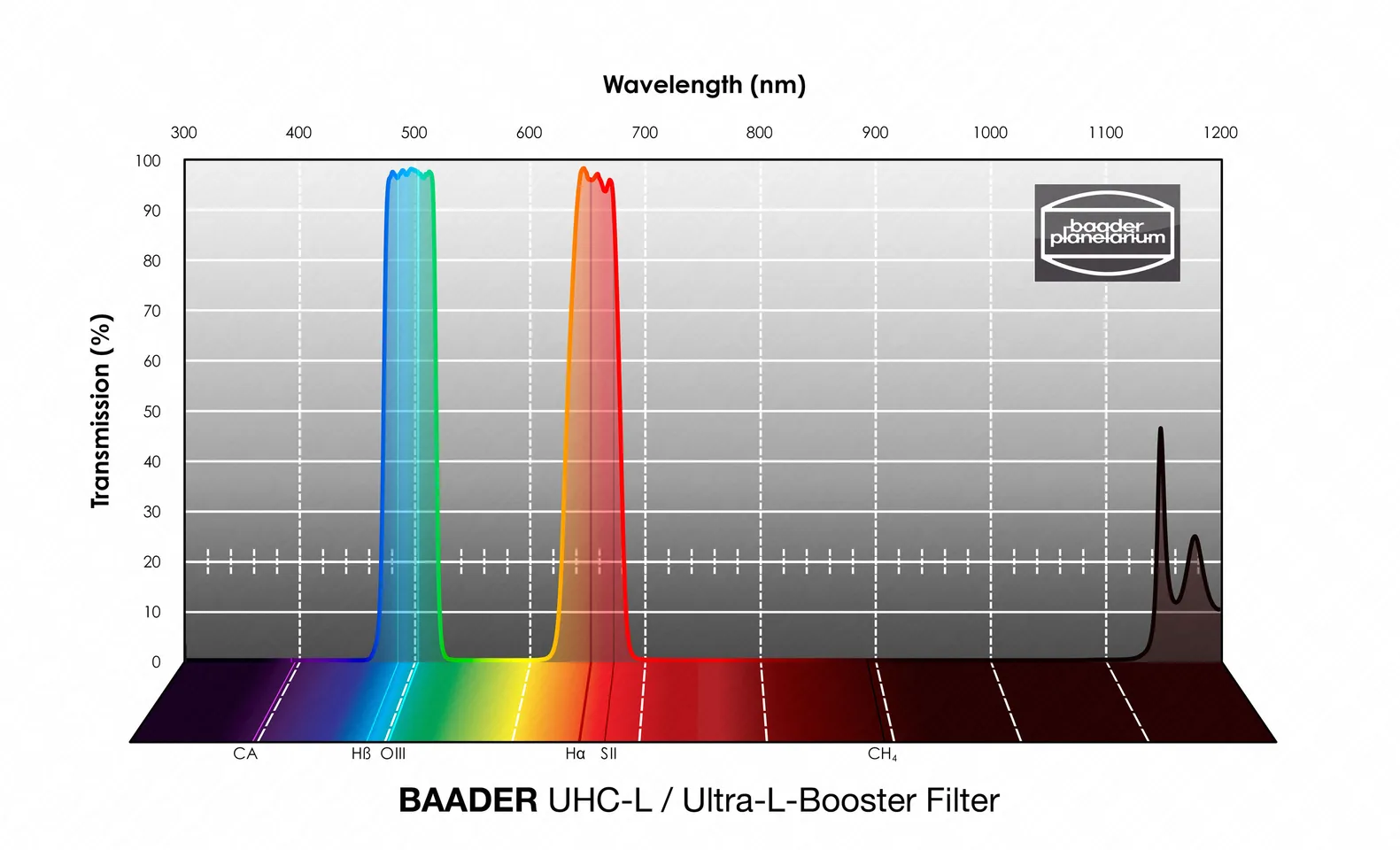
Unlike a conventional broadband luminance filter, the UHC-L uses carefully defined transmission regions to preserve valuable astronomical light while reducing selected unwanted wavelengths. Its blue-green transmission region includes Hydrogen-beta (H-beta) at 486.1 nm and the Oxygen-III (O-III) emission lines at approximately 495.9 and 500.7 nm. It also passes the C2 molecular emission bands near 511 and 514 nm, which can be useful when observing gas-rich comets. A separate red transmission region preserves the important Hydrogen-alpha (H-alpha) emission line at 656.3 nm, making the filter suitable for a broad range of emission-rich deep-sky targets. Compared with a dedicated narrowband filter, this multi-band design offers greater versatility for different objects and observing methods.
Reduced light pollution and improved image quality
Artificial lighting and natural skyglow can reduce the contrast of faint deep-sky objects. The UHC-L / Ultra L-Booster helps by attenuating selected portions of the visible spectrum while retaining key nebular emission wavelengths. This makes it particularly useful for observers and astrophotographers working under suburban or moderately light-polluted skies. The improvement depends on the target and local lighting conditions. Modern broadband LED lighting cannot be completely removed by a selective filter, and continuum targets such as galaxies and reflection nebulae may benefit less than emission nebulae.
Versatile performance for visual astronomy and imaging
For visual observers, the UHC-L can help reveal more structure in suitable emission and planetary nebulae by darkening the background sky relative to the object’s emission. For astrophotographers, it provides a convenient way to improve contrast when using compatible monochrome or colour CMOS and CCD cameras. The filter can also serve as a contrast-enhancing alternative to a conventional luminance filter in certain imaging situations, particularly when photographing emission-rich regions. However, its selective transmission changes the recorded spectrum, so it is not a universal replacement for a standard UV/IR-cut luminance filter.
Advanced Reflex-Blocker™ coatings
The UHC-L incorporates Baader’s Reflex-Blocker™ anti-reflection coating technology, designed to minimise unwanted reflections between the filter and nearby optical components. This is particularly valuable in astrophotography systems containing field flatteners, focal reducers and other accessories, where internal reflections can produce halos around bright stars. The filter also features optically polished surfaces, individually applied dielectric coatings with sealed edges, and blackened outer edges to reduce scattered light. These features help preserve image contrast and optical performance in demanding observing and imaging configurations.
Durable Life-Coat™ technology
Baader’s Life-Coat™ technology uses hardened optical coatings developed for long-term durability and resistance to environmental exposure. The coatings are designed to withstand moisture, temperature changes and normal cleaning when the filter is handled correctly. Baader provides a limited lifetime warranty on qualifying Life-Coat™ coatings for the original purchaser, subject to the manufacturer’s warranty conditions.
Compact 1.25″ low-profile mounting
The filter is supplied in Baader’s Low Profile Filter Cell (LPFC), with an approximately 6 mm cell height and a 2 mm optical substrate. Its standard 1.25″ mounted format makes it suitable for compatible telescope eyepieces, filter wheels, filter drawers and threaded imaging accessories. The compact design is particularly practical for visual observers using 1.25″ eyepieces and astrophotographers working with smaller camera sensors. For imaging, the required filter diameter depends on the sensor size, optical system and distance between the filter and sensor.
A versatile addition to your astronomy equipment
Whether you’re observing the Orion Nebula, photographing the Rosette Nebula or exploring a bright comet, the Baader UHC-L / Ultra L-Booster 1.25″ Filter offers a practical way to improve contrast under challenging sky conditions. Its combination of selective multi-band transmission, modern anti-reflection coatings and compact mounting makes it a valuable accessory for astronomers who enjoy both visual observation and deep-sky astrophotography.


 Cookie policy
Reviews
There are no reviews yet.