Exceptional contrast for advanced H-alpha astrophotography
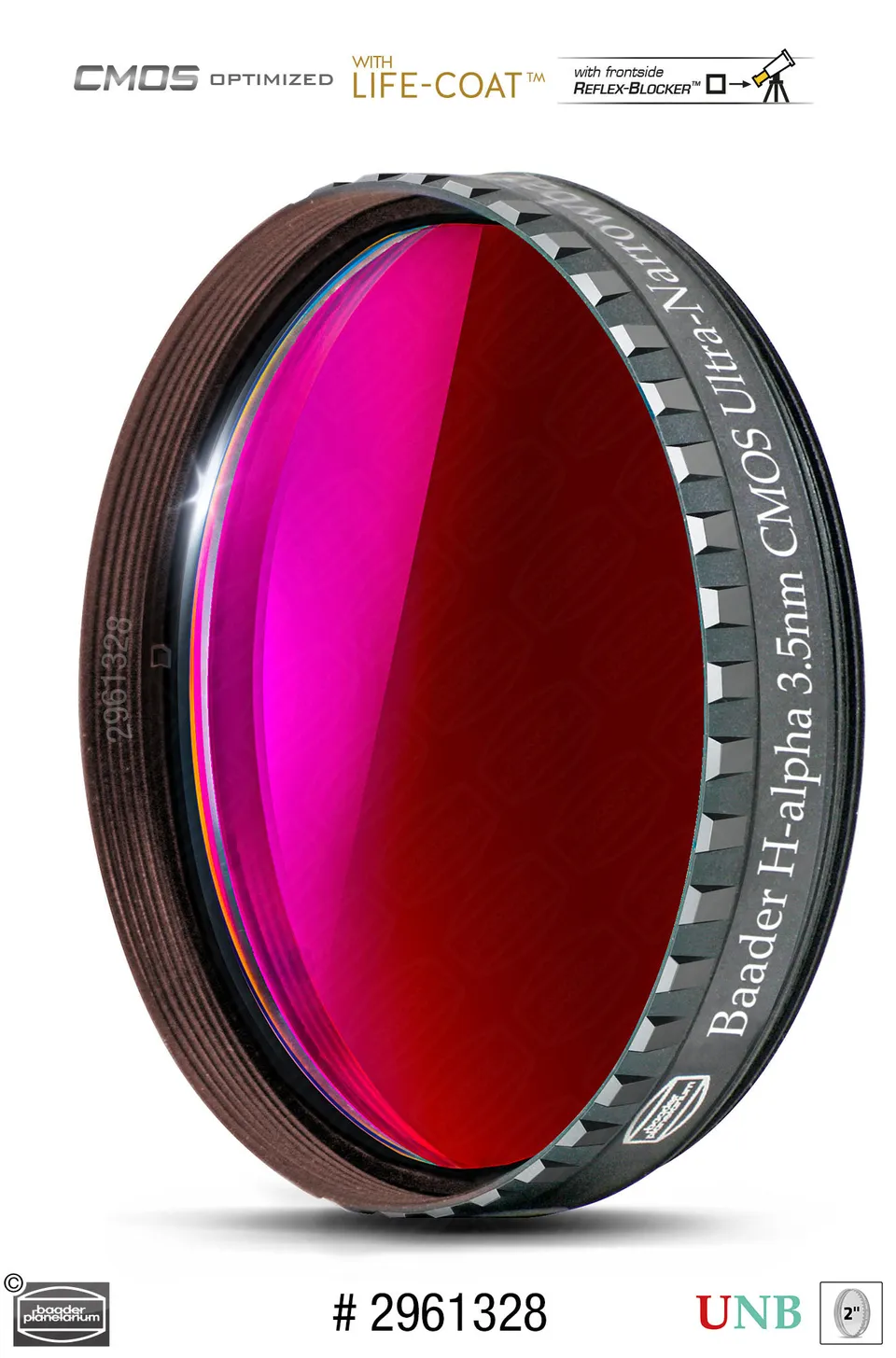
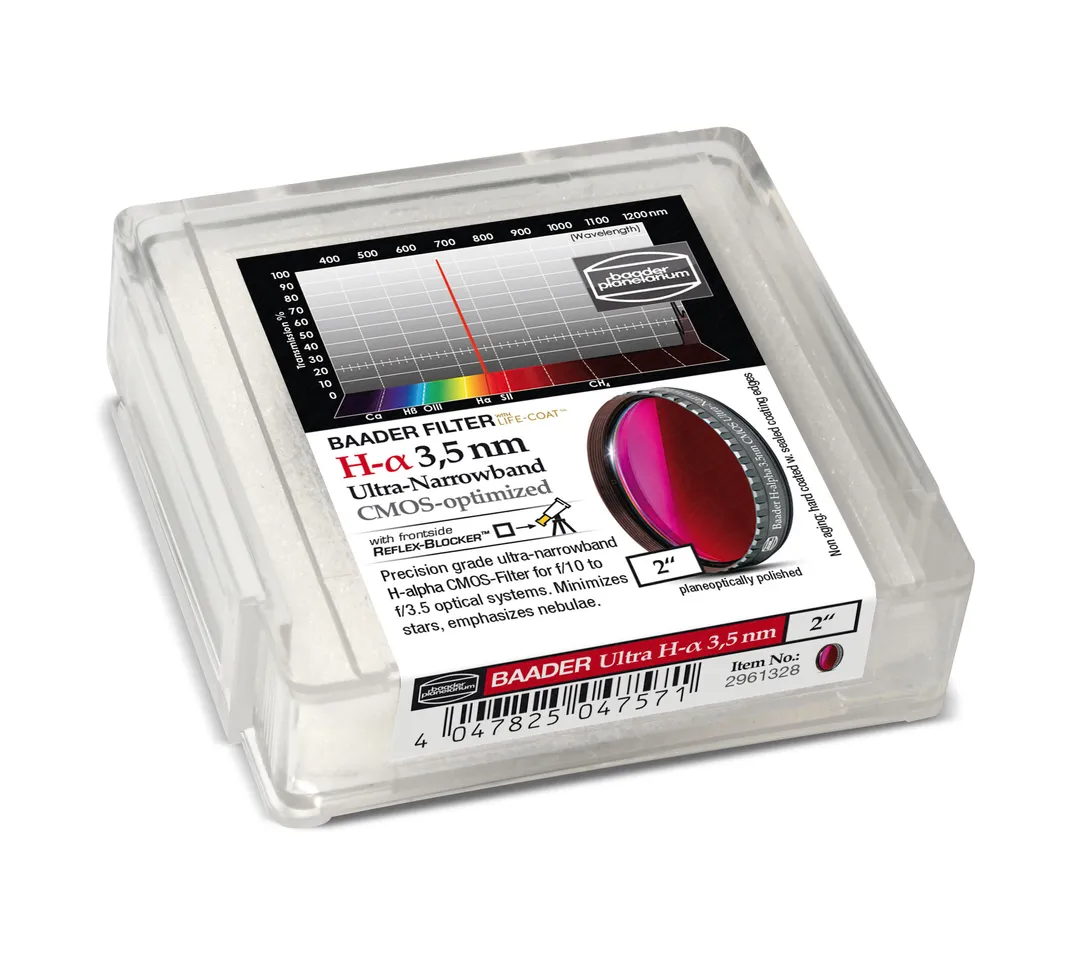
The Baader Planetarium Ultra Narrowband (3.5 nm) CMOS-Optimized H-alpha 2″ Filter is a premium emission-line filter designed for astrophotographers seeking exceptional contrast and fine structural detail in hydrogen-rich nebulae. Developed for modern monochrome CMOS cameras and equally suitable for CCD sensors, it isolates the distinctive red emission of ionised hydrogen while strongly reducing unwanted light from artificial illumination, natural skyglow and other parts of the spectrum. Its exceptionally narrow passband makes it particularly valuable for imaging faint emission structures against challenging sky backgrounds.
Precisely defined 3.5 nm Hydrogen-alpha transmission
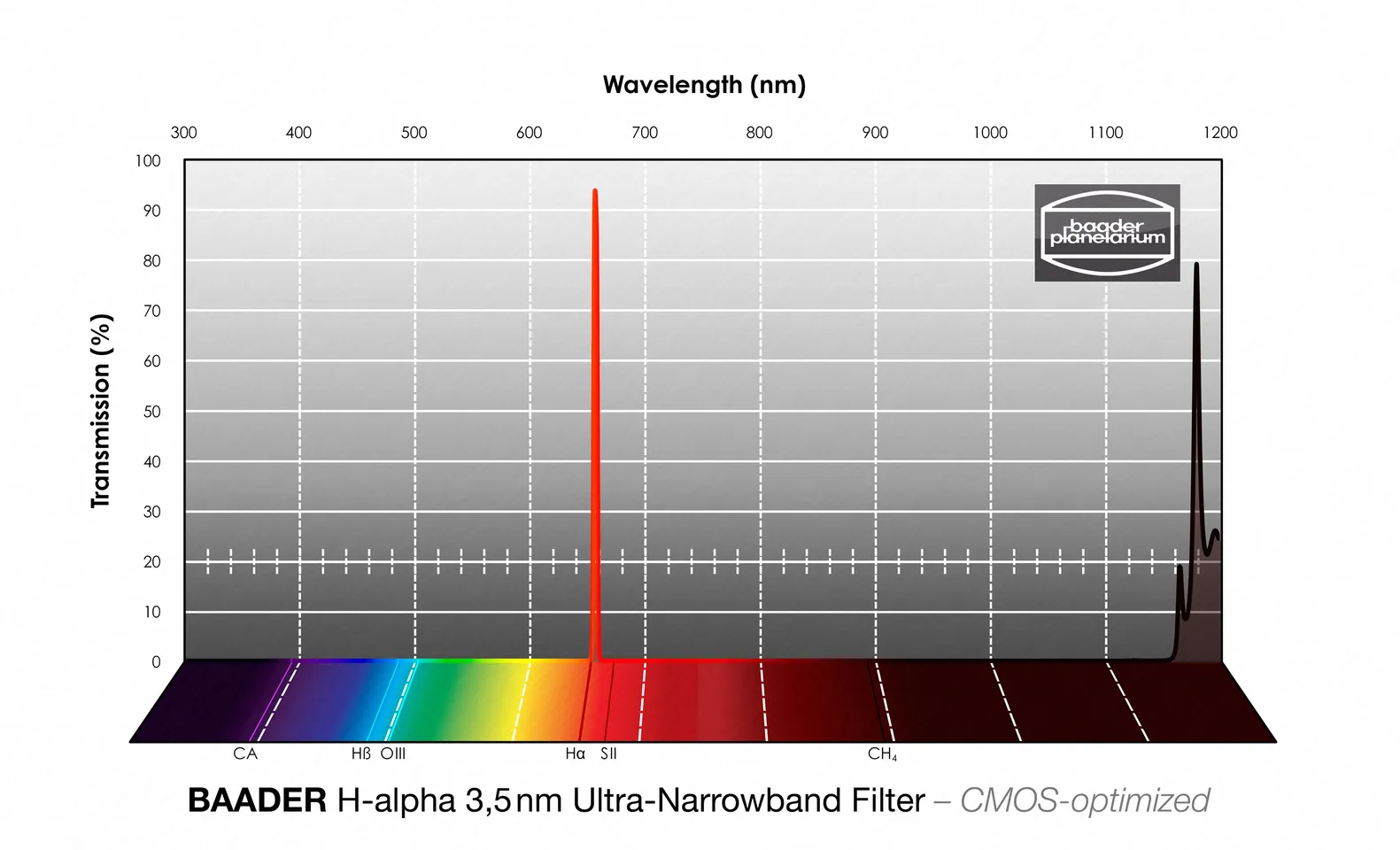
The filter is centred on the Hydrogen-alpha emission line at 656.3 nm and has a full width at half maximum (FWHM) bandwidth of just 3.5 nm. Assuming a symmetrical passband, its nominal half-maximum wavelength boundaries are approximately 654.55–658.05 nm. This extremely selective spectral window transmits the targeted hydrogen emission while excluding a greater proportion of neighbouring wavelengths than a conventional 6.5 nm H-alpha filter. The narrower bandwidth can improve contrast in faint nebular structures, particularly when background light is a significant limitation. It also requires careful matching to the telescope’s focal ratio, since the transmission profile of an interference filter changes when used in a fast converging light cone.
Reveal faint nebulae under challenging skies
Ultra-narrowband imaging is particularly effective for recording hydrogen emission in light-polluted environments. By reducing the amount of unwanted background light reaching the sensor, the Baader 3.5 nm H-alpha filter helps reveal faint filaments, outer shells and subtle variations in emission intensity. It is well suited to objects such as the North America Nebula, Rosette Nebula, Heart Nebula, California Nebula and hydrogen-rich supernova remnants. The filter can also provide advantages under some moonlit conditions, although strong moonlight, atmospheric transparency and local lighting still influence image quality. Compared with a wider H-alpha filter, the narrower passband may offer better background suppression, but it does not automatically guarantee a stronger signal or shorter exposure times.
Advanced Reflex-Blocker™ coatings
Bright stars and reflective components within an imaging train can create unwanted halos and internal reflections. Baader’s Reflex-Blocker™ hard coatings are designed to minimise these effects, helping produce cleaner star profiles and improved contrast. The filter incorporates planeoptically polished optical surfaces, sealed coating edges and blackened glass edges to reduce scattered light. A telescope-facing orientation indicator on the filter rim assists with correct installation. These construction details are particularly useful in high-contrast narrowband imaging, where unwanted reflections can become conspicuous against a dark background.
Durable Life-Coat™ technology
Baader’s Life-Coat™ technology uses hardened optical coatings designed for long-term stability and resistance to normal environmental exposure. The individually coated substrate and sealed coating edges help protect the filter against moisture-related deterioration. Baader offers a limited lifetime coating warranty to qualifying original purchasers, subject to the manufacturer’s warranty conditions.
Designed for conventional and moderately fast optical systems
This standard Ultra Narrowband filter is recommended for optical systems slower than f/3.4. At faster focal ratios, the converging light cone can shift the effective passband towards shorter wavelengths and reduce transmission at the desired H-alpha line. For very fast astrographs, a filter designed for the relevant focal-ratio range is preferable. Baader offers separate Highspeed and Ultra-Highspeed filter variants for these applications. The 2 mm optical substrate is mounted in Baader’s approximately 6 mm Low Profile Filter Cell (LPFC). Its standard 2″ threaded format is compatible with suitable M48 × 0.75 filter wheels, filter drawers and imaging accessories. The larger format is especially useful where the camera sensor size or filter-to-sensor distance makes additional clear aperture desirable.
Build a premium narrowband imaging system
The Baader 3.5 nm H-alpha filter can be used independently for detailed monochrome images or combined with matching Baader Ultra Narrowband Oxygen-III (4 nm) and Sulphur-II (4 nm) filters. These combinations support HOO and SHO imaging, including the popular Hubble Palette. The ultra-narrow H-alpha channel captures the fine hydrogen structures that often form the backbone of a detailed emission-nebula image. With its selective transmission profile, advanced reflection control and durable optical construction, this filter is an excellent choice for serious deep-sky astrophotographers seeking high-contrast hydrogen-emission images.


 Cookie policy
Reviews
There are no reviews yet.