Premium three-channel ultra-narrowband astrophotography
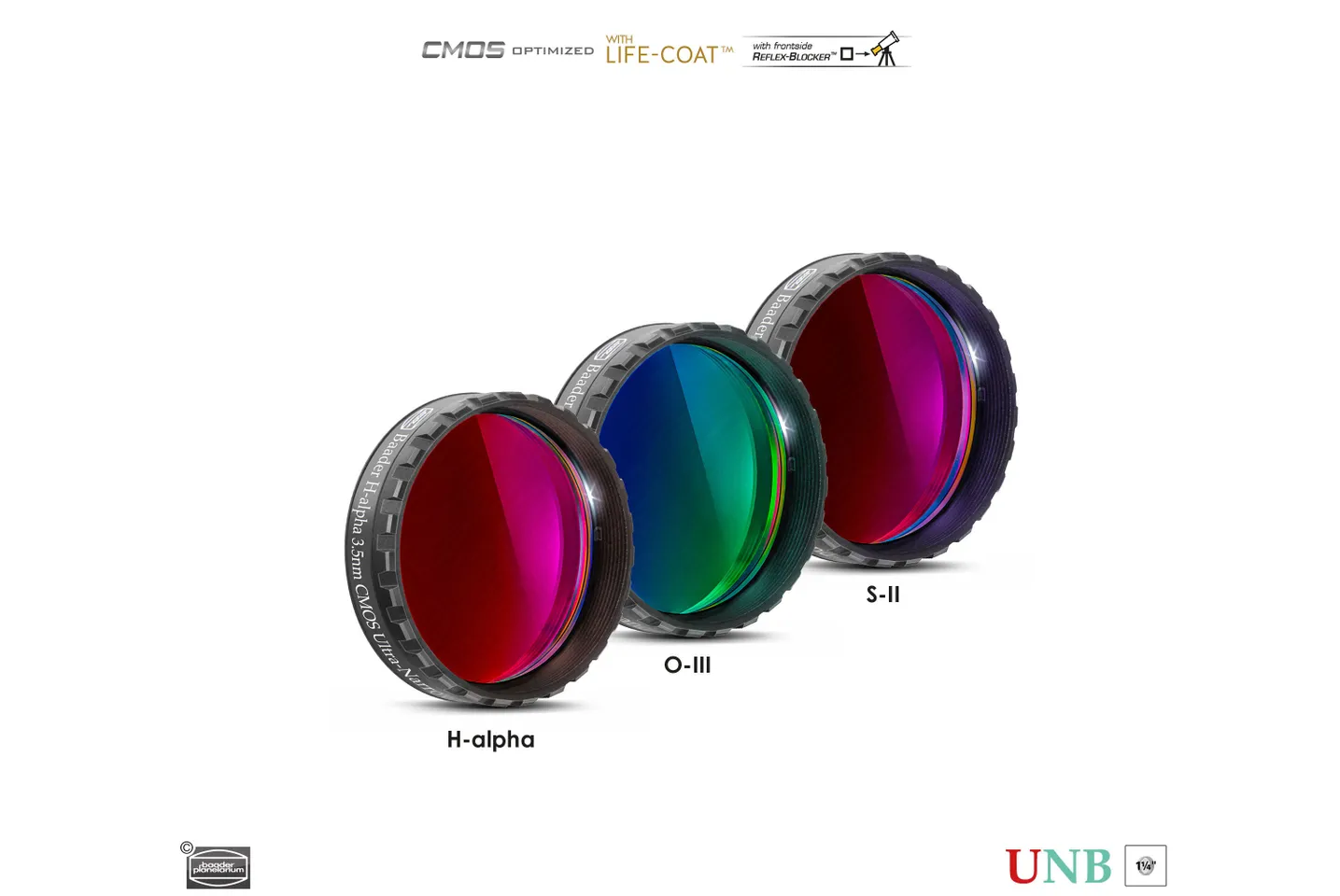
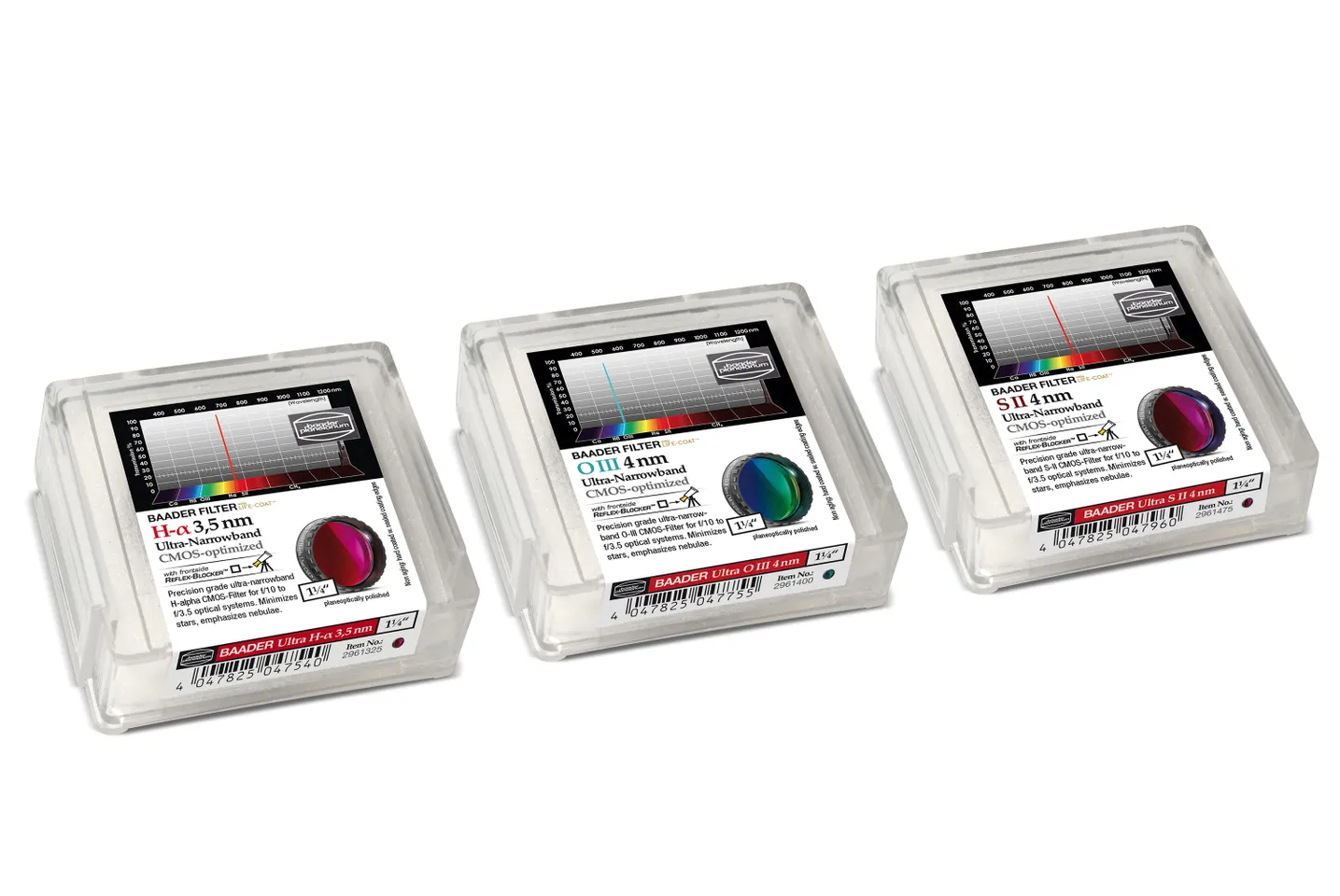
The Baader Planetarium Ultra Narrowband CMOS-Optimized (H-alpha, O-III, S-II) 1.25″ Filter Set is a premium collection of three precision interference filters designed to reveal exceptionally fine structures in emission nebulae. Developed for modern monochrome CMOS cameras and equally suitable for CCD sensors, the set allows astrophotographers to record hydrogen, oxygen and sulphur emission independently and combine the results into richly detailed narrowband images. By isolating very narrow regions of the visible spectrum, these filters help suppress unwanted skyglow and artificial illumination while preserving the distinctive emission signatures of deep-sky objects.
Three precisely selected emission-line passbands
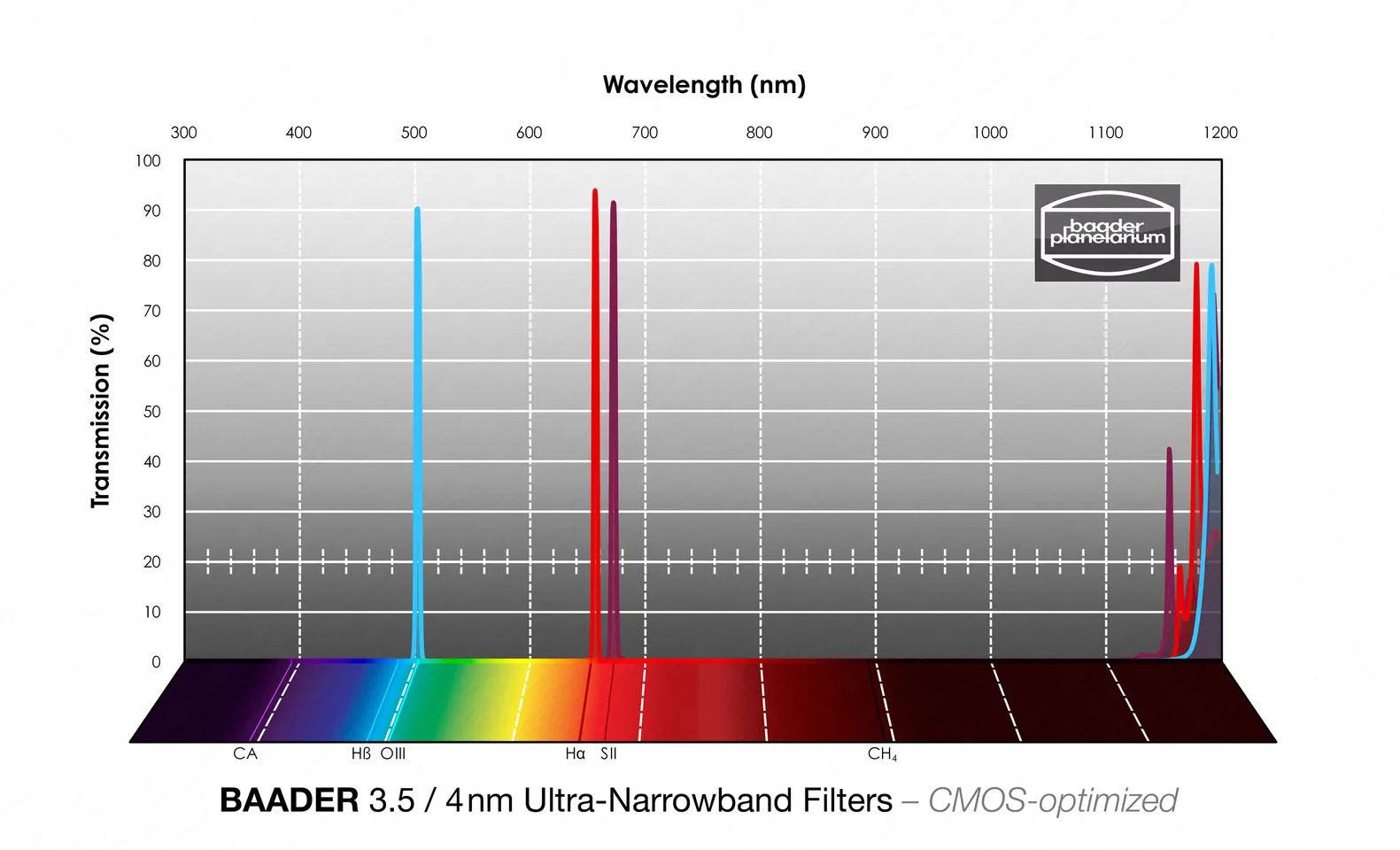
The set includes three individually mounted filters with carefully selected central wavelengths and bandwidths. The Hydrogen-alpha filter is centred at 656.3 nm with an exceptionally narrow 3.5 nm full width at half maximum (FWHM) bandwidth. It records the prominent red hydrogen emission that dominates many large emission nebulae. The Oxygen-III filter is centred at 500.7 nm with a 4 nm FWHM bandwidth. It targets the stronger blue-green emission line of doubly ionised oxygen, revealing intricate structures in planetary nebulae and supernova remnants. The Sulphur-II filter is centred at 671.7 nm with a 4 nm FWHM bandwidth. Its passband covers the principal S-II emission lines at approximately 671.6 nm and 673.1 nm, providing valuable detail in sulphur-emitting regions. The combination of 3.5 nm and 4 nm passbands is designed to provide exceptionally selective emission-line imaging while maintaining practical integration times across the three channels.
Create spectacular Hubble Palette images
This complete filter set provides the three channels required for SHO imaging, commonly known as the Hubble Palette. In a typical SHO composition, Sulphur-II is assigned to red, Hydrogen-alpha to green and Oxygen-III to blue. Combining these channels reveals different emission structures and creates striking false-colour images of nebulae. The H-alpha and O-III filters can also be used together for HOO compositions, while each filter is suitable for detailed monochrome imaging. Popular targets include the Rosette Nebula, Eagle Nebula, Heart Nebula, Veil Nebula and other hydrogen-, oxygen- and sulphur-emitting regions.
Exceptional contrast under light-polluted skies
The ultra-narrow passbands reject more neighbouring background light than conventional 6.5 nm narrowband filters. This can significantly improve the separation between faint nebular emission and unwanted illumination from artificial lighting and natural skyglow. The filters are particularly valuable for astrophotographers working under challenging suburban or urban skies. They can also be useful during some moonlit sessions, although strong moonlight, atmospheric transparency and local lighting conditions still influence the results. Sulphur-II emission is frequently weaker than Hydrogen-alpha emission, so additional exposure time may be necessary for a balanced three-channel image.
Advanced Reflex-Blocker™ coatings
Baader’s Reflex-Blocker™ hard coatings are designed to reduce unwanted halos and internal reflections caused by bright stars and reflective optical components. Each filter features planeoptically polished optical surfaces, individually applied coatings with sealed edges and blackened glass edges to minimise scattered light. A black telescope-facing outer rim provides a useful orientation indicator during installation. These features help maintain clean star profiles and high contrast during demanding long-exposure astrophotography.
Durable Life-Coat™ technology and consistent optical thickness
All three filters incorporate Baader’s Life-Coat™ technology, using hardened optical coatings developed for long-term durability. Each filter has a 2 mm optical substrate, supporting consistent optical spacing and helping minimise focus shifts when changing between channels. Although the matching optical thickness is beneficial, final focus should still be checked during imaging, particularly when temperatures change. Baader provides a limited lifetime coating warranty for qualifying filters, subject to the manufacturer’s warranty conditions.
Compact 1.25″ mounting and focal-ratio compatibility
Each filter is mounted in Baader’s approximately 6 mm Low Profile Filter Cell (LPFC), using the standard M28.5 × 0.6 astronomical filter thread. The compact format is particularly practical for smaller-sensor cameras, compatible filter wheels and filter drawers. Users should check the available clear aperture and filter-to-sensor distance to minimise the risk of vignetting. The standard Ultra Narrowband set is recommended for optical systems slower than f/3.4. In faster systems, the wider range of light-incidence angles can shift the effective passband towards shorter wavelengths, potentially reducing transmission at the desired emission line. For extremely fast astrographs, Baader offers a separate f/2 Ultra-Highspeed filter set specifically designed for those optical configurations.
A complete solution for serious narrowband imaging
The Baader 1.25″ Ultra Narrowband CMOS-Optimized Filter Set combines three highly selective emission channels, advanced reflection control and durable optical construction in one coordinated package. Whether creating detailed monochrome studies, HOO images or richly coloured SHO compositions, this premium set provides the precision and flexibility required for demanding deep-sky astrophotography.


 Cookie policy
Reviews
There are no reviews yet.