The Houdini 7 mm Coma-Correcting Eyepiece combines high magnification, an expansive 86° apparent field of view and integrated optical correction for the coma produced by parabolic Newtonian mirrors. Developed by Belgian astronomy company Houdini, this eyepiece offers an innovative alternative to using a conventional ultra-wide eyepiece together with a separate coma corrector.
Built-In Coma Correction for Newtonian Telescopes
Coma is an optical aberration that can make stars towards the edges of the field appear elongated or comet-shaped in Newtonian reflectors. It becomes particularly noticeable in telescopes with fast focal ratios. The Houdini 7 mm incorporates coma correction directly into its optical design, helping produce more point-like star images across the field without requiring an additional corrector. Houdini specifies correction for Newtonian telescopes as fast as f/3. The eyepiece can be inserted and focused normally, without the spacing adjustments associated with some separate coma-correcting systems. This is particularly valuable for observers who want a simpler optical setup while enjoying a wide apparent field.
7 mm Focal Length for Detailed Observation
The 7 mm focal length provides high magnification for observing lunar landscapes, planetary features, close double stars and compact deep-sky objects. In the Celestron StarSense Explorer 8-inch Dobsonian telescope, it delivers approximately 171× magnification and a 1.18 mm exit pupil. This makes it a useful choice for examining fine detail, provided atmospheric seeing and telescope conditions support the selected magnification.
Immersive 86° Apparent Field of View
The expansive 86° apparent field creates an engaging, immersive observing experience, with plenty of surrounding space around celestial targets. It is especially useful with manually tracked Dobsonian telescopes, allowing objects to drift across a larger field before the telescope needs repositioning. With a 1,200 mm focal-length telescope, the Houdini 7 mm covers approximately 0.50° of the sky.
Advanced Nine-Element Optical Design
The eyepiece uses nine lens elements arranged in six groups, incorporating high-transmission optical glass and fully multi-coated surfaces. Blackened lens edges help reduce unwanted reflections and stray light, supporting image contrast. The optical design also aims to minimise field curvature and angular magnification distortion, helping maintain a natural and well-corrected view across its expansive apparent field.
Comfortable Eye Relief and Fold-Down Eyecup
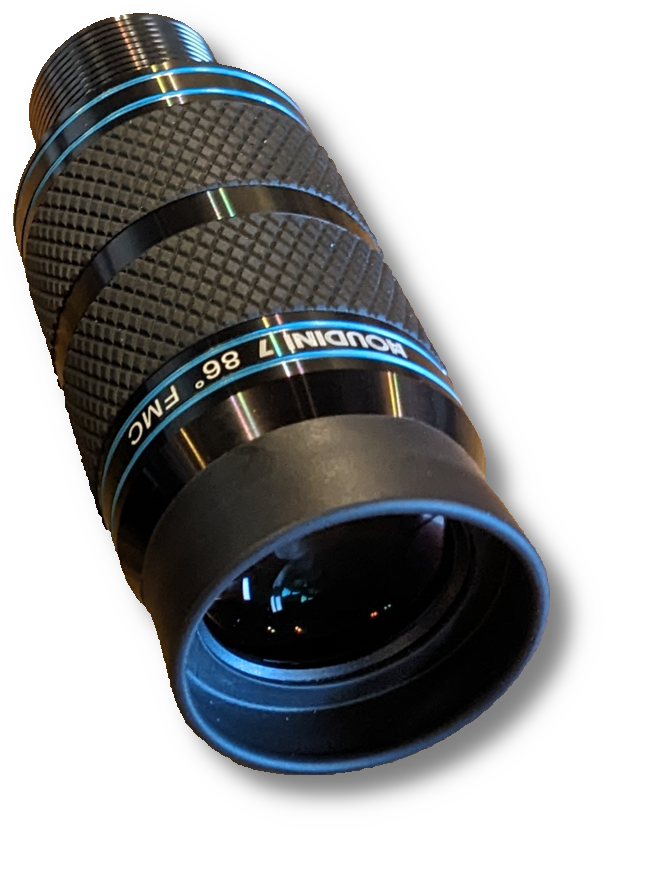
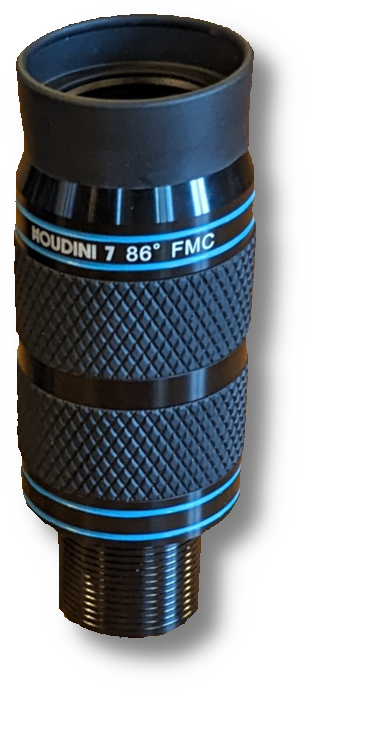
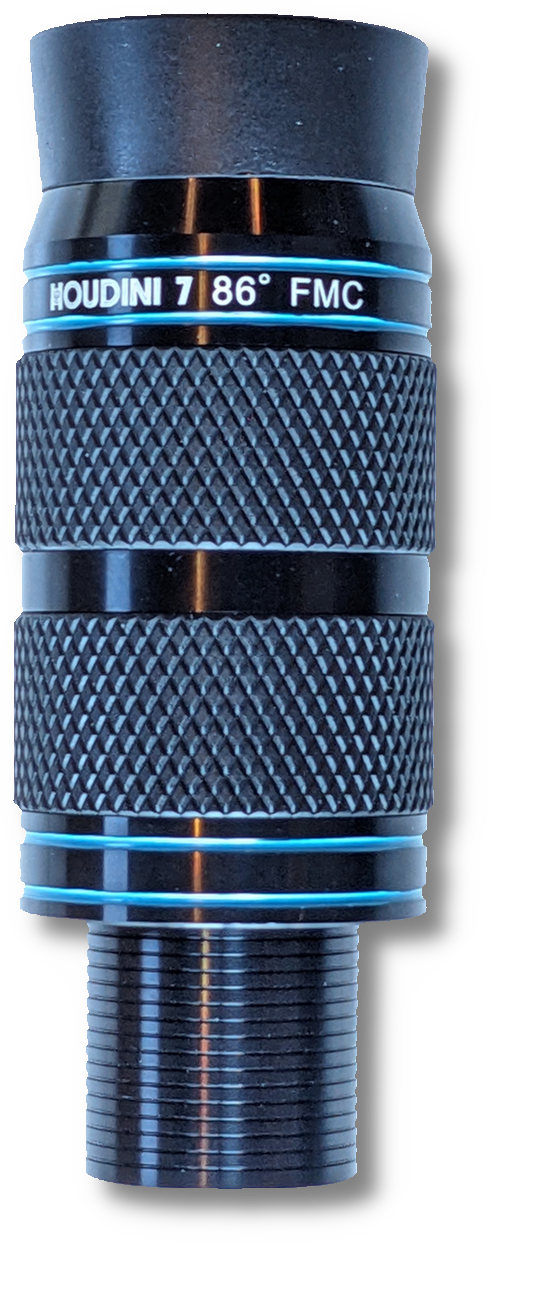
Houdini specifies 19 mm theoretical eye relief and 15 mm effective eye relief, distinguishing between the optical viewing distance and the practically accessible distance. A fold-down rubber eyecup allows observers to adjust their viewing position and helps reduce interference from surrounding light. Rubberised grip sections provide comfortable, secure handling when changing eyepieces.
Practical 1.25-Inch Compatibility
The Houdini 7 mm fits standard 1.25-inch telescope focusers and diagonals. Its barrel features safety kerfs rather than a conventional deep undercut, helping the eyepiece clamp securely without catching on compression rings. Standard 1.25-inch filter threads allow the use of compatible lunar, planetary and other astronomical filters. The protective eyepiece cap also features a photoluminescent focal-length marking, making the eyepiece easier to identify in darkness after exposure to light.
Compatibility Beyond Newtonian Reflectors
Although optimised for Newtonian telescopes with parabolic mirrors, the Houdini 7 mm can also be used with many slower optical systems, including refractors and Schmidt-Cassegrain telescopes operating at approximately f/6 or slower. It is not recommended for fast telescopes without parabolic primary mirrors, such as some f/5 apochromatic refractors, where its coma-correcting design may introduce unwanted aberrations.
A Distinctive Premium Eyepiece for Newtonian Observers
The Houdini 7 mm combines an immersive 86° apparent field with integrated coma correction, comfortable handling and high-power viewing capability. For owners of fast Newtonian and Dobsonian telescopes, it offers a particularly appealing way to enjoy detailed celestial views without adding a separate coma corrector to the optical train.


 Cookie policy
Reviews
There are no reviews yet.