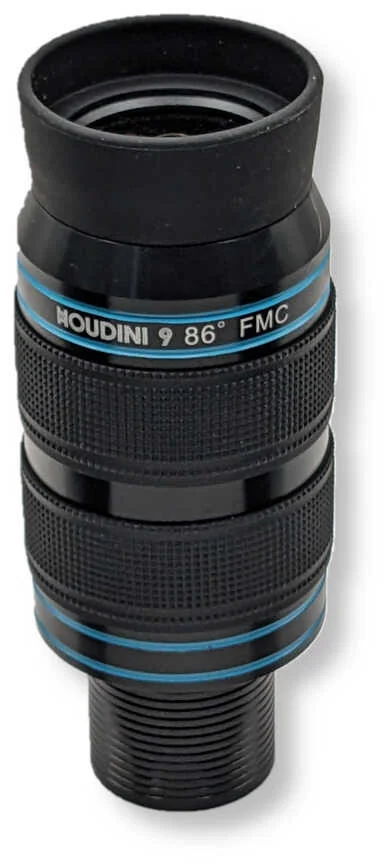
The Houdini 9 mm Coma-Correcting Eyepiece brings together an expansive 86° apparent field of view, medium-high magnification and built-in correction for the coma produced by parabolic Newtonian mirrors. Developed by Belgian astronomy company Houdini, it offers a practical alternative to combining a conventional ultra-wide eyepiece with a separate coma corrector. Its 9 mm focal length sits between the 12 mm and 7 mm models, providing a useful intermediate magnification for a wide variety of celestial targets.
Integrated Coma Correction for Newtonian Reflectors
In Newtonian telescopes, particularly those with fast focal ratios, coma can cause stars away from the centre of the field to appear elongated or comet-shaped. The Houdini 9 mm incorporates coma correction within the eyepiece itself. This helps maintain more compact star images towards the field edge without adding a separate optical accessory to the focuser. Unlike systems requiring precise spacing adjustments, the Houdini can be inserted and focused in the usual way. This simplifies eyepiece changes and reduces the equipment needed for wide-field observing with a fast Newtonian reflector.
A Versatile 9 mm Focal Length
The 9 mm focal length provides a useful balance between image scale and observing flexibility. It is well suited to exploring lunar craters and mountain ranges, observing planetary features when atmospheric conditions permit, and resolving detail within globular clusters. Smaller planetary nebulae, bright galaxies and close double stars are also rewarding targets. In a telescope with a 1,200 mm focal length, such as the Celestron StarSense Explorer 8-inch Dobsonian, the Houdini 9 mm delivers approximately 133× magnification and a 1.52 mm exit pupil. This makes it a practical intermediate step between the wider, lower-power views of the Houdini 12 mm and the higher magnification of the 7 mm.
Immersive 86° Apparent Field of View
The ultra-wide 86° apparent field surrounds the target with a generous area of sky, creating an immersive observing experience. This is particularly beneficial when using a manually tracked Dobsonian telescope. Objects remain in view for longer before the telescope needs repositioning, allowing more time to concentrate on fine detail. With a 1,200 mm focal-length telescope, the 13.5 mm field stop provides a true field of view of approximately 0.64°.
Advanced Optical Construction
The Houdini 9 mm uses nine lens elements arranged in six groups, with fully multi-coated optical surfaces, high-index glass and blackened lens edges. These features help manage internal reflections and stray light, supporting contrast when observing faint objects or subtle planetary detail. The optical design also controls field curvature and angular magnification distortion, contributing to a well-corrected and natural-looking view across the expansive field.
Practical Eye Relief and Comfortable Handling
Houdini specifies 19 mm theoretical eye relief and 15 mm effective eye relief. The effective figure is the more useful indication of the viewing distance available to observers. A fold-down rubber eyecup helps with eye positioning and can reduce interference from surrounding light. Rubberised grip sections make the eyepiece easier to handle during observing sessions. The protective cap carries a photoluminescent focal-length marking, making identification easier in the dark after exposure to light.
Standard 1.25-Inch Compatibility
The Houdini 9 mm fits standard 1.25-inch telescope focusers and diagonals. Its filter-threaded barrel accepts compatible astronomical filters. Safety kerfs provide secure clamping without the snagging sometimes associated with conventional deep barrel undercuts. The Houdini eyepiece range is also designed to be essentially parfocal, so changing between focal lengths generally requires only minor refocusing.
Telescope Compatibility
The Houdini 9 mm is designed primarily for Newtonian reflectors with parabolic primary mirrors, including fast systems where coma is particularly noticeable. It can also perform well in slower telescopes, including many refractors and Schmidt-Cassegrain telescopes operating at f/6 or slower. However, Houdini does not recommend its coma-correcting eyepieces for fast optical systems without parabolic mirrors, such as some f/4 or f/5 apochromatic refractors, where inverse coma may become visible.
A Balanced Choice for Detailed Observation
Combining 133× magnification in a 1,200 mm telescope with an immersive 86° apparent field, the Houdini 9 mm is a versatile choice for observers who want more image scale without moving to the highest powers. Its integrated coma correction is especially valuable for Newtonian owners seeking wide, well-corrected views with a straightforward observing setup.


 Cookie policy
Reviews
There are no reviews yet.