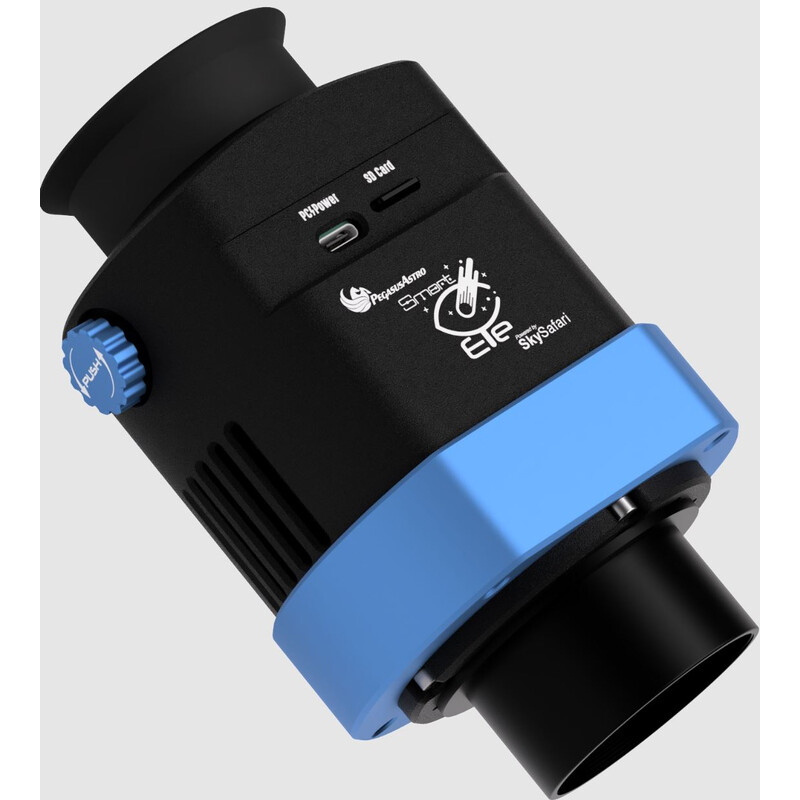
The Pegasus Astro SmartEye Eyepiece brings together the immediacy of looking through a telescope and the extraordinary sensitivity of modern digital astronomical imaging. Rather than relying exclusively on the light that reaches the observer’s eye, SmartEye uses a sensitive cooled astronomical camera to capture celestial objects, intelligent software to enhance the incoming signal and a high-resolution electronic display to present the evolving image through a familiar eyepiece-style interface. The result is a fascinating new approach to astronomy, allowing observers to experience galaxies, nebulae and star clusters with levels of colour and detail that can be difficult to perceive through conventional visual observation. Developed by Pegasus Astro with SkySafari integration, SmartEye is designed to make electronically assisted astronomy more immediate, immersive and accessible.
The Familiar Experience of an Eyepiece, Reinvented
Traditional visual astronomy has a special appeal: the observer looks into the telescope and experiences the night sky directly. However, the human eye has limited sensitivity to faint colour and low-contrast detail, especially when observing dim deep-sky objects. SmartEye approaches this challenge in an entirely different way. A high-sensitivity CMOS sensor captures the image formed by the telescope. The device then processes and combines successive exposures, gradually improving the visibility of faint structures. The resulting image is presented through a miniature, high-resolution display viewed directly through the SmartEye. The experience retains the physical interaction of looking into an eyepiece, but the image itself is electronically captured and enhanced. This distinction is fundamental to understanding what makes SmartEye special. It is not a conventional optical eyepiece and does not reproduce the instantaneous, unprocessed view of the human eye. Instead, it opens the door to a form of observing in which faint celestial detail becomes progressively more visible as light is accumulated.
Sony IMX533 – A Proven Astronomical Imaging Sensor
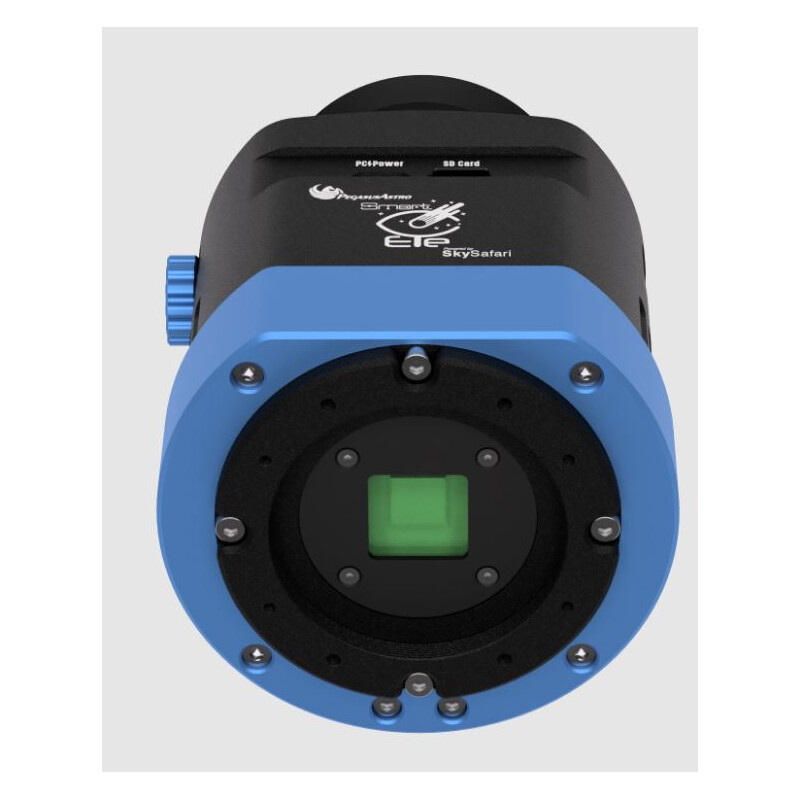
At the heart of SmartEye is the Sony IMX533 colour CMOS sensor, a highly regarded imaging platform used in modern astronomical cameras. The sensor features a square, 1-inch-format imaging area with approximately 9 megapixels of resolution. Its 3008 × 3008 pixel array and 3.76 µm pixels provide a strong foundation for capturing fine celestial detail. The sensor records the light gathered by the telescope, allowing SmartEye to build a digital representation of the observed object. Unlike the human eye, which cannot accumulate faint light indefinitely, the imaging sensor can record exposures that are subsequently combined to improve the visibility of weak signals. This makes SmartEye particularly appealing for deep-sky targets such as emission nebulae, planetary nebulae, galaxies and star clusters. The level of detail ultimately depends on the telescope’s aperture, focal length, optical quality, tracking accuracy, sky conditions and the total amount of accumulated exposure.
Real-Time Live Stacking – Watch the Image Develop
One of SmartEye’s most compelling features is its real-time live-stacking capability. Instead of displaying only a single exposure, the device can combine successive images of the same celestial target. As additional exposures are accumulated, random image noise is reduced and faint structures become easier to distinguish. A galaxy that initially appears as a subtle glow may gradually reveal a brighter central region and more extensive surrounding structure. A nebula may begin to show colour and delicate variations in brightness that are not readily visible through a conventional eyepiece. The image develops over time, creating an engaging observing experience in which the celestial object appears to reveal more of itself. This process is not instantaneous, and the improvement depends on the exposure settings, telescope tracking, sky brightness and observing conditions. For the best results, the target should remain sufficiently stable within the camera’s field during image acquisition.
A Remarkable 90° Immersive Digital Display
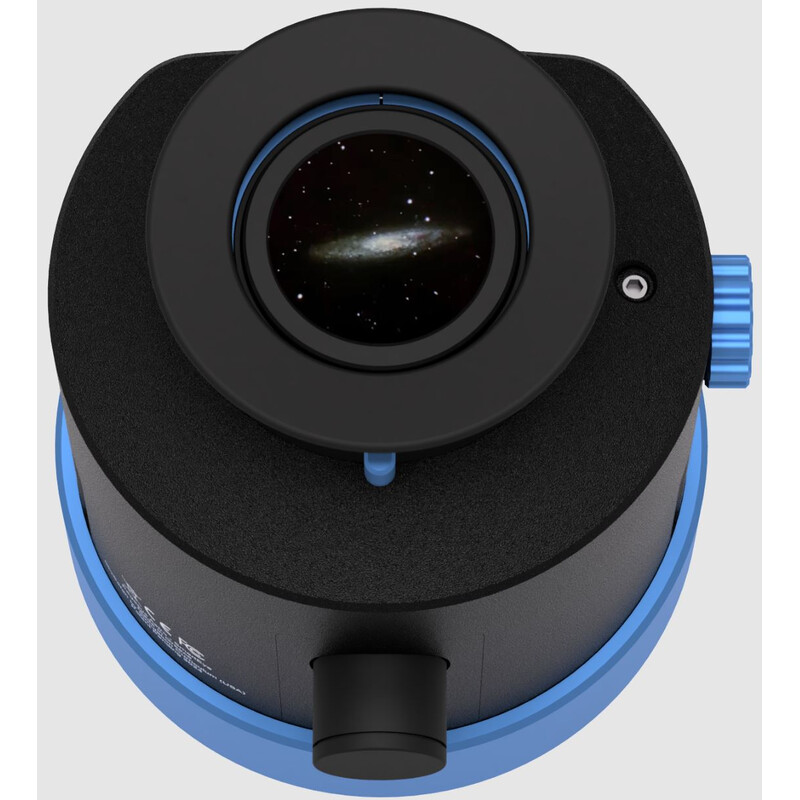
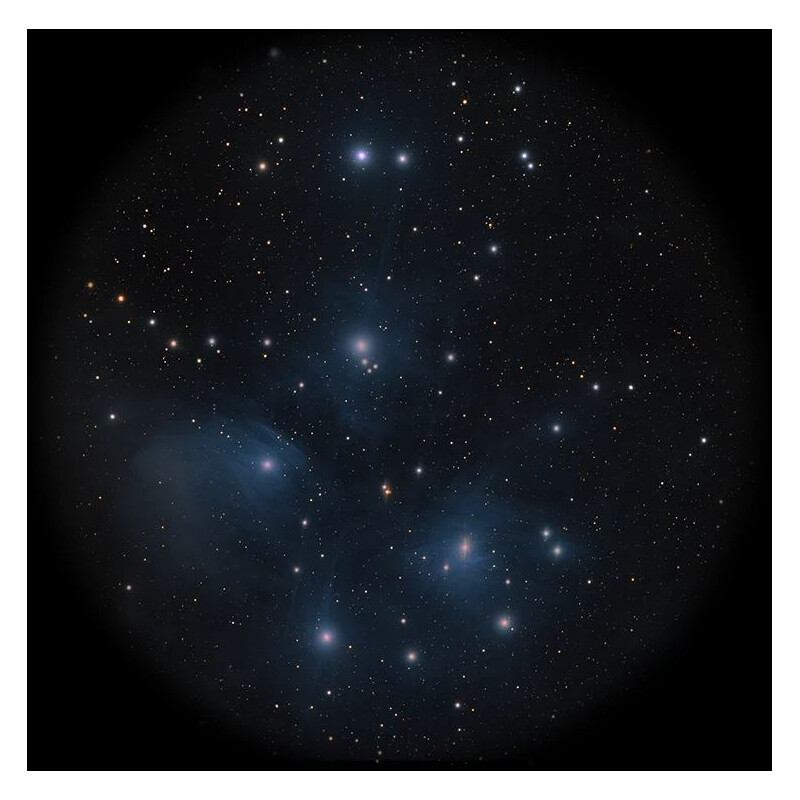
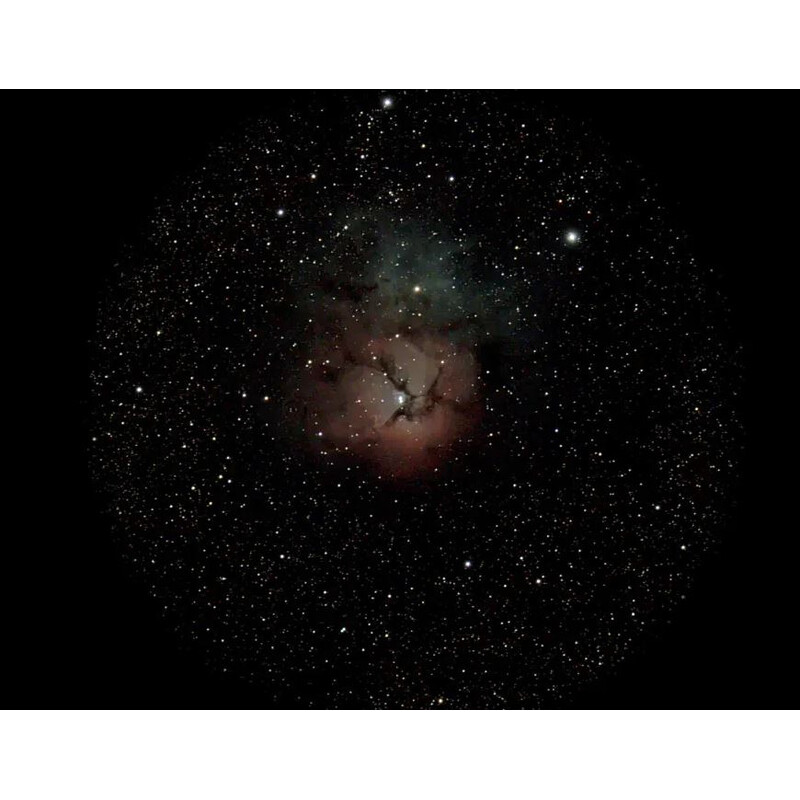
SmartEye presents its processed images through an advanced OLEDoS display – OLED on Silicon – with a resolution of 2560 × 2560 pixels. The viewing system creates a circular, eyepiece-style presentation with an approximately 90° apparent field of view. This provides an immersive experience while allowing the observer to examine the electronically enhanced image directly at the telescope. The display’s exceptionally high pixel density helps maintain a detailed visual presentation. Unlike a conventional optical eyepiece, however, the 90° field refers to the viewing angle of the electronic display. The actual area of sky captured by SmartEye is determined by the physical dimensions of its camera sensor and the focal length of the telescope. This is an important distinction when selecting targets and calculating framing. The internal display offers a striking way to experience the image, while the telescope and sensor determine the underlying celestial field.
Active Thermoelectric Cooling for Cleaner Images
SmartEye incorporates an active thermoelectric cooling system with an integrated fan. Cooling the imaging sensor helps reduce thermal noise, particularly during extended observing sessions and longer exposures. According to the manufacturer’s technical documentation, the system can achieve sensor temperatures up to approximately 30°C below ambient temperature, depending on operating conditions. The cooling system is user-controllable, allowing observers to adapt power consumption and thermal performance to the requirements of a particular session. An integrated anti-dew system also helps manage moisture around the optical assembly. These features make SmartEye more than a simple digital viewer. They reflect the engineering approach of a dedicated astronomical imaging instrument, adapted for immersive eyepiece-style observation.
Discover Faint Nebulae, Galaxies and Star Clusters
SmartEye is particularly well suited to deep-sky astronomy. Emission nebulae are fascinating targets because their colours and faint structures can become more apparent as exposures accumulate. Galaxies may reveal central brightness concentrations, extended halos and, under favourable conditions, additional structure. Globular clusters and rich open clusters can also provide impressive results, with numerous stars appearing across the high-resolution display. The device can be especially appealing for observers working from suburban or moderately light-polluted locations, where conventional visual views of faint objects can be challenging. However, SmartEye does not eliminate the effects of light pollution. Dark skies, good transparency, suitable filters and careful image settings remain valuable. Its ability to reveal faint objects also depends on the telescope and the available integration time.
Built-In Plate Solving and Intelligent Navigation
SmartEye incorporates onboard plate solving, allowing captured star fields to be analysed to determine the telescope’s pointing position. This can simplify the process of identifying and locating celestial targets. The device also supports integration with SkySafari Pro, providing access to an interactive astronomical map and compatible telescope-control functionality. When used with supported equipment and the appropriate configuration, observers can combine object identification, telescope navigation and image acquisition within a connected observing workflow. The available features depend on the telescope mount, software version and supported control interfaces. SmartEye also provides wireless connectivity through dual-band Wi-Fi and Bluetooth. These capabilities allow the device to operate as part of a modern, connected astronomical setup.
Capture Images as Well as Observe
Although SmartEye is designed around the experience of viewing through an eyepiece, it also functions as an astronomical camera. The device supports image capture and storage, including RAW FITS files for subsequent processing. A microSD card slot provides a practical way to save observational data. This means an observing session can produce more than a memorable view. The observer can also retain captured images for later examination, processing or sharing. SmartEye therefore bridges the gap between casual visual observation and more involved astronomical imaging. It does not replace every capability of a dedicated astrophotography system, but it provides a remarkably integrated way to begin capturing astronomical data while observing.
A 2-Inch Connection for Existing Telescope
SmartEye is designed for use with telescopes equipped with a 2-inch focuser or compatible 2-inch optical connection. Its supplied nosepiece provides the physical connection to the telescope and includes standard M48 filter threading for suitable 2-inch astronomical filters. The SmartEye body also uses an M54 connection, providing additional flexibility for compatible imaging configurations. A telescope with a relatively fast focal ratio is particularly desirable because it allows the sensor to collect useful image signal efficiently. Pegasus Astro recommends approximately f/7 or faster for effective real-time observing, although slower telescopes can still be used with appropriate expectations and exposure settings. A focal reducer may be beneficial in some longer-focal-length systems, subject to optical compatibility and available backfocus. The telescope must also provide sufficient focuser travel and mechanical support for the device.
Power and Practical Observing Considerations
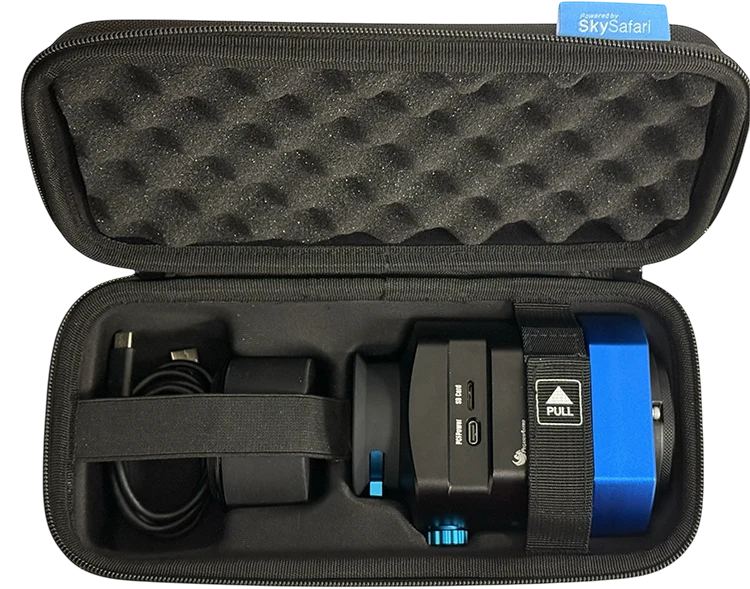
Unlike a conventional optical eyepiece, SmartEye requires external electrical power. The device is powered through a USB-C connection, with a suitable high-current power source required to support its imaging electronics and cooling system. A USB-C power cable and a 12 V-to-5 V conversion adapter are supplied. The external power bank or 12 V power supply itself is not included.For portable astronomy, a suitable USB-C power bank provides a convenient solution. Observers should follow the manufacturer’s current power recommendations, particularly when using active cooling. SmartEye also weighs approximately 795 g, so telescope balance and focuser load capacity should be checked before use. Because the device contains a sensitive imaging sensor, precision electronics and an active cooling system, it should be handled and stored with the care appropriate to a premium astronomical camera.
An Entirely Different Observing Experience
SmartEye is not intended to reproduce the experience of a traditional optical eyepiece exactly. The view is electronic, the image is processed, and faint details become more visible as light is accumulated. For many observers, this is precisely what makes the device exciting. It provides a new way to explore objects that may otherwise remain faint, colourless or difficult to detect through direct visual observation. It also offers an engaging opportunity to introduce others to astronomy, allowing them to appreciate colourful nebulae and distant galaxies through an intuitive eyepiece-style interface. The experience can be particularly rewarding when combined with a suitable telescope, stable tracking and thoughtful observing conditions.
Why Choose the Pegasus Astro SmartEye Eyepiece?
The Pegasus Astro SmartEye is a compelling choice for astronomers who want to combine the familiar interaction of eyepiece observing with the capabilities of modern digital astronomy. Its cooled Sony IMX533 colour sensor, real-time live stacking, immersive 90° OLEDoS display, onboard plate solving and connected telescope-control features create an innovative and highly integrated observing system. It is particularly appealing for observers who want to reveal faint deep-sky detail, explore celestial colour and capture images without building a conventional multi-component astrophotography setup. For astronomers ready to experience the night sky in a completely different way, the Pegasus Astro SmartEye offers an exciting combination of digital sensitivity, immersive observation and intelligent astronomical technology.
Important: SmartEye is not a solar observing device. Never use it to view the Sun without a properly designed and certified solar filtration system. Its electronic display and imaging sensor do not provide solar protection.

 Cookie policy
Reviews
There are no reviews yet.