A complete imaging system in one housing
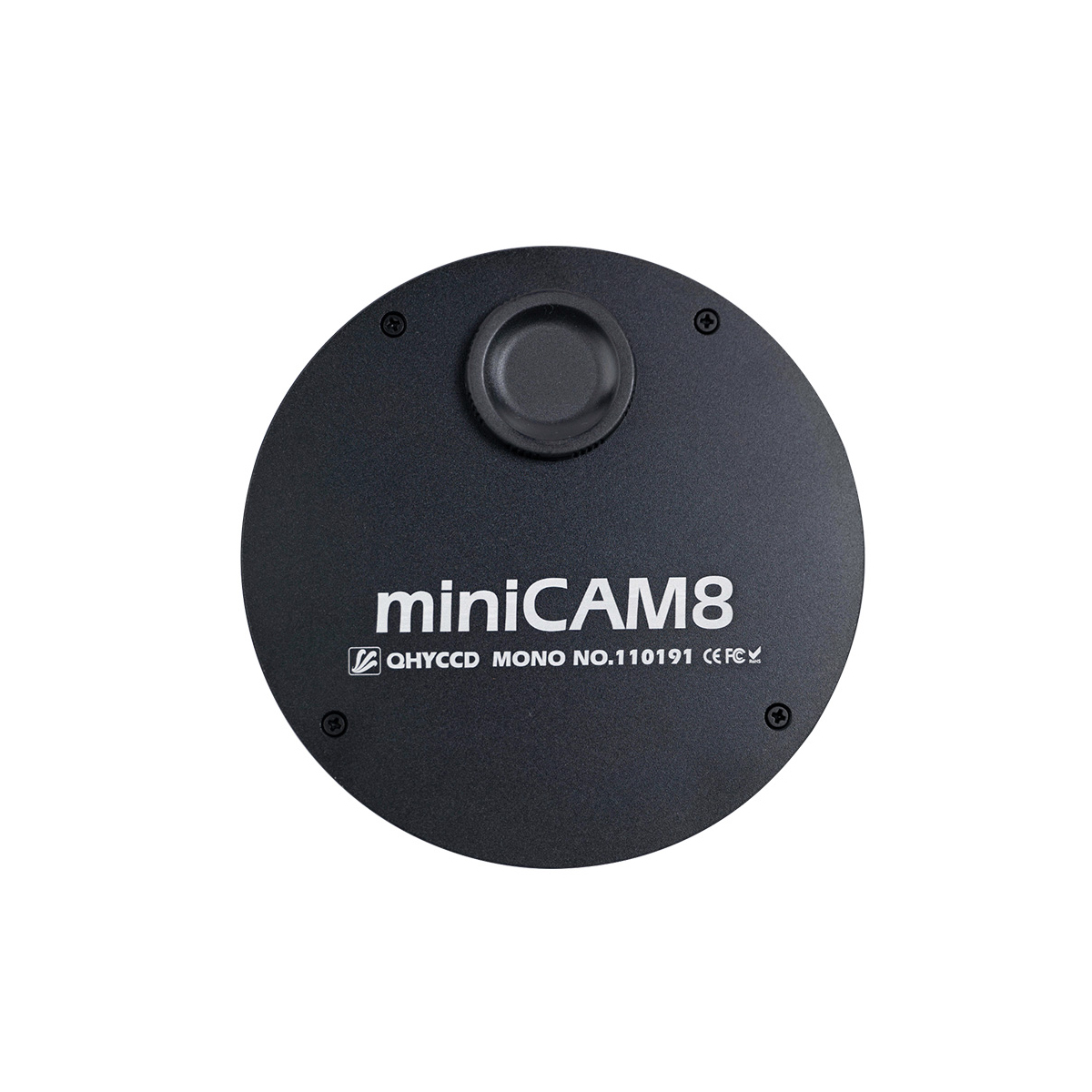
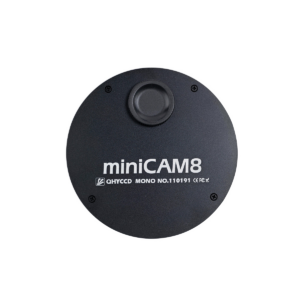
Traditional cooled astrophotography systems often require a separate camera, filter wheel, adapters and additional connections. The miniCAM8C brings the camera and its eight-position filter carousel together in one compact body, reducing the number of components in the optical train and simplifying setup. This integrated approach is particularly attractive for portable imaging rigs. It can reduce packing volume, cable clutter and the number of separate parts to align or connect when setting up at a dark-sky location or travelling with astronomy equipment.
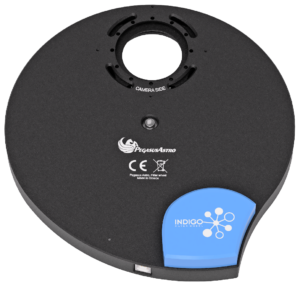
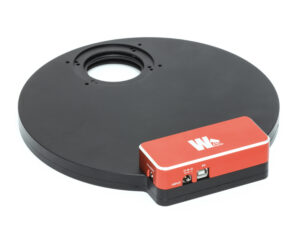
The motorised filter wheel is controlled electronically through compatible camera software. Four filter positions are occupied by the supplied filters, leaving the remaining positions available for other compatible filters or open positions, depending on the wheel configuration.
Sony IMX585 colour sensor
The miniCAM8C uses Sony’s IMX585 back-illuminated CMOS sensor, with 3840 × 2160 effective pixels, approximately 8 megapixels and a 2.9 μm pixel pitch. Its active imaging area is approximately 11.2 × 6.3 mm, with a diagonal of about 12.8 mm. The back-illuminated sensor structure helps incoming light reach the photosensitive layer efficiently. This is beneficial when recording relatively faint objects such as nebulae and galaxies, as well as when imaging planets with short exposures.
As a colour camera, the IMX585 uses a Bayer colour-filter array to record red, green and blue information in a single exposure. This makes it convenient for producing colour images without separately capturing and combining monochrome LRGB channels. Its response also extends into the near-infrared, although the supplied UV/IR-cut filter is useful when a more conventional visible-light colour response is desired.
Four filters for flexible deep-sky imaging
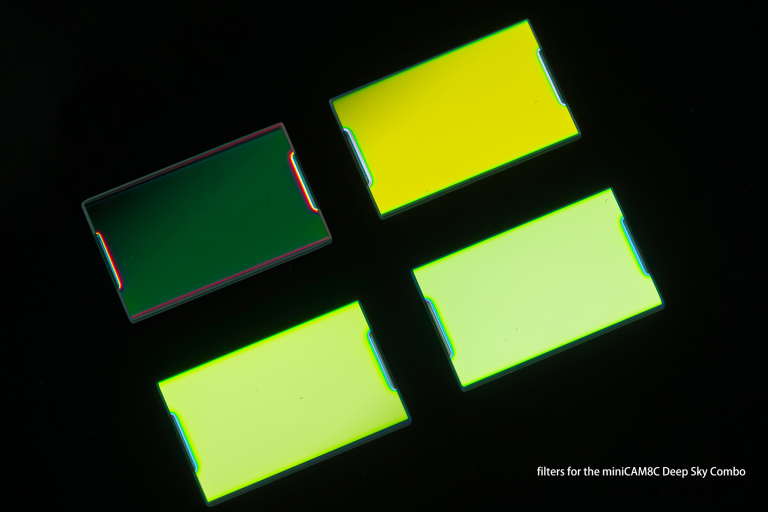
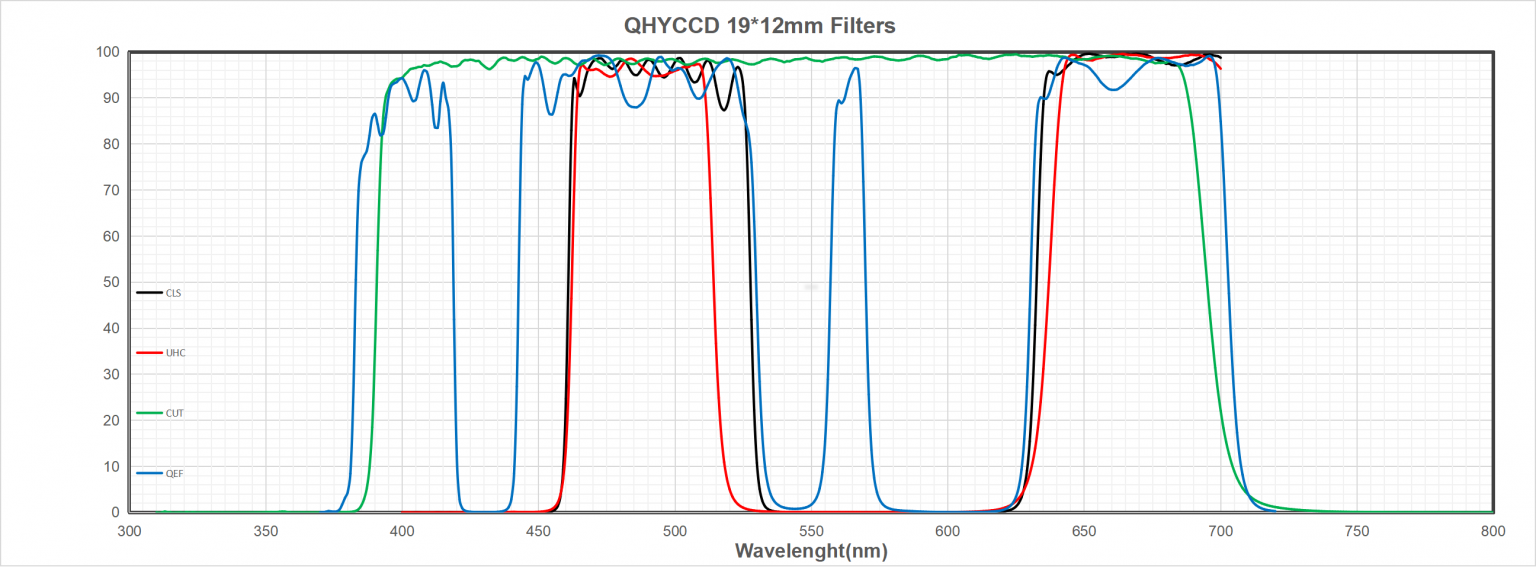
The Deep Sky Combo includes four compact filters, each measuring 19 × 12 × 1.1 mm. The filter set is customised for the miniCAM8 system by Optolong.
- Light Pollution Filter (LPF): Designed to reduce selected unwanted wavelengths associated with artificial lighting while retaining useful astronomical signal. Its effectiveness depends on the light sources, target spectrum and sky conditions.
- Heavy Light Pollution Filter (HLP): Provides an alternative light-pollution filtering option for more challenging urban or suburban conditions. Results depend on the target and the spectrum of the local lighting.
- Four-Channel Enhancement Filter (FCE): Designed to enhance selected emission bands for imaging nebulae and other emission-rich targets. It offers a different spectral response from the general-purpose pollution filters.
- UV/IR-Cut Filter: Blocks ultraviolet and infrared wavelengths outside the intended visible-light range. This helps control unwanted out-of-band signal and can improve colour rendition with the camera’s colour sensor.
These filters are designed to give imagers options for different targets and observing conditions. They are not equivalent to a full monochrome narrowband set such as separate H-alpha, OIII and SII filters, and the colour camera’s Bayer array remains in place regardless of which filter is selected.
Dual-stage cooling for cleaner images
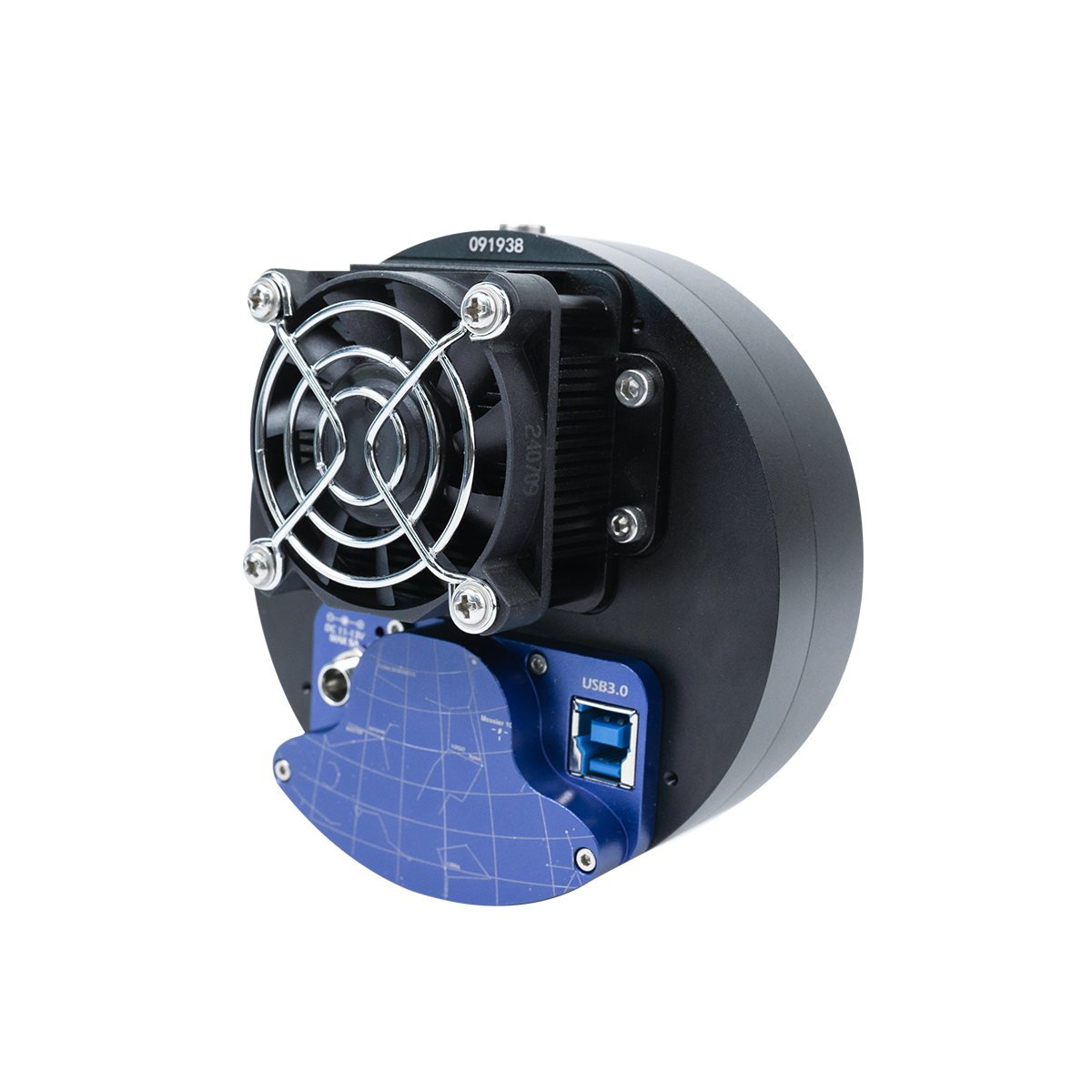
The miniCAM8C incorporates a dual-stage thermoelectric cooler (TEC) that can lower the sensor temperature by approximately 45 °C below ambient during longer exposures under suitable conditions. Cooling reduces dark-current noise generated by the sensor, which is particularly important when capturing long exposures of faint deep-sky objects. Temperature regulation also makes it easier to obtain consistent calibration frames.
The camera includes a built-in dew heater on the optical window and an internal humidity-control arrangement to help prevent condensation during cooled operation. Its zero-amplifier-glow design also avoids the characteristic glow associated with some sensor readout amplifiers, reducing one potential source of unwanted signal in long exposures.
Linearity HDR and dynamic range
The IMX585 uses a native 12-bit analogue-to-digital converter. QHYCCD’s Linearity HDR mode combines high- and low-gain information using a software-assisted correction process, producing a 16-bit output with improved linearity. In this mode, the manufacturer specifies a full-well capacity of 46,000 electrons, read noise of approximately 1 electron and dynamic range of up to 46,300:1, equivalent to 93 dB or around 15.5 stops.
In practical terms, this mode is intended to improve tonal transitions and preserve information across a broad range of signal levels. The HDR correction requires compatible driver, firmware and capture-software versions. Its quoted performance should not be assumed to apply identically to every camera operating mode.
High-speed capture and versatile exposure control
Although designed for deep-sky imaging, the miniCAM8C can also be used for planetary imaging and other applications requiring rapid capture. The exposure range extends from 11 μs to 900 seconds. At full resolution, QHYCCD specifies up to 41.5 frames per second in 8-bit mode and 23.5 frames per second in 16-bit mode. Region-of-interest capture can increase the frame rate when only a smaller portion of the sensor is needed.
For deep-sky work, the combination of regulated cooling, an integrated filter wheel and a colour sensor offers a relatively straightforward route to multi-filter imaging without assembling a conventional separate camera-and-wheel combination.
Connections and practical setup
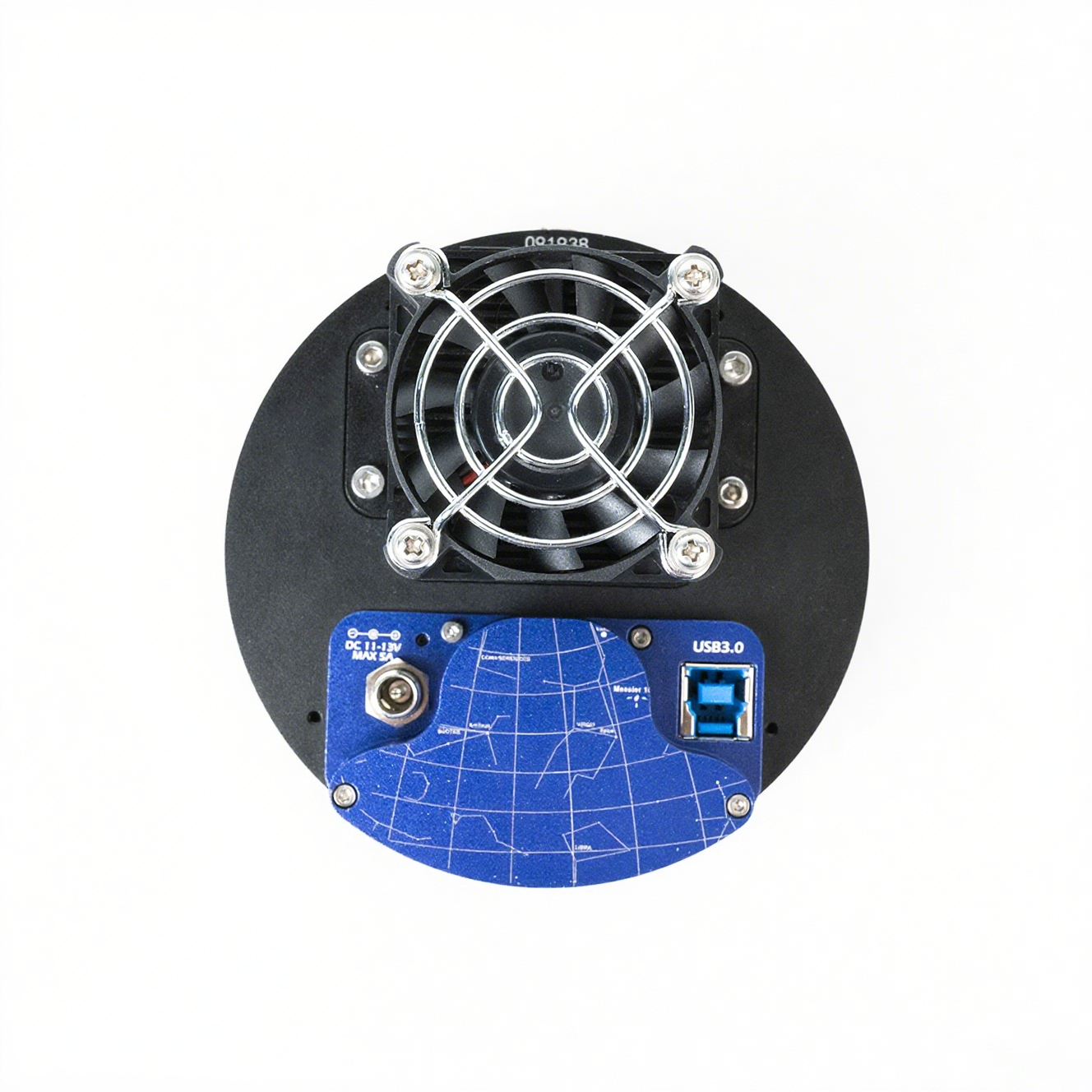
The miniCAM8C connects to a computer through USB 3.0 and requires an external 12 V DC power supply for cooled operation. QHYCCD specifies an input range of 11–13.8 V; a stable 12 V supply is recommended. The telescope interface uses a C-mount-based arrangement, with adapters for 31.75 mm (1.25-inch) and 50.8 mm (2-inch) connections. The stated back focal length is 17.5 mm. Before purchasing, check that the supplied adapter configuration and optical spacing suit your telescope or lens.
The camera weighs approximately 480 g. Its integrated design can simplify a portable setup, but the imaging system still requires a suitable mount, optical instrument, computer and power source. Cooling performance and accessories should also be considered when planning a genuinely travel-friendly rig.


 Cookie policy
Reviews
There are no reviews yet.