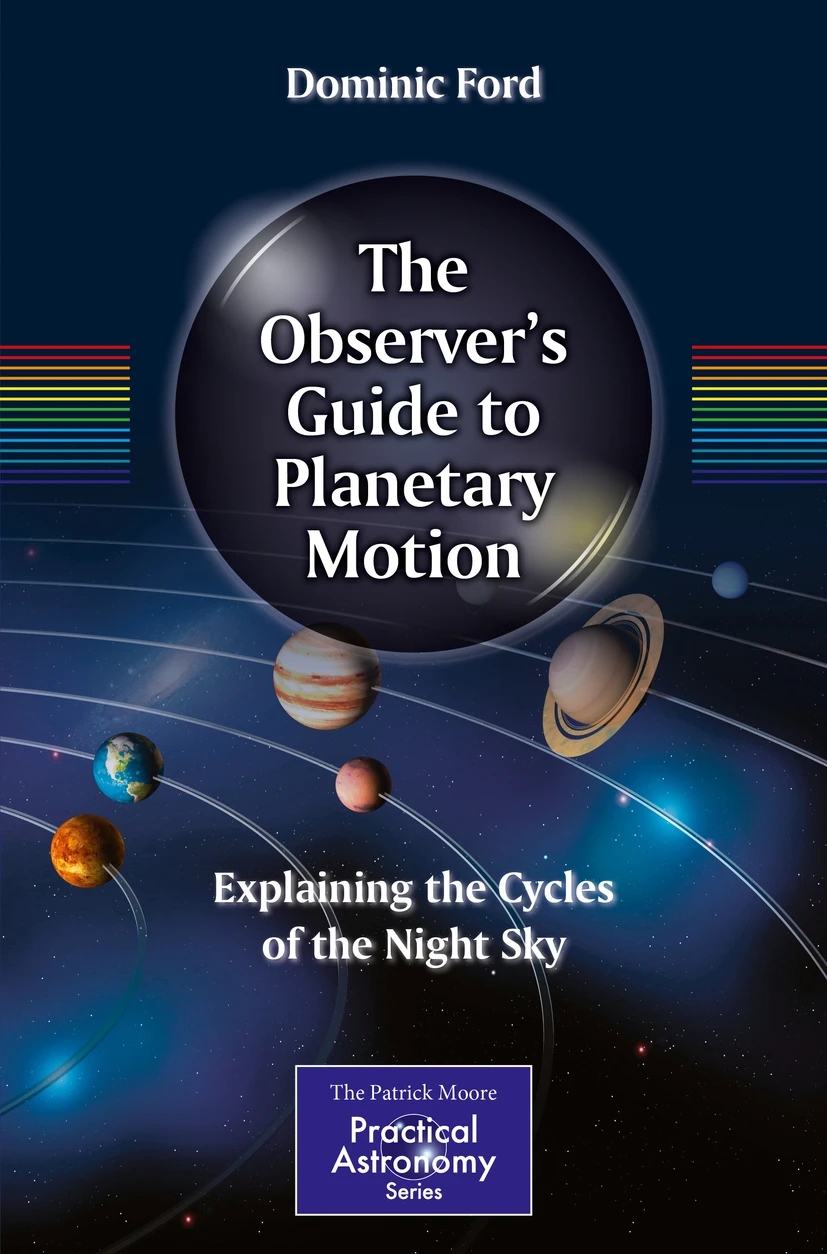
The planets appear to wander across the night sky in constantly changing patterns, and understanding these movements adds a fascinating new dimension to observing the Solar System. The Observer’s Guide to Planetary Motion explains how the geometry and motion of the Earth, Sun, planets, and their moons combine to produce the movements we see from our observing position on Earth.
Each planet is examined in turn, with clear explanations of phenomena such as oppositions, conjunctions, periods of visibility, and changes in apparent position. The book answers many of the questions that naturally arise when following the planets, such as why some planets return to prominence at different intervals, why their positions vary with the seasons, and why Saturn’s rings appear to change their orientation over time.
Detailed observing tables cover planetary events from 2010 to 2030, with longer time spans provided for less frequent phenomena such as favourable Mars apparitions and eclipses. Rather than simply presenting dates and data, the book explains the underlying geometry behind these events, helping observers understand and anticipate what they see in the sky.
A concise final chapter extends this approach to deep-sky objects, explaining how their seasonal visibility follows from Earth’s yearly journey around the Sun. This is an engaging and practical guide for amateur astronomers who want to understand the changing planetary sky rather than simply follow an observing calendar.


 Cookie policy
Reviews
There are no reviews yet.