Four filters for detailed colour astrophotography
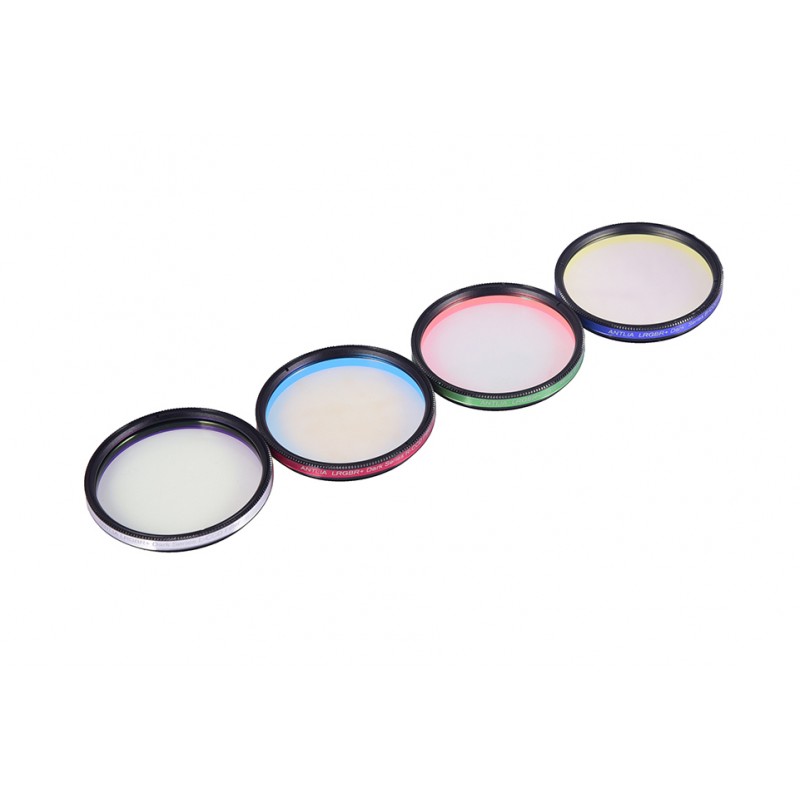
The Antlia LRGB-V Pro set provides the four channels used to build a full-colour image with a monochrome astronomy camera. The luminance (L) filter passes visible light while blocking ultraviolet and infrared wavelengths, allowing you to record fine detail. The red (R), green (G) and blue (B) filters capture separate colour channels, which are combined during image processing to produce a colour image. This approach gives you control over detail and colour data independently. It is well suited to imaging galaxies, star clusters and nebulae with compatible monochrome CCD and CMOS cameras.
Balanced RGB exposures
The RGB filters are designed to produce a balanced response, aiming for a 1:1:1 exposure ratio across the red, green and blue channels with most telescope optical systems. This can simplify acquisition planning and colour processing, reducing the need to compensate for substantially different exposure times between channels. Actual exposure requirements still depend on the camera sensor, telescope, sky conditions and target.
Designed to manage light pollution
The spectral gap between the green and red channels is intended to block much of the light emitted by common high-pressure sodium and mercury street lighting. This can improve contrast in affected skies, although these are broadband colour filters rather than dedicated narrowband light-pollution filters. They cannot remove all artificial skyglow, particularly from broad-spectrum LED lighting.
Strong transmission of O-III emission
The green and blue filters overlap in the region of the oxygen-III (O-III) emission line. Antlia specifies more than 95% O-III signal transmission in both channels, helping preserve this emission when producing colour images of planetary nebulae and other O-III-rich objects. The red filter is designed for high transmission of H-alpha and S-II emission, supporting the capture of red nebular structures in broadband colour imaging.
Reduced reflections and consistent focus
Multi-layer anti-reflection coatings on both sides of the optical substrate help reduce reflections and unwanted light scatter. The filter edges are blackened to limit internal reflections, while the blue channel is designed to reduce halos and bloated star profiles around bright stars. All four filters use closely controlled substrate thicknesses to support parfocal performance, helping maintain a similar focus position when changing filters. However, temperature changes and differences in the imaging system can still cause focus shifts. Checking focus during longer imaging sessions is therefore advisable.
Optical quality and 2″ mounting
Each filter uses a single, non-glued optical substrate with a thickness of 2 ± 0.05 mm. Antlia specifies a surface quality of 60/40, a transmitted wavefront of λ/4 or better, and parallelism below 30 arcseconds. The filters are supplied in mounted 2″ format, with M48 × 0.75 threads. Their ultra-thin, black-anodised cells are designed to maximise the available clear aperture and help minimise vignetting. The cells also feature laser engraving. The 2″ format is intended for compatible 2″ filter holders, filter wheels and other accessories. Check the clear aperture of your imaging train, particularly when using a large camera sensor, to ensure that the complete setup does not introduce vignetting.
Important: These filters are intended for astrophotography with monochrome cameras. They are not recommended for visual observation or solar observing and imaging.


 Cookie policy
Reviews
There are no reviews yet.