Built for planetary imaging and autoguiding
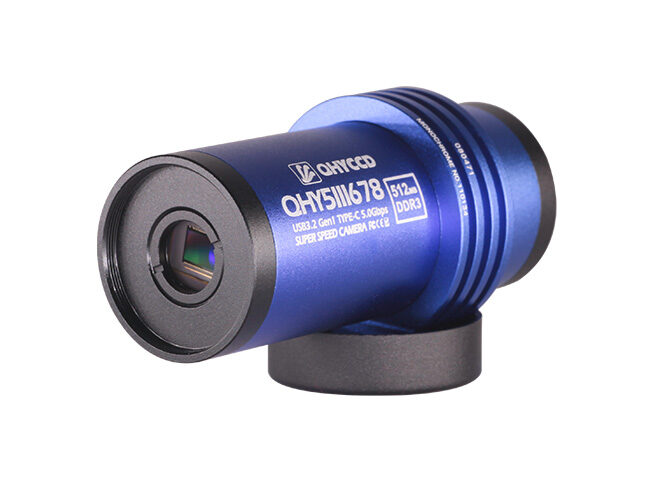
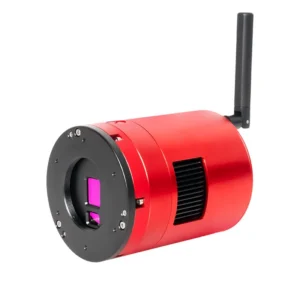
The QHYCCD 5III678M is part of QHYCCD’s 5III V2 series of planetary and guiding cameras. It combines high-resolution image capture with fast readout, making it suitable for recording detailed views of the Moon and planets as well as guiding a telescope during long-exposure astrophotography.
Planetary imaging usually involves recording many short video frames while atmospheric turbulence causes the image to fluctuate. Software can then select the sharpest frames and combine them to produce a more detailed final image. The 5III678M’s 8.4-megapixel resolution and fast capture modes make it well suited to this workflow.
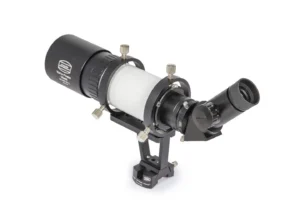
For autoguiding, the camera records a guide star and passes its images to guiding software. The software measures changes in the star’s position and helps correct tracking errors in a compatible mount. The relatively large sensor format can also provide a useful field of view when paired with an appropriate guide scope or off-axis guider.
Sony IMX678 monochrome sensor
At the heart of the 5III678M is Sony’s IMX678 back-illuminated CMOS sensor. It provides 3856 × 2180 effective pixels, equivalent to approximately 8.4 megapixels, in a 1/1.8-inch sensor format. The nominal sensor dimensions are approximately 7.7 × 4.3 mm, although these millimetre dimensions are estimates rather than measurements specified in QHYCCD’s published table. The sensor’s 2.0 μm pixels allow fine image sampling, which can be advantageous when recording small planetary features. The detail ultimately achieved depends on the telescope’s focal length, atmospheric seeing, focus and capture settings. Fine pixels provide flexibility when matching the camera to an optical system, but they do not by themselves guarantee a sharper image.
Unlike a colour camera, the 5III678M does not use a Bayer colour-filter array. Each pixel records the light reaching it without an integrated red, green or blue filter. This makes the camera suitable for monochrome imaging and gives users more freedom to select wavelength-specific filters.
Enhanced sensitivity to red and near-infrared light
QHYCCD highlights the IMX678’s enhanced sensitivity to red and near-infrared light. The sensor’s back-illuminated construction helps longer-wavelength photons reach the light-sensitive region, making it useful for specialised planetary imaging through red and infrared filters.
The 5III678M has an anti-reflection glass window rather than the built-in IR-cut filter fitted to the 5III678C colour model. This is an important distinction for monochrome imaging: the window does not impose the same infrared-blocking function, allowing the user to choose a suitable filter for the intended wavelength range.
QHYCCD includes an IR850 filter with the camera. This is intended for near-infrared imaging around the 850 nm region. Other filters, such as red or near-infrared pass filters, can be selected according to the target and observing conditions. Imaging at different wavelengths can reveal different features and may help reduce the impact of atmospheric turbulence in some planetary imaging situations.
For conventional monochrome luminance imaging, users can work without a colour filter. For specialist wavelength imaging, the appropriate filter must be selected and installed in the optical train.
Fast frame rates and a large image buffer
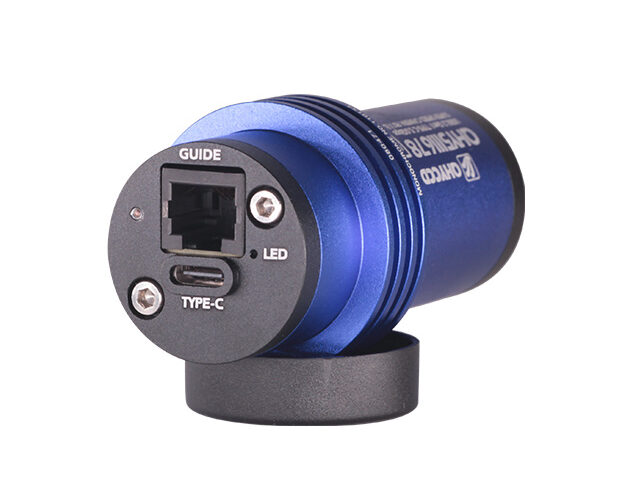
The camera uses a USB 3.0 Type-C interface and includes 512 MB of DDR3 image-buffer memory. This buffer temporarily stores image data and helps manage the large data streams produced during high-speed planetary capture. At the full 3856 × 2180 resolution, QHYCCD specifies up to 43 FPS in 8-bit mode and 22 FPS in 16-bit mode. Higher rates are possible when using a reduced region of interest (ROI). An ROI limits readout to a selected portion of the sensor, which is particularly useful when a planet occupies only a small area of the frame. The 8-bit mode offers higher capture speed and smaller data files, while 16-bit output provides more levels for recording brightness information. The best choice depends on the target, exposure, gain and processing workflow. Actual frame rates can vary with the computer, capture software, USB connection and storage performance.
Read noise and exposure flexibility
QHYCCD specifies a read-noise range of approximately 0.57 to 3.3 electrons, depending on the gain setting. Read noise is the electronic noise introduced when the sensor is read out. Lower read noise can help preserve faint signals, particularly when using short exposures. The camera supports exposure times from 11 microseconds to 900 seconds. Its very short minimum exposure is useful for capturing bright lunar and planetary targets, while its longer exposure capability also supports guiding and other imaging applications. Actual results depend on target brightness, gain, exposure, atmospheric conditions and the optical setup. QHYCCD lists a full-well capacity of 9,000 electrons. This describes the approximate amount of charge a pixel can hold before saturating and helps characterise how the sensor handles brighter signals.
Compact design and flexible connections
The 5III678M uses QHYCCD’s compact V2-series front-end design. The manufacturer specifies a back focal length of 17 mm with the adapter fitted and 8 mm without it. This short back-focus arrangement can be useful when connecting the camera to optical systems with limited available space, including some off-axis guiding setups. The camera provides a 1.25-inch interface and supports CS- and C-mount lenses through the appropriate adapters. USB 3.0 Type-C handles image-data transfer, while the standard ST4-style guiding port allows direct guiding connections to a compatible mount.
The 5III678M is not specified as an actively cooled camera. It is designed primarily for planetary capture and guiding rather than temperature-regulated, long-exposure deep-sky imaging.


 Cookie policy
Reviews
There are no reviews yet.