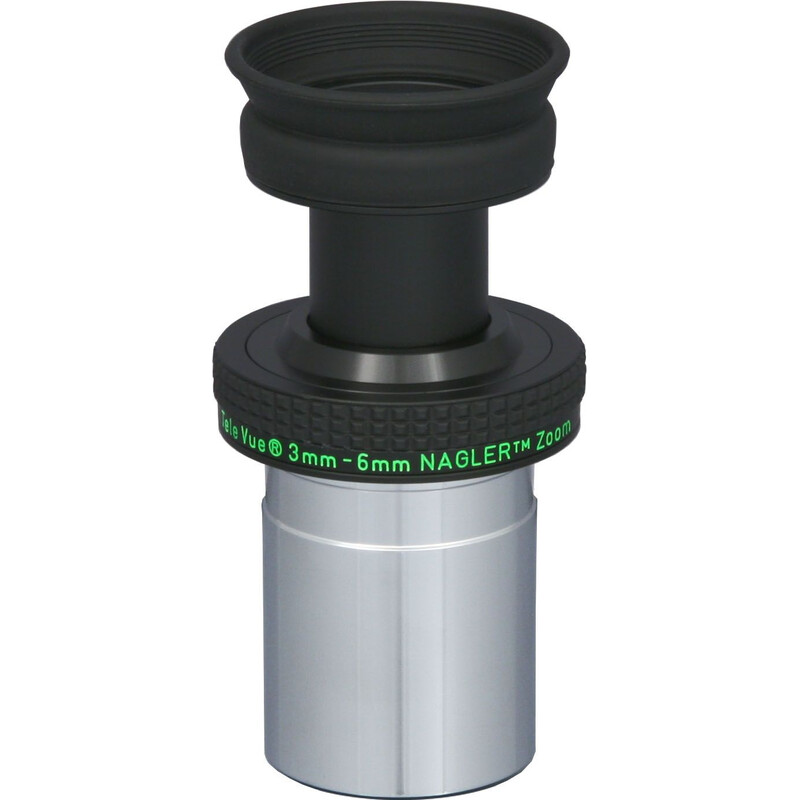
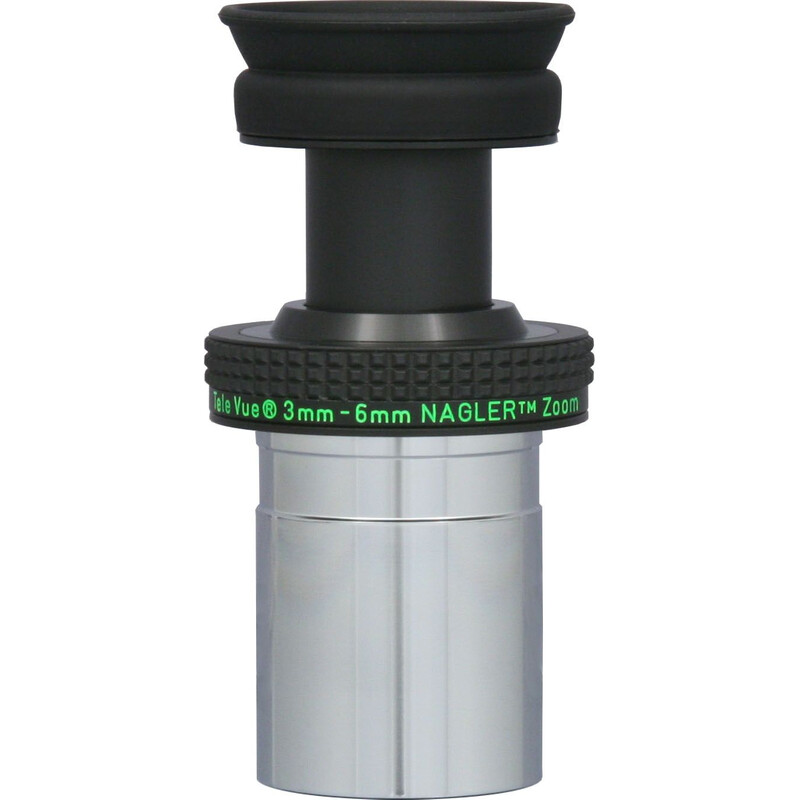
The Tele Vue Nagler 3–6 mm Zoom Eyepiece is a sophisticated high-resolution optical instrument created for astronomers who want complete control over magnification when observing the finest celestial detail. Designed specifically for demanding lunar, planetary and double-star observation, it combines a precision five-element, three-group optical system with a continuously adjustable 3–6 mm focal-length range, a constant 50° apparent field and 10 mm eye relief. Its defining advantage is simple but powerful: the ability to select precisely the magnification that the telescope and atmosphere can support, without changing eyepieces or interrupting the observation. For dedicated visual astronomers, this creates a wonderfully intuitive way to explore high-resolution detail.
Designed for the Demands of Planetary Astronomy
High-magnification observation requires a careful balance between image scale, optical resolution, contrast and atmospheric stability. Increasing magnification can make fine lunar and planetary details easier to examine, but it also enlarges the effects of atmospheric turbulence. The ideal magnification can therefore change from one moment to the next. The Nagler 3–6 mm Zoom was designed around this challenge. Instead of requiring the observer to choose one fixed focal length, it allows the image scale to be adjusted smoothly while maintaining a consistent apparent field and viewing position. When atmospheric conditions improve, magnification can be increased to reveal finer detail. When turbulence becomes more noticeable, it can be reduced immediately to recover a steadier, more useful image. This flexibility is particularly valuable for serious lunar and planetary observation, where fleeting moments of excellent seeing can reveal remarkable detail.
Continuously Variable Magnification with Precise Click-Stops
The Nagler Zoom provides a continuously adjustable focal-length range from 6 mm to 3 mm. Four positive click-stops identify the 6, 5, 4 and 3 mm settings, allowing the observer to recognise each position by touch. Intermediate settings remain available, so the zoom can be adjusted to a focal length such as 4.5 mm or 3.7 mm when that provides the most rewarding image scale. The click-stop mechanism is particularly convenient during night-time observation. There is no need to switch on a light or remove the eye from the eyepiece simply to identify a familiar setting. A textured rubber grip ring provides secure handling, including when observing in cold conditions. The result is a remarkably practical system for selecting and refining high magnification.
A Constant 50° Apparent Field Throughout the Zoom Range
One of the most distinctive characteristics of the Nagler 3–6 mm Zoom is its constant 50° apparent field of view. The apparent field does not narrow as the focal length changes. This means that the view retains a consistent visual character whether the eyepiece is set to 6 mm, 4 mm or 3 mm. The actual area of sky visible becomes smaller as magnification increases, as it does with any eyepiece, but the apparent angular width of the view remains unchanged. For the observer, this creates a natural, predictable experience when moving between magnifications. The 50° field is particularly well suited to focused high-resolution observation, providing a useful area around the target without distracting from the fine detail under examination.
Sophisticated Five-Element, Three-Group Optical Design
The Nagler Zoom uses five optical elements arranged in three groups, a carefully considered configuration developed for demanding high-power visual performance. Its optical design is intended to preserve image definition and contrast throughout the zoom range. Fully multi-coated optical surfaces help minimise reflection losses, while blackened lens edges and anti-reflection treatments reduce unwanted scattered light. The eyepiece also incorporates internal design features intended to suppress stray reflections. These refinements are especially important when examining bright targets such as the Moon and planets, where unwanted light can interfere with subtle variations in brightness and colour. The result is an optical system engineered to deliver precise, high-contrast views while providing the considerable convenience of variable magnification.
Near-Parfocal Zooming – Stay Focused on the Detail
The Nagler Zoom is designed to remain essentially parfocal as the focal length changes. Once the telescope is carefully focused, the observer can move between zoom settings with little or no need to adjust the focuser. This is a particularly valuable characteristic when observing subtle planetary features. The observer can increase magnification during a moment of steady seeing, or reduce it when atmospheric conditions deteriorate, without repeatedly interrupting the observation. Small focus adjustments may occasionally be beneficial, depending on the telescope and the observer’s eyesight. The eyepiece also belongs to Tele Vue’s parfocal Group B, allowing convenient changes between compatible eyepieces in that group.
Exceptional Lunar Observing Flexibility
The Moon is one of the most rewarding targets for the Nagler 3–6 mm Zoom. At the longer focal-length end, observers can examine larger crater formations, mountain ranges and broad regions along the terminator. Increasing magnification allows closer inspection of crater terraces, central peaks, narrow valleys and delicate shadow structures. Because lunar detail is often affected by atmospheric turbulence, the ability to adjust magnification immediately is particularly useful. The observer can select the image scale that reveals the greatest amount of useful detail under the prevailing conditions. For high-performance telescopes, this makes the Nagler Zoom an excellent instrument for exploring the intricate landscape of the lunar surface.
Planetary and Double-Star Observation
Planetary astronomy is another natural application. Jupiter’s cloud belts, Saturn’s rings and selected Martian surface features can all benefit from substantial magnification when the telescope and atmosphere permit. The Nagler Zoom allows the observer to find a precise balance between image scale and image steadiness. This can be particularly rewarding when the atmosphere briefly settles and additional detail becomes visible. Double-star observers will also appreciate the ability to increase magnification gradually when examining close stellar pairs. The zoom can help establish the image scale at which separation becomes most apparent, while preserving a consistent apparent field and viewing position.
Choosing the Right Magnification for Your Telescope
The Nagler 3–6 mm Zoom is especially appealing in high-quality telescopes with relatively short focal lengths. For example, a telescope with a 600 mm focal length provides 100× at 6 mm and 200× at 3 mm. This is a useful range for detailed lunar and planetary observation in a suitable instrument. With an 800 mm telescope, the zoom provides approximately 133× to 267×. In our reference Celestron StarSense Explorer 8-inch Dobsonian, which has a 1,200 mm focal length, it delivers 200× to 400×. At the 3 mm setting, this corresponds to a particularly small exit pupil and demanding magnification. Such high power will not be useful on every night. Atmospheric stability, telescope aperture, optical quality, cooling and accurate collimation where applicable all influence the amount of detail that can be seen. The advantage of the Nagler Zoom is that magnification can be reduced instantly when the conditions do not support the highest setting.
10 mm Eye Relief and Practical Viewing Comfort
The Nagler Zoom provides 10 mm eye relief throughout its entire focal-length range. This maintains a consistent viewing position while zooming and helps make the eyepiece intuitive to use. A fold-down rubber eyeguard assists with eye positioning and can be folded back when desired. However, 10 mm eye relief is generally insufficient for observers who must wear spectacles to see the complete apparent field. For those who can observe without glasses, the constant eye relief and compact design provide a practical high-power viewing experience.
Compact, Carefully Engineered Construction
Despite its sophisticated optical and mechanical design, the Nagler 3–6 mm Zoom remains compact and manageable. Its standard 1.25-inch barrel provides compatibility with a wide range of astronomical focusers and diagonals. The barrel incorporates standard filter threads, while the rubber grip ring provides secure handling. A safety undercut helps improve retention in compatible eyepiece holders. The eyepiece measures approximately 58 mm in overall length, with a maximum diameter of approximately 43 mm. At approximately 150 g, it is well suited to a wide range of telescope configurations. The combination of compact dimensions, precision mechanics and practical controls makes it a particularly appealing accessory for observers who frequently work at high magnification.
Why Choose the Tele Vue Nagler 3–6 mm Zoom?
The Tele Vue Nagler 3–6 mm Zoom is an outstanding choice for astronomers who want premium high-power optical performance combined with exceptional control over magnification. Its continuous zoom range, precise click-stops, constant 50° apparent field, constant 10 mm eye relief and near-parfocal operation create a remarkably convenient observing experience. The sophisticated five-element design, full multi-coatings and meticulous attention to stray-light control further reinforce its credentials as a serious high-resolution instrument. Whether exploring intricate lunar terrain, examining subtle planetary features or investigating close double stars, the Nagler Zoom allows magnification to be matched precisely to the target and observing conditions. For dedicated visual astronomers seeking refined optical performance and immediate control over high magnification, the Tele Vue Nagler 3–6 mm Zoom Eyepiece is an exceptional specialist instrument.


 Cookie policy
Reviews
There are no reviews yet.