High-resolution Sony IMX428 sensor
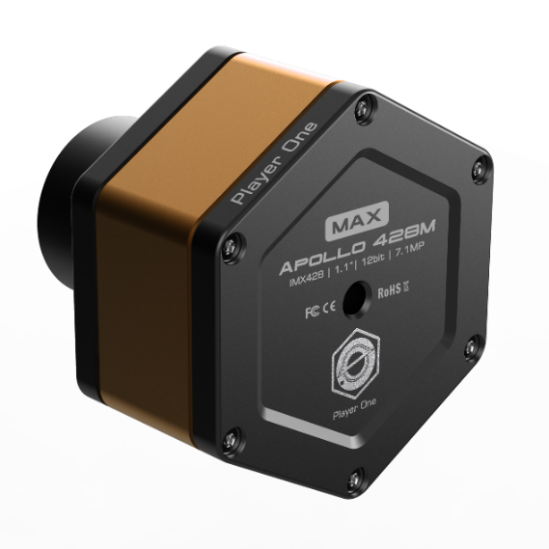
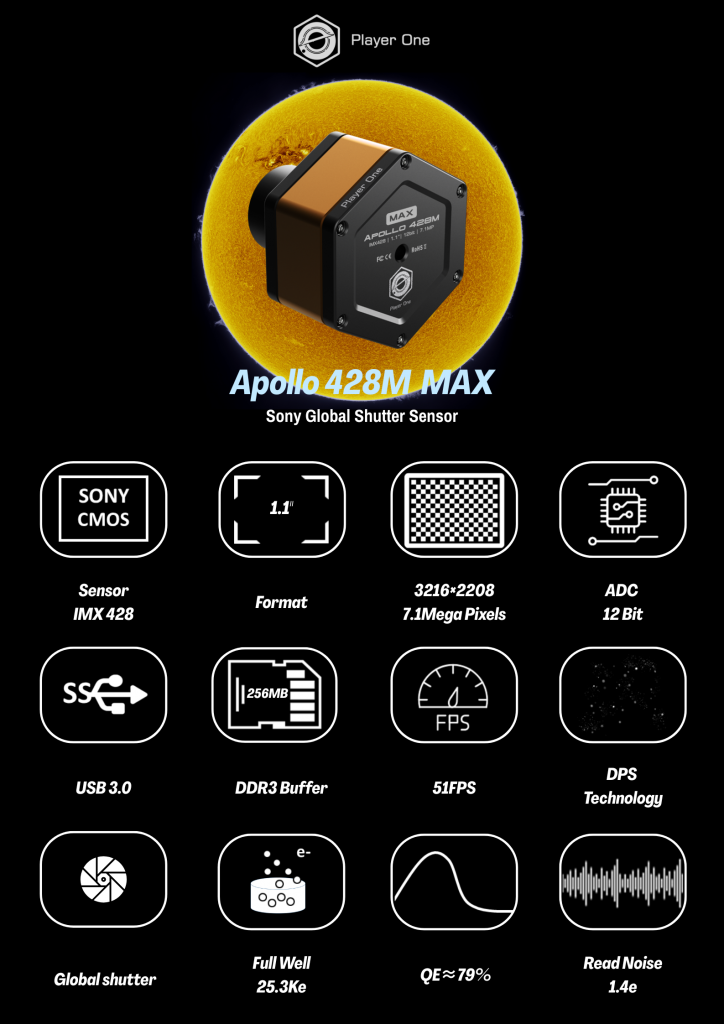
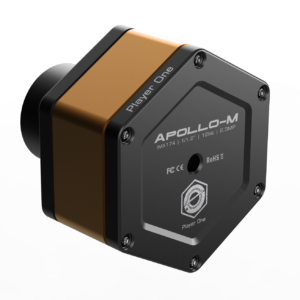
At the heart of the Apollo 428M MAX is Sony’s monochrome IMX428 CMOS sensor, with a 14.5 × 9.9 mm, 3216 × 2208 resolution and 4.5 μm pixels. The relatively large sensor captures a broad field, while its high pixel count is well suited to detailed close-ups of sunspots, granulation, prominences and other solar structures. The monochrome sensor records brightness without a colour-filter array over the pixels. This makes it particularly suitable for narrowband solar imaging, including H-alpha setups, where fine detail and sensitivity are priorities.
Global shutter and high-speed capture
Unlike a rolling-shutter sensor, which reads different rows at slightly different times, a global shutter exposes the entire image at once. This helps preserve the shape of fast-moving or rapidly changing subjects and is useful for high-resolution solar imaging and capturing the International Space Station in transit.
At full resolution, the camera reaches up to 51 frames per second in 10-bit mode and 27 frames per second in 12-bit mode over USB 3.0. The higher-speed 10-bit mode is useful for collecting many frames during brief periods of good atmospheric seeing; 12-bit capture offers more tonal precision for processing.
BIN2 modes for different imaging priorities
The camera supports hardware and software BIN2 modes. Binning combines information from neighbouring pixels, trading spatial resolution for larger effective pixels and increased charge capacity. In BIN2, the effective pixel size becomes 9 μm and the stated full-well capacity can rise to around 100,000 electrons. Depending on the selected mode, the manufacturer lists speeds of up to 135 FPS in hardware MONO8 BIN2 and 109 FPS in hardware MONO16 BIN2. These modes let imagers adapt capture settings to seeing conditions, brightness and the level of detail required.
Adjustable tilt plate to help reduce Newton’s rings
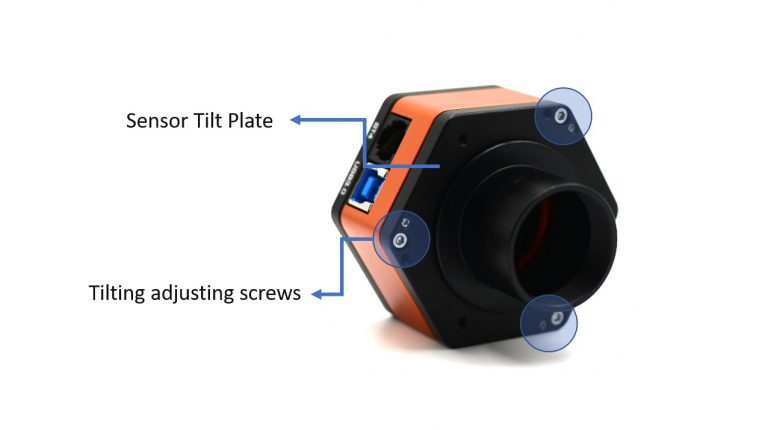
Newton’s rings are unwanted interference patterns that can appear in solar imaging trains, particularly in some H-alpha configurations. The Apollo 428M MAX includes an adjustable sensor tilt plate, allowing the sensor angle to be fine-tuned to help suppress these rings. The adjustment can also help compensate for field-curvature effects in the optical system. A built-in light-blocking foam seal helps prevent stray light entering through the camera’s side openings.
Passive cooling and stable data handling
Solar imaging often takes place in warm daylight conditions, so sensor heat management matters. The camera’s Passive Cooling System (PCS) transfers heat away from the sensor and into the camera body without active refrigeration. For additional thermal management, it supports Player One’s optional external ACS cooling unit; this accessory is not included with the standard camera.
The internal 256 MB DDR3 buffer helps smooth data transfer between the camera and computer, reducing the risk of dropped frames when the computer or storage drive cannot keep up perfectly. The camera also includes DPS (Dead Pixel Suppression) technology, which identifies mapped abnormal pixels and corrects them using surrounding pixel data.
Connections and optical compatibility
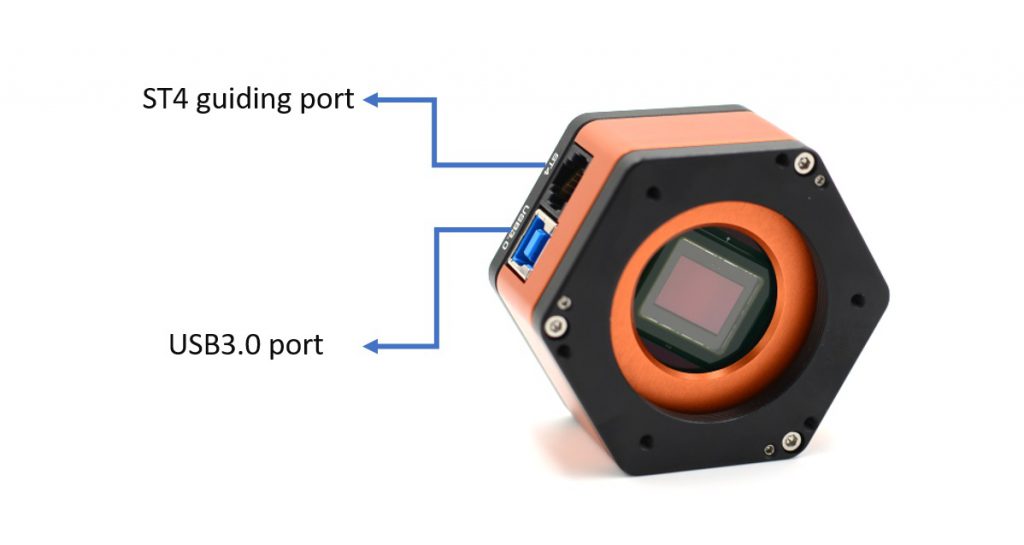
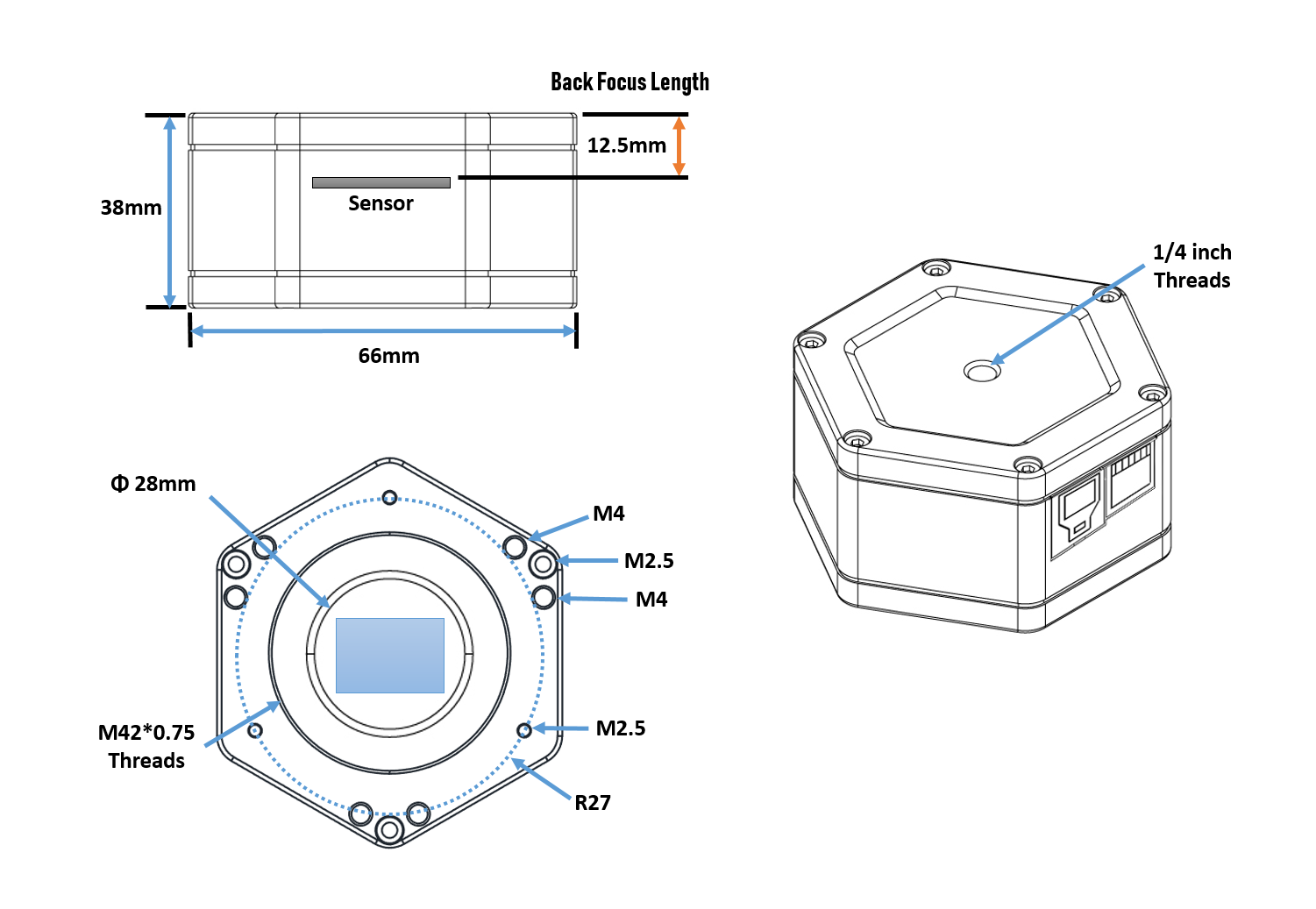
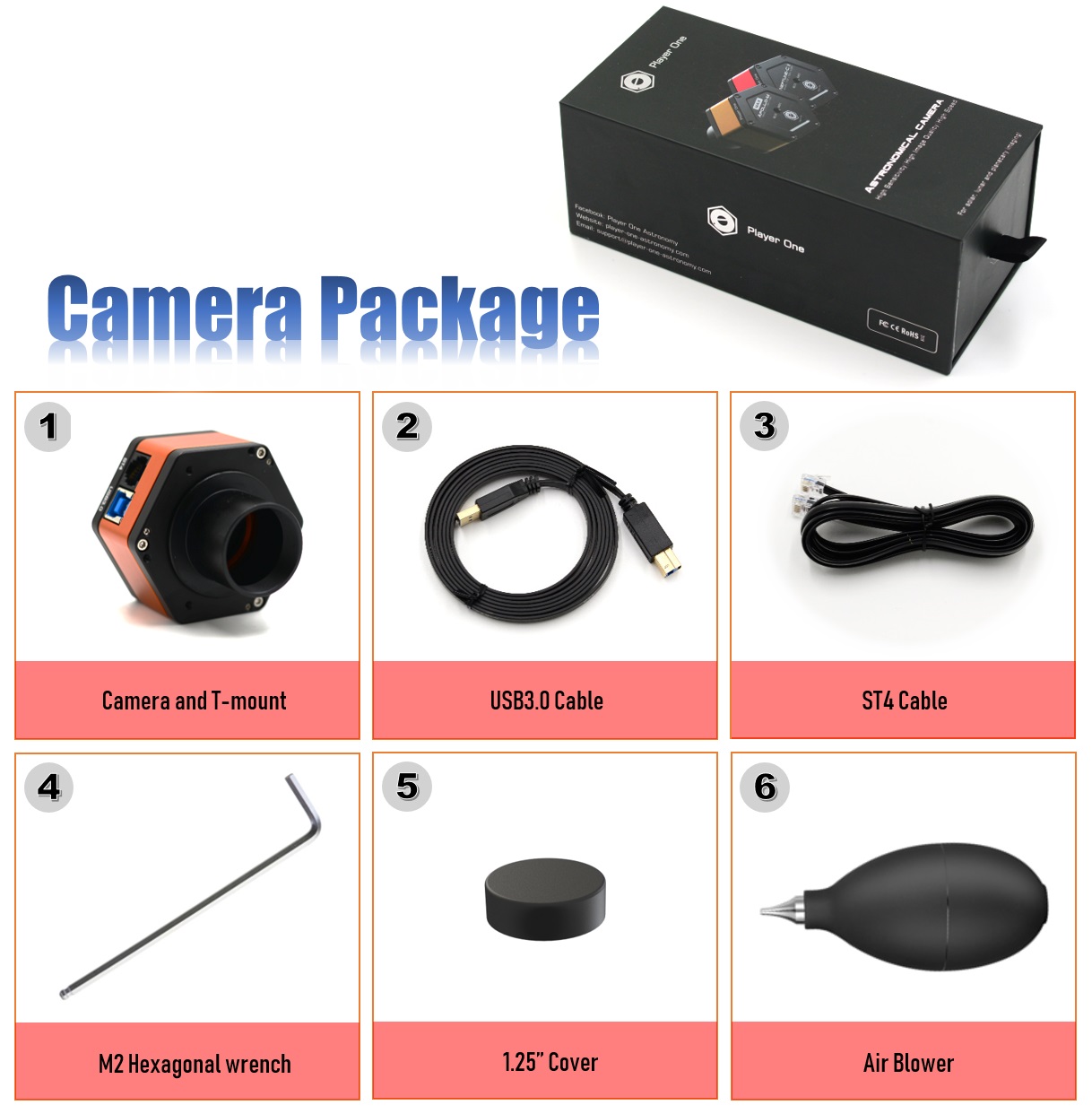
The camera connects through USB 3.0 and can also operate over USB 2.0, although the available transfer speed will be lower. An ST4 guide port is provided for compatible mount-guiding setups. The mounting options are 1.25-inch nosepiece and M42 × 0.75 thread, with a stated 12.5 mm back focal length.
Important solar safety warning: This camera is an imaging device, not a solar safety filter. Never point a telescope at the Sun without a suitable, correctly installed solar energy-rejection system. Use an appropriate full-aperture solar filter, a purpose-built solar telescope, or a properly configured Herschel wedge where suitable, and always follow the telescope and filter manufacturers’ instructions. A camera window or ordinary UV/IR-cut filter alone does not make solar viewing or imaging safe.





 Cookie policy
Reviews
There are no reviews yet.